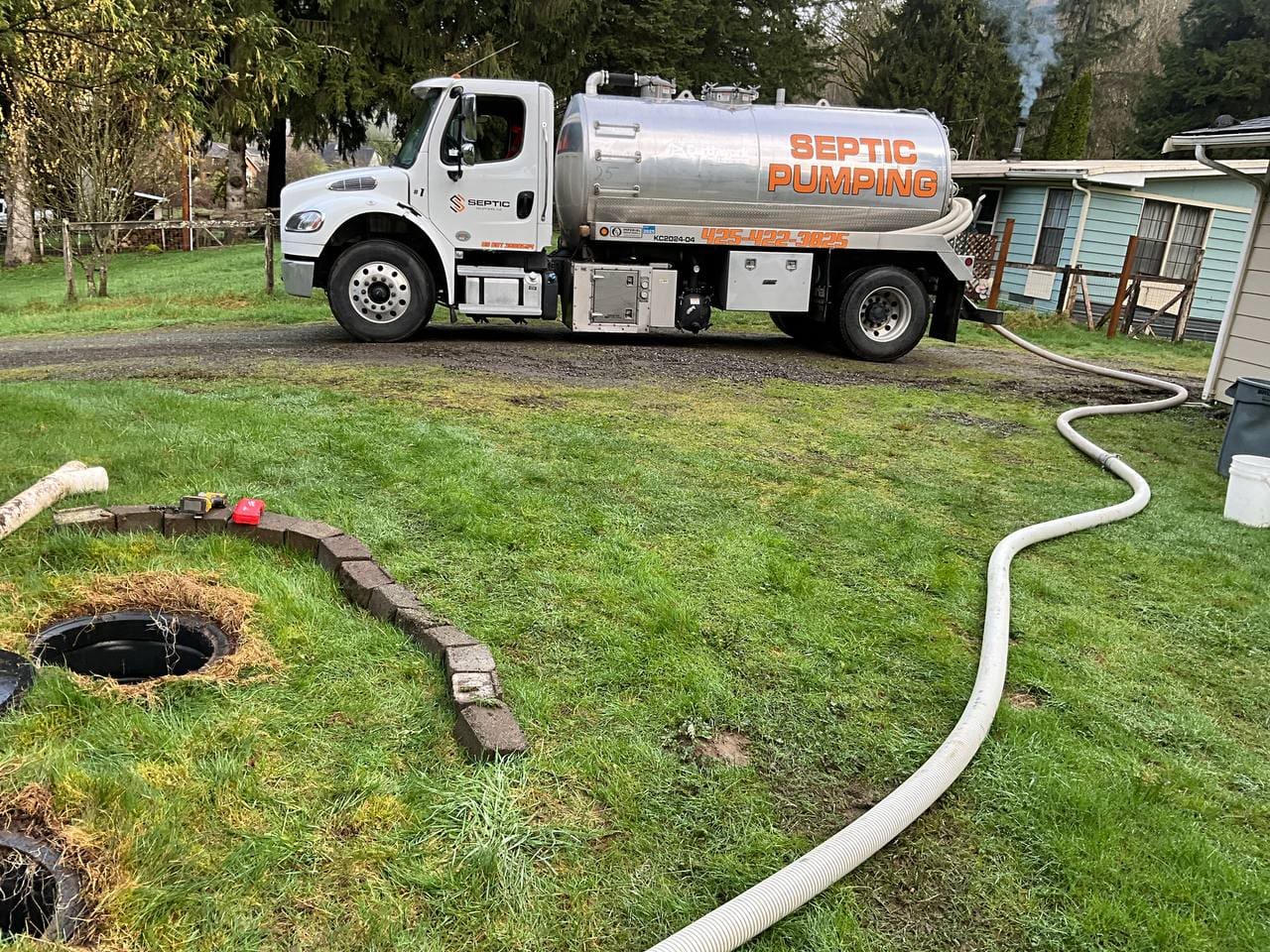
The call I remember most clearly came from a property in Brier, WA, an older home sitting on a 1975 two-compartment concrete tank that hadn't been serviced in fifteen years. Both compartments were overflowing. The toilets had stopped flushing. We ran an emergency pump-out, documented the condition, and left with a system that was draining again. Two and a half months later, the homeowner called back. The tank was full again.
Two and a half months isn't how long it takes for solids to build back up. It's how long it takes for wastewater to back up once a drain field stops accepting liquid. The second call wasn't about a full tank at all. It was about a failing drain field, a different problem with a different price tag, and the two look almost identical from inside the house.
The Early Warning Signs of a Failing Septic System
A septic system rarely fails without warning. It tells you first, in a progression that's easy to recognize once you know what you're looking at: slow drains at more than one fixture, gurgling from toilets or drains after use, a sulfur smell that shows up inside the house or near the tank after a big load of laundry. Those are scheduling signs. They mean the tank is getting full and due for a pump-out, not that anything has gone wrong yet.
When Septic Symptoms Signal a True Emergency
The next stage is different. Standing water over the drain field after the rain has stopped, grass that stays unusually green and lush over the lines in dry weather, sewage backing into a floor drain or bathtub: these mean the system has stopped keeping up with what's coming in.
When we get calls like this from homes we service for septic services in King County, the pattern is almost always the same: symptoms that built quietly for months before the homeowner noticed, followed by a week or two of rapid decline once the system lost its margin.
Is It the Septic Tank or the Drain Field? How to Tell the Difference
The distinction that actually matters (the one most homeowners can't answer without someone opening the lids) is whether the tank is full or the drain field is failing. A tank that fills over two to five years with solids at the bottom and scum on top is doing exactly what it's designed to do. The drain field is still accepting the clarified liquid, the solids are simply accumulating on schedule, and a pump-out resets the clock. That's the ordinary case, and it's most of what we see.
A tank that refills within weeks of being pumped is telling a different story. When we went back to the Brier property, the tank hadn't refilled with sludge. It had refilled with the same gray-brown wastewater that leaves the house every day, water that should have passed through the outlet baffle, moved through the drain field, and disappeared into the soil. When it comes back into the tank instead, the drain field isn't doing its job, and no amount of pumping fixes that. What we found on that job was a destroyed distribution box and pipe fragments that had migrated into the drain lines after a tree stump the homeowner had removed years earlier turned out to have a root system that had already reached the infrastructure underneath it.
Why a Soft Spot in the Yard Isn't Always Drain Field Failure
Not every surface symptom means what it looks like it means, either. On a job in Woodinville, a homeowner found a soft, wet patch in the yard and assumed the worst: a failed drain field. When our technician opened the distribution box first, based on where the soft spot sat relative to the system layout, the water level inside was above all four outlet lines. Nothing was flowing out.
A root system from a mature tree had blocked the D-box itself, and the drain field underneath it was untouched. An 8-foot root extraction, four sections of replaced pipe, and a new sealed distribution box later, the system passed a 457-gallon stress test with the original drain field still intact. The homeowner had been ready to pay for a replacement the system never needed.
Can a Failing Septic System Contaminate Your Well Water?
There's a well-water question tied into all of this too, and it matters most in neighborhoods where private wells sit within a few hundred feet of an aging system. A tank that's simply full but mechanically sound is a low risk to a properly sited well. That risk changes once a system is actively failing or surfacing effluent, because nitrates and bacteria travel through soil far more easily once a drain field can no longer absorb what it's supposed to.
It's one of the reasons we treat a rising nitrate reading on a well test, on a property that hasn't had documented service in years, as a reason to look at the septic system before assuming the well itself is the problem: something we see often enough providing septic system service in Bellevue, where older systems and private wells frequently share the same lot.
Reading the Signs Before They Become a Bigger Problem
The signs sit on a spectrum, and the spectrum is the useful part. Slow drains and mild odor mean you have time to schedule something. Standing water, green patches over the lines, and backups into the house mean the system needs a look now, not next month. And a tank that's already been pumped recently but is filling again fast means the conversation isn't about the tank anymore. It's about everything downstream of it.
None of it announces itself as an emergency at first. It just tells you, quietly, in the order it's designed to. Whether anyone's paying attention is the only variable left.
— Art Nikolin, Operations Manager, Septic Solutions LLC
Arlington · Snohomish County · King County · Skagit County · Island County · Whatcom County · Western Washington