Bathroom Remodel Cost in Seattle in 2026: What Homeowners Actually Pay and Why

By Sam Brenich, Chief Marketing Officer at New Day Construction
Ask five people what a bathroom remodel costs and you may get five completely different answers. In Seattle, one homeowner can spend around $10,000 and end up with a fresh, good-looking bathroom. Another can spend $50,000 without choosing anything particularly extravagant. A large custom primary bath can go well past $100,000. That sounds confusing until you look at what people are actually calling a “bathroom remodel.”
I’m Sam Brenich, Chief Marketing Officer at New Day Construction. A big part of my work is taking what happens on real remodeling projects and turning it into information homeowners can actually use. Cost is probably the subject where context matters most. An average is useful, but it can also give you a false sense of precision.
Current 2026 Seattle data puts the average bathroom remodel at about $14,779, with a typical range of roughly $3,000 to $38,000. Full remodels can go much higher. The important part is figuring out which type of project your bathroom actually is.
So, What Does a Bathroom Remodel Cost in Seattle?
A smaller cosmetic remodel may fall between $3,310 and $15,840. This is the territory of paint, a new vanity, updated lighting and fixtures while the basic room stays where it is.
A partial remodel moves into a different category. Current Seattle estimates place these projects at roughly $12,180 to $39,020. You may be replacing a shower or tub, installing new tile, changing the vanity and doing more substantial plumbing work, while still keeping much of the existing room intact.
A full remodel is where the range really opens up. Seattle data puts these projects at approximately $31,190 to $123,270. At that point, you may be dealing with extensive demolition, a new shower assembly, altered plumbing and electrical work, cabinetry and a much more involved finish package.
For comparison, the 2025 Cost vs. Value Report estimated $107,451 for its defined upscale bathroom remodel in Seattle.
|
Scope |
Approximate Seattle Cost |
|
Minor bathroom remodel |
$3,310 to $15,840 |
|
Partial bathroom remodel |
$12,180 to $39,020 |
|
Full bathroom remodel |
$31,190 to $123,270 |
|
Cost vs. Value upscale Seattle benchmark |
$107,451 |
Room type matters too, although not always as much as people expect. A half bath is usually cheaper because there is no shower or bathtub. Current small-bathroom estimates run from about $1,667 to $16,665, averaging roughly $7,222. A primary bathroom normally costs more because the room itself is larger and homeowners tend to put more into the shower, vanity and finishes.
Still, I would be careful about thinking of bathrooms in terms of size alone. A 40-square-foot bathroom can be surprisingly expensive if almost every square foot requires skilled work. That is also why cost per square foot has limited value here. Seattle estimates generally put bathroom remodeling around $70 to $250 per square foot, but bathrooms contain a lot of fixed costs. A small room still needs plumbing. It still needs ventilation and waterproofing. If there is a tiled shower, somebody still has to build it correctly.
Two bathrooms with almost identical dimensions can end up with very different budgets.
What Actually Makes One Bathroom Cost So Much More?
Layout is one of the first things I would look at. If the toilet, vanity and shower are staying in roughly the same locations, you have removed a major source of extra work. Once drains need to move or the shower is relocated, floors and walls may need to be opened and rebuilt. That change can add thousands of dollars without making the finished bathroom look obviously more expensive.
The shower is another big one. Current Seattle data puts the average cost of a new shower at around $9,000, although the range is wide, from approximately $600 to $16,000 depending on what is being installed. For walk-in showers, current figures are roughly $6,666 to $13,332.
Homeowners naturally look at the tile because that is what they see when the job is finished. Much of the cost, however, is behind it. There is preparation and waterproofing underneath that finished surface, plus all the labor required to build the assembly correctly. This is one of those areas where saving money on something invisible can become very expensive later. The same applies to what is already hiding inside the house.
Before demolition, a contractor can inspect what is accessible. Once the walls come open, an older bathroom may reveal plumbing that needs attention, damaged subflooring or signs of an old leak. New and altered work has to meet the applicable requirements for the project, although remodeling one bathroom does not automatically mean every untouched system in an older house has to be upgraded.
Washington also has rules around materials that may contain asbestos. Before remodeling work disturbs affected material, the applicable good-faith inspection requirements need to be addressed. If asbestos is found and the work will disturb it, proper abatement can affect both the schedule and the budget.
Then there are finish choices. They matter more than people sometimes realize.
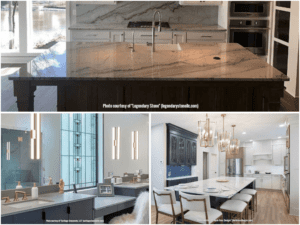
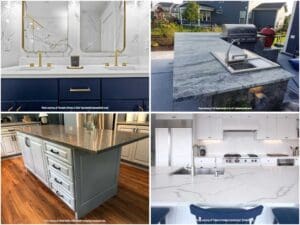
Bathroom vanity tops work the same way on a smaller scale. Seattle planning data puts installed vanity countertops at roughly $500 to $5,300. A ready-made vanity can start around $600, while a custom piece with a stone or quartz top can reach $6,000 or more.
Countertops are interesting in bathrooms because the amount of material is relatively small, but the decisions around that material are not. Cabinet dimensions have to work with the top. The sink opening has to be fabricated correctly. Faucet placement matters. With natural stone, the particular slab and fabrication can matter too.
Where Does the Budget Actually Go?
Labor is often one of the biggest parts of the total. Angi’s 2026 Seattle data estimates that labor can account for about 40 to 60 percent of a bathroom remodeling budget on labor-intensive projects.
That percentage makes more sense when you think about how compact and complicated a bathroom is. Plumbing work has to happen before finishes close the wall. Waterproofing has to be completed correctly before the shower can be tiled. Countertops cannot be templated until the cabinets are ready. One part of the job often depends on the part before it.
Here are some useful Seattle planning figures. They are not meant to be added together as a universal bathroom price because every project uses a different combination of work.
|
Part of the Project |
Approximate Planning Figure |
|
Demolition and prep |
$1,000 to $2,300 |
|
New shower |
$600 to $16,000 |
|
Walk-in shower |
$6,666 to $13,332 |
|
Bathtub replacement |
$2,000 to $10,000 |
|
Vanity countertop |
$500 to $5,300 installed |
|
Plumbing upgrades |
About $970 average |
|
Rough-in plumbing |
About $8,470 average |
|
Midrange toilet installation |
About $445 average |
|
Bathroom flooring |
About $12.50 per sq. ft. |
|
New light fixture |
$200 to $600 |
|
Bathroom fan with light |
Around $400 |
Tile is another category where the material price by itself does not tell you very much. Seattle data puts ceramic and porcelain tile at roughly $2 to $30 per square foot before installation. Marble can run around $5 to $35 per square foot. For shower tile, professional installation labor alone may run roughly $10 to $20 per square foot, depending on the complexity.
Lighting and electrical upgrades can add another $800 to $2,500 to a bathroom project when the scope goes beyond simply swapping a fixture.
Permits are also project-specific. A simple cosmetic update is not going to have the same permitting needs as a remodel that alters plumbing or electrical systems. Depending on the work and jurisdiction, permit-related costs can move from a few hundred dollars into the thousands.
Where Can You Save Without Making a Bad Compromise?
Keeping a workable layout is one of the cleanest ways to save. If the toilet and shower are already where they should be, there is little reason to move them simply because everything else in the room is changing.
Material choices can help as well. Porcelain tile can give you a polished finish without the cost or maintenance considerations of some natural stones. Semi-custom cabinetry can make sense when stock cabinets do not fit the room well but fully custom work does not add enough value to justify the jump in price.
Timing your decisions matters too. If you want heated flooring, decide while the floor assembly is being planned. Adding it after a finished tile floor is installed is no longer a small upgrade. The same logic applies to niches, electrical locations and many of the details that disappear behind finished surfaces.
DIY has a place, but I would draw the line based on what happens if the work fails. Painting a wall yourself is one thing. A shower pan is different. If a waterproofing mistake means tearing out finished tile later, the initial savings can disappear quickly.
The payment structure deserves the same attention as the construction budget.
The season can influence trade availability, but I would not build a budget around waiting for a supposedly cheap month. A remodel start date depends on current schedules, permits and material lead times. If you need the bathroom finished by a certain date, starting the planning process earlier is usually more useful than trying to guess the perfect season.
Is Spending That Much on a Bathroom Worth It?
The 2025 Cost vs. Value Report estimated that its defined midrange bathroom remodel recouped about 80 percent nationally. Seattle looked very different. The report put the local project cost at $36,146, estimated resale value at $16,933 and cost recouped at 46.8 percent. That does not mean a Seattle bathroom remodel is a bad investment. It means ROI statistics have to be read for what they are: models based on a defined project and a particular market. They are not a promise about what will happen to the sale price of your house.
There is also the value of living with the bathroom. If a shower has been leaking, the room has almost no storage or the layout annoys you every morning, fixing those problems has value even if Zillow cannot attach an exact number to it. That matters a lot more to somebody planning to stay for ten years than it does to an owner preparing a house for sale.
For me, the most useful way to budget is to stop asking what an “average bathroom” costs and start defining the actual room. What needs to move? What can stay? Which finishes matter enough to spend more on? What is currently unknown? Once those answers are clear, the budget becomes much less mysterious.
Expert Conversation: The Stone Magazine and Sam Brenich
The Stone Magazine (TSM): Sam, homeowners see that $14,779 average and naturally think, “Okay, my bathroom should cost around fifteen grand.” Is that the biggest mistake?
Sam Brenich (SB): I would not call it a mistake, because you need somewhere to start. The problem comes when the average becomes an expectation. You can absolutely do bathroom work in that range, but you need to know what kind of work we are talking about. If the layout stays in place and the project is mostly finishes, that number may be relevant. If you want a tiled walk-in shower and custom cabinetry, you are already talking about a very different bathroom.
TSM: So when somebody tells you, “I have a small bathroom, it shouldn’t cost much,” what do you say?
SB: Small helps, but only up to a point. Bathrooms pack a lot of expensive work into very little space. You still need the plumber. You still have waterproofing if there is a shower. You still have electrical and ventilation requirements. I would rather know what is happening in the room than just know its square footage.
TSM: What is the first thing you would change if a homeowner’s wish list is coming in over budget?
SB: I would look at the layout before I started cutting corners on quality. If the existing plumbing locations work, keeping them usually makes more sense than moving everything and then trying to save money on the finishes. Sometimes a layout really does need to change, and then you budget for it. But I would want that move to solve a real problem.
TSM: Homeowners spend a lot of time choosing tile. Is that where the money usually goes?
SB: Tile can absolutely get expensive, especially once you are talking about a complicated shower. But people tend to focus on the tile they can see and forget what is underneath it. Beautiful tile does not make a badly built shower a good shower. If I had to choose where not to get overly aggressive about saving money, waterproofing would be very high on that list.
TSM: You mentioned a Lake Forest Park project where cabinetry changed the price by about $8,000. Does that kind of swing surprise homeowners?
SB: It can. That project is a good example because the overall scope did not suddenly change. The homeowner was looking at about $46,000 for the semi-custom option and $54,000 for the custom one. The difference came from cabinetry. When people hear “upgrade,” they sometimes imagine a few hundred dollars here and there. One major category can move the total a lot more than that.
TSM: What about the countertop? This is The Stone Magazine, so we have to ask.
SB: Of course. In a bathroom, you are working with a smaller countertop than in a kitchen, so homeowners sometimes treat it as an afterthought. I would not. The vanity, sink and top really need to work together. If you decide on those pieces independently, you can create unnecessary fabrication changes or discover that something simply does not fit the way you expected. The amount of stone may be small, but the countertop is still a fabricated piece made for that exact setup.
TSM: How do you tell if a contractor’s estimate is actually complete?
SB: Read the scope, not just the last line. If two estimates are far apart, I want to know what each contractor is actually including. Sometimes you are not comparing two prices for one project. You are comparing two different versions of the project. That is a very important distinction.
TSM: Last question. If somebody is just starting to plan a Seattle bathroom remodel, what number should they have in mind?
SB: I would have a range in mind, not one number. Then I would define the scope before getting emotionally attached to that range. Current Seattle data tells us a minor project may be under $15,000, while a full remodel can move well beyond $30,000 and, in some cases, beyond $100,000. The useful number is the one attached to your actual bathroom and the work you actually want done. Everything before that is just a planning reference.