

What a Branded Delivery Truck Tells a Homeowner Before the Countertop Fabricator Ever Rings the Doorbell
The truck that pulls up to a homeowner's curb with a slab still strapped to the rack has already said something about the company behind it, before a single word is exchanged. If it's a plain white box truck with a sign curling at the corner, that's one impression. If it's a clean, consistent, well-produced wrap with a name the homeowner half-remembers from a neighbor's kitchen, that's a completely different one. Neither impression is an accident. Both are decisions, even when the company that made them didn't think of it that way.
I've spent eighteen years producing vehicle graphics for service businesses in Western Washington, and the pattern holds regardless of trade: plumbers, electricians, general contractors, and increasingly the stone and countertop fabricators who are hauling slabs worth more than the truck itself into somebody's driveway. The vehicle arrives before the relationship does. What it looks like when it gets there is doing work whether the company intended it to or not.
The Trust Decision Homeowners Make Before a Word Is Spoken
A countertop installation is not a small purchase, and it's not a small intrusion. A homeowner is letting a crew into their kitchen, often for the better part of a day, to remove an old surface and set a new one that costs several thousand dollars and is expected to last decades. Every signal that arrives before the crew does gets folded into whether that homeowner feels good about the decision they already made when they signed the contract.
An unmarked or minimally branded vehicle asks the homeowner to extend trust with no visual context: nothing to confirm that the truck in the driveway belongs to the company they hired, nothing that matches the quote, the invoice, or the name on the estimate. A vehicle with a clear, consistent identity does the opposite. It closes the gap between the sales conversation and the crew standing at the door, and it does it silently, before anyone has to explain anything.
What a Professional Wrap Actually Signals
The difference between a wrap that still looks sharp in year five and one that's peeling at the seams by year two comes down to production decisions most homeowners never think to ask about: film grade, ink type, whether the install was handled in-house or handed off to whoever was available that week.
After doing Vehicle Wraps and Graphics in Everett, WA for 18 years, we always take all the important details into account.
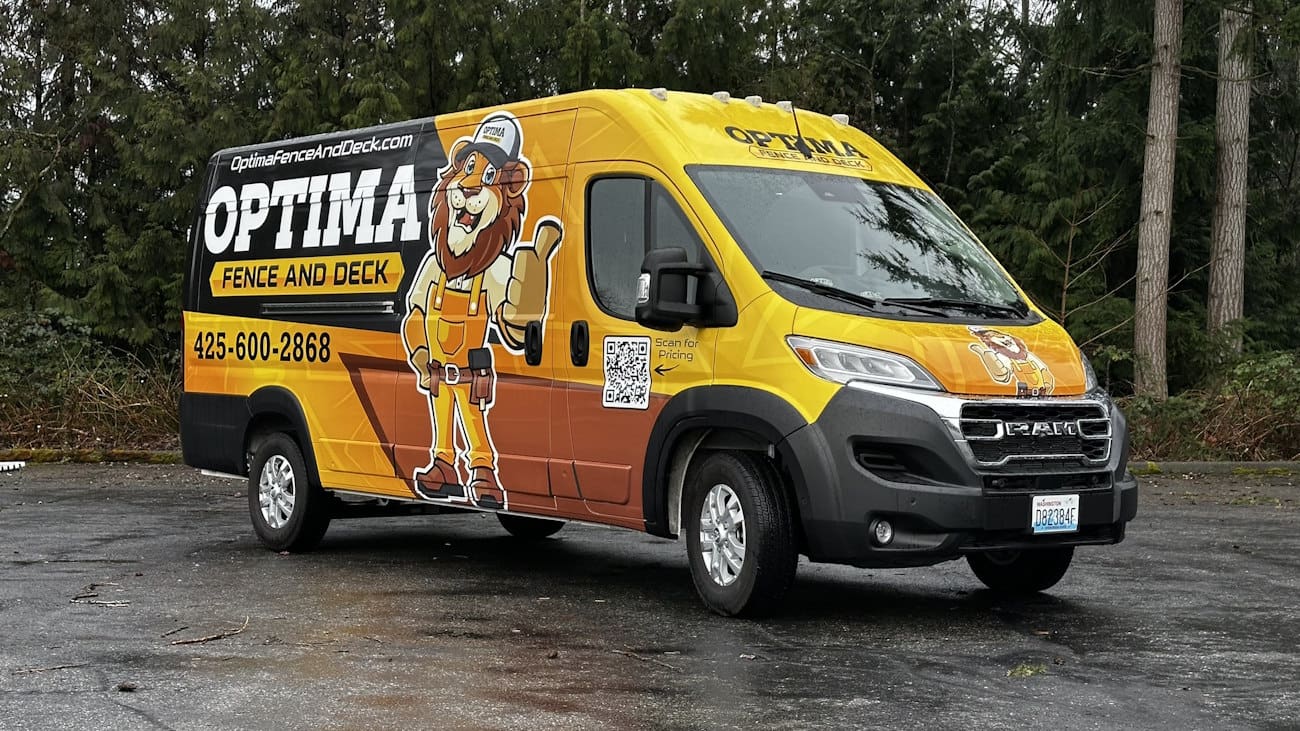
I've watched this identity problem get solved on two recent projects. Rooster's Plumbing came to us with a strong name and trucks nobody noticed; a full wrap with a custom mascot, a direct tagline, and a QR code on the tailgate turned those same trucks into something homeowners in Snohomish County recognize before they read a word of it.
New Day Construction brought in a finished design from a national wrap design firm, and the finished Sprinter, wrapped down to the plastic trim most shops leave bare, reads as a single, deliberate piece of branding rather than a truck with a logo stuck on it. Both projects say the same thing to a homeowner standing on their porch: this is a company organized enough to invest in how it presents itself, which is generally a reasonable proxy for how it runs its business.
Why Countertop and Stone Fabricators Are Especially Exposed to This
Most trades roll a work van through a neighborhood a few times a week. A countertop fabricator's truck shows up loaded with the actual product, often visible through the rack, often the single most expensive-looking object the homeowner will see all day. That truck is not just transportation. It's the physical proof that the company that quoted the job is the same company capable of delivering and installing it.
A template van covered in granite dust with a faded logo tells the homeowner one story. A clean, wrapped vehicle with the fabricator's name, service area, and a clear visual identity tells a different one and it tells that story to every neighbor, every passing contractor, and every homeowner three doors down who's been meaning to redo their own kitchen but hasn't called anyone yet. A fabrication shop running 4 or 5 vehicles between the showroom, the template appointments, and the install crews has 4 or 5 separate opportunities to make that impression, and most of them are making it badly by default rather than on purpose.
The Difference Between a Wrap and a Sticker
Not every wrap earns the trust it's supposed to build. Cheap, unbranded vinyl shrinks at the edges within a year or two, especially on the compound curves of a cargo van or box truck, and a peeling wrap reads worse to a homeowner than no wrap at all. It looks like a company that cut corners somewhere, and a homeowner evaluating a countertop fabricator is already primed to wonder where else corners might have been cut. Cast vinyl, properly laminated and professionally installed, behaves differently. It conforms to the vehicle instead of fighting it, holds its color through Pacific Northwest winters and summers alike, and, contrary to what a lot of business owners assume before they call, protects the paint underneath rather than damaging it, since the film acts as a barrier against UV and road grime the exposed panels never had.
That distinction matters because homeowners can tell the difference even when they can't name it. A wrap that's holding up reads as intentional. A wrap that's failing reads as neglect, and neglect is the last impression a countertop company wants sitting in someone's driveway next to a slab of quartz they're about to trust that same company to install correctly.
The truck a fabricator sends to a job site is going to make an impression either way. The only real choice is whether that impression is the one the company would choose if it were paying attention and most of the time, the companies that are still getting called back in ten years are the ones that decided to pay attention.
— Andrey Tsarenko, Owner & CEO, Promo Box LLC
Everett, WA · Serving Greater Seattle & Snohomish County