Granite is no longer the automatic countertop choice it once was, especially for indoor kitchens where many homeowners now prefer quartz for its consistency and lower routine maintenance. That does not make granite outdated. It means homeowners are choosing it for more specific reasons: natural movement, heat resistance, durability, and the fact that two slabs never look exactly the same.
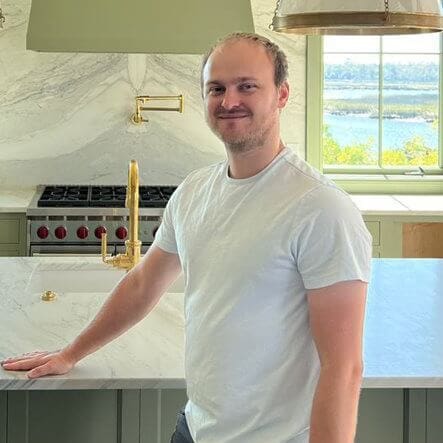
I’m Iurii Pirogov, Owner and CEO of Perfect Stones Countertops. I started by cutting and polishing stone and have spent more than 12 years working through measurement, layout, fabrication, and installation. When I stand in front of a granite slab with a homeowner, I am not trying to match it to a trend list. I am comparing it with the cabinetry, flooring, backsplash, hardware, lighting, and the way the kitchen will actually be used.
Light Granite Is Still Strong, but It Is Not the Only Direction
Light granite remains a popular choice among Charleston homeowners and continues to appear in the projects we handle. White, gray, cream, and taupe movement can keep a kitchen bright while still giving the surface the variation people expect from natural stone. Alaska White, White Ice, River White, Colonial White, and Viscount White all work within that general direction, but they do not create the same room.
Alaska White can mix white and silver with charcoal, beige, brown, and warmer mineral clusters. White Ice has a cleaner white and steel-gray field with darker flecks. River White tends to read lighter with soft gray movement and small burgundy details, while Viscount White can range from relatively quiet to strongly directional. Those differences are why I never want someone to choose granite from a small chip and assume the full slab will behave the same way.
Black granite is also still useful when the room can support it. Black Pearl, Absolute Black, Steel Gray, and Black Galaxy can create a stronger visual contrast between the cabinets and countertop, but the amount of daylight, cabinet color, and flooring matter more when the surface is dark. A black slab in a bright kitchen with light cabinetry can feel controlled and elegant. The same stone in a darker room with heavy cabinetry may make the space feel too enclosed.
Brown and Speckled Granite Are Not Automatically Outdated
The stone itself is not necessarily the problem. Brown, gold, and active granite can feel dated when it is surrounded by equally busy cabinetry, flooring, and backsplash tile. Sometimes the countertop still works perfectly well, and changing one or two surrounding finishes brings the entire kitchen back into balance.
For a new project, I would still compare warmer granite with lighter and darker options instead of ruling it out because the color is no longer dominating design magazines. Santa Cecilia Light, for example, can work naturally with wood cabinetry and warm floors because its beige, cream, gold, gray, and occasional burgundy details repeat those tones. The important question is whether the countertop supports the room or competes with everything around it.
We go through these color families, current Charleston pricing, finish options, and material comparisons in more detail in our full guide to granite countertop trends in 2026.
The Finish Can Change the Stone Almost as Much as the Color
Granite selection does not stop once the slab color is right. Polished, honed, and leathered finishes can make the same material look and feel significantly different. A polished finish reflects more light and usually makes the stone read darker and richer. Honed granite has a flatter, matte appearance and softens the visual contrast. Leathered granite adds texture and can make fingerprints and everyday handling marks less obvious on some darker stones.
I always recommend touching a leathered or textured finish before making the decision because it cleans differently from polished stone and feels different under your hand. The finish should also be viewed in lighting similar to the kitchen. A slab that looks quiet in a stone yard can feel much stronger once direct light begins reflecting across the surface.
Finish availability also has to be confirmed for the actual material before fabrication. I would not design an entire kitchen around a particular look and then discover that the selected slab is not available in the finish the homeowner expected.
Granite Makes the Most Sense When You Want Natural Variation
Quartz is still the main alternative I discuss when a homeowner wants a more consistent pattern and less routine maintenance. Quartzite appeals to people who want a one-of-a-kind natural slab with a different visual character. Marble has become more visible again in 2026, especially strongly veined looks such as Calacatta Viola, but marble comes with etching and more visible wear.
Granite sits somewhere else in that conversation. It gives you natural variation and generally handles heat better than resin-based quartz. It also resists everyday scratching and acids better than marble, although it is not indestructible. A hard impact can chip an exposed edge or the area around a sink, and abrasive grit can still affect the finish.
There is no material I would call universally better. If someone wants uniform movement and low maintenance, quartz may make more sense. If the priority is natural slab variation, heat performance, and a surface that does not repeat from kitchen to kitchen, granite can still be one of the strongest choices.
Granite Still Needs Practical Care
One reason granite has remained useful in working kitchens is that it handles everyday use well, but I do not sell it as damage-proof. I still recommend trivets even though granite has good heat resistance. The trivet costs almost nothing and protects the surface treatment and the materials around the countertop from concentrated heat.
Sealing is another area where I avoid blanket rules. I often use one year as a reminder to check the countertop, not as an automatic instruction to apply sealer every twelve months. The stone, finish, previous treatment, absorption, and sealer manufacturer’s directions should guide that decision. Sealing improves stain resistance, but it does not make granite stain-proof.
For outdoor kitchens, I generally start the conversation with granite before engineered quartz because prolonged ultraviolet exposure and heat can affect some quartz products. That still does not mean every granite is automatically right for exterior use. Color, finish, exposure, and installation conditions should be reviewed for the particular project.
The Real Price Depends on the Slab and the Fabrication
I prefer pricing the complete countertop project because an advertised square-foot number rarely tells homeowners what they will actually pay. For a typical 45-square-foot granite kitchen, our current planning range is approximately $4,500 to $7,000. That depends on the slab price and count, usable material, finish, cutouts, seams, support requirements, and access. A full-height backsplash of about 30 square feet may start around $1,400 when enough material remains from the purchased slab. If another full slab is required, that starting point may be closer to $3,400.
Edge details can move the budget as well. On our projects, a double bullnose can add roughly 25% to 30%, while a mitered edge may add around 50%, depending on the stone and project complexity. A waterfall on both ends of an island can add approximately 30% to the overall project cost because of the additional material, miters, vein matching, handling, and installation. Those are planning figures, not automatic charges. The actual quote follows the selected slab and written scope. If walls are uneven, cabinets need correction, or site conditions require additional work, that should be discussed before fabrication rather than appearing as a surprise during installation.
Full-Slab Selection Matters More Than the Trend Name
Granite is natural stone, which means two slabs sold under the same name can look noticeably different. The pattern may be tighter, more directional, warmer, cooler, or more active. That difference affects seam placement, sink cutouts, island orientation, and how the countertop works with the rest of the room. When a granite has strong movement, we review the layout before fabrication. A seam can be well made and still remain visible at close range, so the goal is not to pretend seams disappear. It is to put them where the slab pattern, cabinet support, piece size, access, and installation conditions allow the cleanest result.
Our usual countertop project timeline is approximately 14 to 17 days once the required details are confirmed, although material availability, site preparation, complex fabrication, and difficult access can extend that schedule. That is why I ask homeowners to bring cabinet doors, flooring, paint colors, backsplash samples, and hardware finishes to the stone yard. Put those real materials against the real slab and the decision becomes much clearer than choosing from a trend photo online.
Homeowners considering granite, quartz, marble, quartzite, porcelain, or another countertop material can see more of our fabrication and installation work at Perfect Stones Countertops.
Iurii Pirogov Explains Why Granite Still Works in Modern Kitchens
The Stone Magazine (TSM): Iurii, is granite still popular in 2026?
Iurii Pirogov (IP): Yes, but it is not the automatic indoor choice it used to be. Quartz is more common for homeowners who want consistency and lower maintenance, while granite is usually chosen because someone wants a natural slab and more individual movement.
TSM: Which granite colors are getting the most interest?
IP: Light surfaces are still important, especially white, gray, cream, and taupe movement. Selected black granite also works very well when the room has enough light.
TSM: Are brown granite countertops outdated?
IP: Not automatically. Sometimes the problem is that the entire kitchen is busy. The granite, cabinets, floor, and backsplash are all competing. Changing the surrounding finishes can make the same countertop look much better.
TSM: How much does the finish change the appearance?
IP: A lot. Polished stone usually looks richer and more reflective. Honed is flatter and quieter. Leathered adds texture and can make some daily marks less obvious.
TSM: Is granite better than quartz?
IP: No material is automatically better. Quartz gives you more consistency and lower routine maintenance. Granite gives you natural variation and handles heat well. I ask what the homeowner wants from the kitchen.
TSM: Can you put a hot pan directly on granite?
IP: Granite handles heat well, but I still recommend using a trivet. It is a very easy way to protect the countertop and the materials around it.
TSM: Does granite need sealing every year?
IP: Not automatically. I use that as a reminder to check the surface. The actual need depends on the stone, finish, previous treatment, absorption, and sealer instructions.
TSM: Why can two granite projects with the same square footage have different prices?
IP: Slab price, slab count, usable yield, cutouts, seams, finish, edge profile, access, and installation conditions can all be different. Square footage is only one part of the cost.
TSM: Why do you want homeowners to see the full slab?
IP: Because one sample cannot show the pattern, direction, usable area, or how the movement will meet a seam. The full slab tells us what we are really working with.
TSM: What should someone bring to the stone yard?
IP: Bring the cabinet color, flooring, backsplash, paint, and hardware if you have them. Put everything beside the slab. That gives you a much better answer than choosing granite because somebody said that color is trending.