White marble is not disappearing from Charleston kitchens. If anything, light stone is still the strongest direction we see. What has changed in 2026 is how much movement homeowners are willing to bring into that light background. Instead of asking only for soft gray veining, more people are stopping at slabs with burgundy, gold, blue-gray, green, or heavier contrast.
I’m Iurii Pirogov, Owner and CEO of Perfect Stones Countertops. I have worked in the countertop industry for more than 12 years, beginning with cutting and polishing stone before moving into measurements, installation planning, sales, and management. My advice on marble is simple: choose it because you understand the material and genuinely want the way that particular slab looks in your home. I would not choose a countertop because somebody called it the stone of the year.
White Marble Is Still Leading, but the Veining Is Getting Stronger
The Charleston and Lowcountry projects we see still lean heavily toward white and cream backgrounds. Gray, gold, and blue-gray veining remains popular because those colors work with a wide range of cabinetry and flooring. The difference is that homeowners are increasingly comfortable letting the countertop become the visual center of the room instead of treating it as a quiet background surface.
Calacatta Viola is the clearest example. Its cream or white field can carry deep burgundy, purple, gray, and sometimes gold movement, so nobody mistakes it for a neutral surface once it is installed. In our own 2026 requests, it has taken some of the attention that more traditional Calacatta looks received before. We still sell quieter natural stone, but more homeowners are asking to see slabs that make a stronger statement.
That shift does not mean every kitchen should have dramatic marble. A heavily veined slab can look balanced in a large room with restrained cabinetry and simple finishes, while the same material can make a smaller kitchen feel crowded. I always want to see the cabinet color, flooring, lighting, and backsplash direction before recommending a bold slab.
Calacatta Viola Is Popular Because It Does Not Look Generic
Calacatta Viola is one of the most requested premium marble looks we are seeing right now because the movement is so recognizable. It can make an island, full-height backsplash, or entire kitchen feel custom without relying on a complicated cabinet design.
The same strong pattern that makes Viola attractive also makes fabrication more demanding. A sink cutout can remove the part of the slab the homeowner liked most. A seam through a large burgundy vein may be far more visible than a seam placed through a quieter area. If the project needs multiple slabs, we have to look at how the movement continues between them instead of simply ordering the correct square footage. That is why I never want a strongly veined marble approved from a small sample. The slab is the design. Two pieces carrying the same trade name can have completely different color balance, vein density, repaired areas, fissures, and usable dimensions.
We go deeper into the current Charleston marble selections, slab pricing, fabrication, and maintenance in our full guide to popular marble countertops in 2026.
Carrara, Calacatta Gold, and Statuario Still Have Very Different Jobs
Carrara is usually the quietest place to start. Many slabs have a light gray or soft white background with fine gray or blue-gray veining, which works well when the cabinetry, millwork, or other finishes should carry more of the attention. I would still never assume Carrara means bright white. Some slabs read noticeably gray, and that difference becomes obvious once a cabinet door is placed beside them.
Calacatta Gold usually brings a lighter white or creamy field with broader gray movement and warm gold or beige accents. That warmth can connect naturally with brass hardware, wood, and warmer white cabinetry. Statuario tends to create more contrast, with a brighter white field and stronger gray veining separated by a more open background. On a large island, one major Statuario vein can determine the visual direction of the entire room.
Darker Marble Works Best When the Room Gives It Space
The biggest visual shift I see is that homeowners are more willing to consider marble outside the white-and-gray family.
Rosso Levanto can bring deep red or burgundy with lighter veining. Verde Alpi introduces dark green with fragmented lighter movement. Nero Marquina creates a completely different effect with its black background and irregular white veins. Rosa Portogallo offers a softer pink direction, while Breccia Capraia can combine burgundy, purple, gray, and gold across a lighter field.
I would not use these stones everywhere automatically. A dramatic marble often works best when it has a clear purpose, such as a central island, bar, vanity, fireplace, or full-height backsplash, while the surrounding materials stay more controlled. Dark polished stone also shows fingerprints, dust, scratches, and finish changes more readily under some lighting, so appearance and maintenance have to be part of the same conversation.
Charleston style does not change that rule. I do not choose blue-gray marble simply because a home is near the coast, and I do not prescribe warm Calacatta because a kitchen is traditional. I want to see the actual daylight, paint, flooring, cabinet finish, and hardware in that home.
Marble Only Makes Sense if You Accept What Marble Does
Marble is a calcareous natural stone. Lemon, vinegar, wine, tomato, and other acids can react with the surface and leave a dull etch. It is also softer than granite and can scratch more easily. Sealing improves resistance to staining, but it does not make marble stain-proof and does not prevent acid etching.
A honed finish can make everyday etching less noticeable because the surface is already matte. A polished finish reflects more light and brings out the color and veining, but dull etch marks can be easier to notice against that polish. Neither finish eliminates the underlying behavior of marble.
I do not consider marble the right kitchen material for everybody. If you know that a small etch mark or scratch will bother you every time you walk into the room, quartz may be a better fit. If you want natural stone but need different performance, granite or quartzite may deserve a look. I would rather tell a homeowner that before fabrication than watch them become frustrated with a surface they were never prepared to live with.
The Slab Price Is Only the Beginning of the Countertop Price
Marble also shows why countertop pricing cannot be reduced to one advertised square-foot number. For context, the approximate individual slab prices we are currently seeing vary dramatically. Carrara may be around $2,640 per slab, Statuario about $8,800, Calacatta Gold around $12,500, and Calacatta Viola around $17,600. Rosso Levanto is approximately $14,500, while Rosa Portogallo is around $16,300. Those are slab prices, not installed countertop quotes.
A kitchen with roughly 50 square feet of countertop area may have general countertop pricing starting around $5,500, but that is not a marble-specific starting price. High-end natural stone projects can reach $15,000 to $20,000 depending on the material, number of slabs, and fabrication involved.
The final number also follows the usable stone. Strong veining, fissures, cutouts, island dimensions, seams, edge profiles, backsplash, waterfall panels, access, and installation conditions can all affect how much material we need and how much fabrication is involved.
In Charleston, about 75% of the projects we see use a standard flat edge. A double bullnose can add roughly 25% to 30% to a project, while a mitered edge can add around 50% depending on the material and scope. A waterfall on both ends of an island can add about 30% overall. I use those percentages as planning references, not automatic charges.
Vein Layout Can Matter More Than Buying the Most Expensive Stone
A marble slab is still raw material when you choose it. We have to measure it, lay out the countertops, decide where the seams and cutouts belong, fabricate the edges, polish the pieces, transport them, and install everything in the house. That process becomes more important as the movement gets stronger. If the homeowner loves one large vein, I need to know whether it belongs on the island, whether a sink will cut through it, and how the surrounding pieces will relate to it. A full-height backsplash adds another surface that needs to connect visually to the countertop rather than look like a random leftover piece.
We normally confirm the final layout after templating when the stone has visible veining. Our team then handles cutting, polishing, and fabrication in our own production facility before installation. Keeping measurement, fabrication, and installation under one company gives us clearer responsibility for how the final countertop comes together.
Access can change the plan too. We have worked with pieces up to approximately 139 by 79 inches, but the fact that we can fabricate a large piece does not mean we can physically carry it through every home. Doors, hallways, stairs, and other tight areas have to be checked before cutting. If the piece cannot be delivered safely in one section, the seam needs to be planned before fabrication, not improvised at installation.
One Finished Kitchen Shows Why Natural Stone Needs to Be Planned as a Whole Room
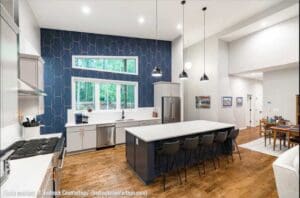
One completed Perfect Stones project used natural stone across the perimeter countertops, central island, and full-height backsplash. In one of our completed projects, we installed natural stone with a soft white background, subtle gray veining, and a polished finish across the kitchen. This project is a useful example of how important the overall layout is, regardless of the specific stone variety.
What it does show very well is why layout matters. The countertops, island, and backsplash do not look like three unrelated stone selections. The movement continues through the room and works with the cabinetry, openings, and custom range hood. That kind of continuity has to be planned before fabrication begins. That is how I want homeowners to think about marble too. The question is not which name is most fashionable or which slab costs the most. The question is whether the actual stone works with the room, whether the homeowner understands how it will age, and whether we can fabricate it in a way that makes the natural pattern look intentional.
Homeowners choosing marble, quartz, granite, quartzite, or another surface in Charleston and the Lowcountry can see more of our materials and fabrication work at Perfect Stones Countertops.
Iurii Pirogov Explains How to Choose Marble Without Chasing a Trend
The Stone Magazine (TSM): Iurii, is white marble still the most popular direction in Charleston?
Iurii Pirogov (IP): Yes. Light backgrounds are still the strongest direction we see. What is changing is the movement. People are more comfortable with gold, burgundy, blue-gray, and stronger contrast.
TSM: Why is Calacatta Viola getting so much attention?
IP: It is very recognizable. The burgundy and purple movement can make the countertop the main feature of the kitchen. It is also expensive, so I want homeowners to understand the material and see the actual slab before they make that decision.
TSM: Would you choose Viola for every large island?
IP: No. The rest of the room has to support it. If the cabinets, floor, and backsplash are already very busy, the stone can become too much.
TSM: Is Carrara the safer option?
IP: It is usually quieter, but even Carrara varies. Some slabs are much grayer than people expect. I still want the homeowner to see the full slab with the cabinet and floor samples.
TSM: What is the biggest practical drawback of marble?
IP: Etching and visible wear. It can also stain and scratch. Sealer helps with staining, but it does not stop acid from reacting with the stone.
TSM: Would you recommend honed marble instead of polished?
IP: Honed can make etching less noticeable because it is already matte. Polished shows the color and veining more strongly. I would choose based on the look the homeowner wants and how comfortable they are with maintenance.
TSM: Why can two marble kitchens with similar square footage cost so differently?
IP: The slab itself can have a huge price difference, and then you have slab count, usable material, seams, edges, cutouts, backsplash, waterfalls, access, and fabrication. Square footage does not explain all of that.
TSM: How important is slab layout with strongly veined marble?
IP: Very important. A sink can remove an important vein, and a seam can cut through the strongest part of the pattern. We want to resolve that before we cut anything.
TSM: Is an expensive slab automatically a better countertop?
IP: No. It may be rarer or more dramatic, but that does not mean it is better for your kitchen. I want to know whether it fits the design and how you live.
TSM: What should homeowners bring when they come to look at marble?
IP: Bring the cabinet color, flooring, paint, backsplash ideas, and hardware or appliance finishes if you have them. Put those materials next to the full slab. That will tell you much more than choosing from a small sample or a photo online.