

Waterfall Countertops: When the Extra Stone Is Actually Worth It

A waterfall countertop can make an island look much more finished, but I would not recommend one just because it is popular. Sometimes that vertical stone panel is exactly what the kitchen needs. In another room, the side of the island is barely visible, and the homeowner is paying for extra material and fabrication that nobody is really going to notice.
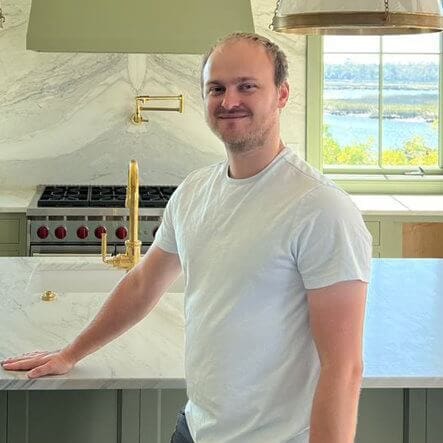
I’m Iurii Pirogov, owner and CEO of Perfect Stones Countertops, and I have worked with countertops for more than 12 years. When someone shows me a waterfall they found online, I first look at their actual kitchen. The size of the room is not the deciding factor. We have installed waterfalls in large Charleston homes and in smaller kitchens where the material was much more affordable. What matters is whether the detail works with the island, the stone, and the budget.
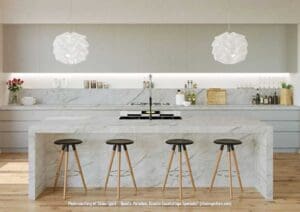
A waterfall is simply the countertop material continuing vertically down the end of an island or peninsula instead of stopping at the horizontal surface. At our shop, the common approach is to cut the horizontal and vertical pieces at 45 degrees and join them so they form a clean 90-degree turn. When it is done well, your eye follows the stone around the corner. When it is done badly, the first thing you notice is the seam.
The Slab Matters More Than the Trend
Quartz is usually the easiest material for me to recommend for a waterfall because it is predictable to fabricate and straightforward for homeowners to maintain. We tend to get very clean mitered edges with it, which matters when that corner is one of the most visible details on the island. It also gives you more consistency when the design depends on a pattern continuing from the top down the side. That does not mean natural stone is a bad choice. Granite can make an excellent waterfall, and I use it often when a homeowner wants natural stone without moving into the highest price range. With granite or quartzite, I want to see the actual slab before we decide where the waterfall pieces will come from. A strong vein may look beautiful across the countertop but make no sense if it turns down the side in the wrong direction.
Quartzite is usually chosen for the movement in the slab, so layout becomes even more important. Around Charleston, lighter surfaces are still very popular in 2026, especially stone with a white background and softer movement. Taj Mahal is still requested, although we are seeing it less often than we did last year.
Marble is a different conversation. It can look incredible in a waterfall, but I am careful about recommending it for somebody who expects the countertop to stay visually perfect with very little maintenance. Marble can etch and scratch more easily than quartz, and homeowners need to be comfortable with that before they spend a lot of money on it. Viola Marble is getting a lot of attention right now because of its dramatic white and dark movement, including those purple tones that make it immediately recognizable. A few years ago, everyone seemed to ask about Calacatta. In 2026, Viola is the name I hear much more often.
The important thing is not choosing a material because somebody called it the best stone for a waterfall. I want to know how that particular slab is going to behave when we cut it, and I want to know whether the pattern will still look right after it makes the turn.
Most of the Work Happens Before Installation
A finished waterfall looks simple because you only see the countertop and the vertical panel. The hard part happens before those pieces arrive at the house.
The cabinets have to be installed and ready for templating. We take the final measurements, then bring that information back to the shop and plan the pieces on the actual slab. If the stone has strong veining, this is where we decide exactly where the cuts should fall and how the movement should continue through the corner. For a waterfall, I am usually looking for continuity rather than a book-matched effect. Book matching creates a mirror image, which can be beautiful on a wall or another large feature. On an island, I normally want the vein to look as though it naturally traveled across the countertop and then continued down the side. That planning matters because there is very little room to hide a bad decision once the stone has been cut. If a major vein stops abruptly at the corner, installation cannot fix the layout afterward.
The condition of the kitchen matters too. In older Lowcountry homes, the floor may have some pitch, or the cabinets may not be perfectly level. That does not automatically prevent a waterfall, but we need to know what we are working with before fabrication. I would rather find an uneven condition during templating than discover it while somebody is holding a heavy vertical stone panel next to the island. That is also why I like having fabrication under the same roof as the rest of the countertop work. We can look at the slab and adjust the layout before cutting rather than passing drawings through several companies and hoping everybody is interpreting them the same way. For something simple, that may not make a huge difference. On a waterfall with strong movement, those small decisions are the project.
What a Waterfall Actually Adds to the Cost
A waterfall uses more material, but the extra square footage is not always the biggest issue. What I care about is how the countertop and vertical pieces fit onto the slabs we already need. If the waterfall pieces fit efficiently into the material being purchased for the kitchen, the increase can be fairly manageable. If adding the waterfall means buying another full slab, the price changes much more quickly.
For a baseline kitchen of around 45 square feet, quartz countertops at Perfect Stones may start around $4,500 to $7,200, while granite for a similar project may run roughly $4,500 to $7,000. Higher-end marble or quartzite projects can move into the $15,000 to $20,000-plus range. As a working estimate, a two-sided waterfall can add about 30% to the overall project cost, but I would never use that percentage as a quote without seeing the slab layout first.
Sometimes the best answer is sitting in the shop already. We had a recent project where 27.3 square feet of Taj Amber remnant material was enough to create the waterfall without ordering another full slab. During templating, we marked where the waterfall and miter connections would go, then fabricated the pieces so the stone continued cleanly from the top of the island down to the floor. That is the kind of situation where asking about remnants can save real money. A waterfall may only need a little more material than the main countertop layout provides. If we have the right stone and enough of it available, there is no reason to buy a full slab just because the extra piece is vertical.
The same logic comes up with full-height backsplashes. If enough matching material remains from the countertop job, a backsplash of around 30 square feet can start around $1,400. If we need another slab specifically for that backsplash, the cost may start closer to $3,400. The surface itself did not suddenly become more difficult to install. The big difference is whether another slab has to be purchased. That is why square-foot pricing alone can be misleading with stone. Slab yield matters.
Not Every Island Needs One
In our Charleston-area work, the standard flat edge is still by far the most common countertop treatment. Roughly 75% of the countertops we fabricate use a standard flat edge, while waterfalls are a more specific design choice. If the end of the island is open to the room and you are using a slab with movement worth showing, a waterfall can become one of the strongest details in the kitchen. If that side is pushed against a wall or mostly hidden by the layout, I would question whether the extra stone is doing enough to justify the money. I look at the cabinets the same way. One advantage of the waterfall is that it hides the side of the base cabinetry and gives the island a clean finished end. That can work very well around seating areas because the stone also takes the everyday contact that otherwise lands on a cabinet panel.
The downside is that the island becomes more committed to its current configuration. Changing the cabinetry later is more complicated when stone wraps down the side. There is no reason to force the detail into a kitchen because waterfall countertops are fashionable. Sometimes the standard edge looks better because it allows the cabinetry to show. Sometimes I would rather take the money that would have gone into another slab and use it on a material the homeowner likes more. That is generally how I make the recommendation. I look at what you are going to see when you walk into the room, and then I look at what the slab is going to cost us to accomplish it.
If you are considering a waterfall island and want to compare the stone layout before committing to another slab, you can see materials and completed countertop work at Perfect Stones Countertops.
Expert Conversation: The Stone Magazine and Iurii Pirogov
The Stone Magazine (TSM): Iurii, are waterfall countertops still something homeowners ask for regularly in 2026?
Iurii Pirogov (IP): Yes, but they are still much less common than a normal edge. For us, the standard flat edge is probably around 75 percent of what we fabricate. A waterfall is more of a design decision for a particular island.
TSM: Do you need a large luxury kitchen for it to work?
IP: No. That is one of those ideas people get from photos online because most of the examples are huge kitchens. We have done waterfalls in smaller kitchens and they looked very good. You need the right proportions and the right material. The size of the house does not decide it.
TSM: Why do you usually recommend quartz first?
IP: It is easier for the homeowner to live with, and from our side it gives us very clean cuts for the miter. On a waterfall, that corner is important. If the connection looks bad, you are going to see it every time you walk past the island.
TSM: Does natural stone make vein matching much harder?
IP: It makes you think more before you cut it. With quartz, the pattern is more predictable. With granite or quartzite, I want the actual slab in front of me because every slab is different. If there is a strong vein, I need to know where it is going when the countertop turns down.
TSM: Is that book matching?
IP: Usually not. Book matching is when you mirror two slabs. For a waterfall, I normally want continuity. I want the vein to keep moving naturally through the corner instead of looking like we took two random pieces and glued them together.
TSM: What makes a waterfall suddenly much more expensive?
IP: Another slab. That is usually the big one. If I can fit the top and the waterfall pieces into the slabs you already need, that is one situation. If I am short by a small amount and now I need to buy a whole slab, that changes the number.
TSM: Is that why you suggest checking remnants?
IP: Exactly. If I have the same material in the shop and the remnant is big enough, why should I make you buy another full slab? We recently had 27.3 square feet of Taj Amber and it was enough for the waterfall. That made sense.
TSM: What material are you seeing homeowners ask about most right now?
IP: Quartz is still very common because it is practical. With natural stone, Viola Marble is getting a lot of attention right now. Taj Mahal quartzite is still popular too, but I would say we are seeing less of it than last year.
TSM: Would you put marble on a waterfall island in a working kitchen?
IP: I would if the homeowner understands marble. It is beautiful, but I do not want somebody buying an expensive marble countertop and then being surprised that it can etch. If you know what you are choosing and you are okay with the maintenance, that is different.
TSM: When do you tell someone not to do the waterfall?
IP: If I do not think they are going to see enough benefit from it. If the side of the island is hidden or adding the waterfall forces us into another expensive slab for very little visual difference, I would rather tell them that. There are plenty of other places to spend that money in a kitchen.