Introduction
When I first started looking into which countertops are better for the kitchen — quartz or laminate — I thought the difference would be obvious. But the more I read, compared, and asked others, the harder the choice became. It’s not just about price or looks. What really matters is how the material performs in everyday life, how resistant it is to damage, how easy it is to clean — and whether it will fit into your interior.
Comparing laminate countertops vs quartz is a lot like debating Samsung vs Apple. One option is practical and affordable, the other is stylish and high-status. But the truth is, both have their strong sides — you just need to figure out which ones matter most to you.
I keep seeing this question pop up — on Reddit, on Pinterest, and in conversations with friends. People are trying to choose between visual appeal, durability, and reasonable cost. And the truth is, choosing between quartz and laminate countertops isn’t just about design. It’s about lifestyle, daily routine, and how much time you’re willing to spend on maintenance.
In this article, I’ll explain the key differences between quartz and laminate countertops — how they look in interiors, how they perform in everyday life, how much they cost, and how durable they are. We’ll break down the pros and cons of each option and look at real-life scenarios — from kitchens in family homes to bathrooms in rental apartments. I’ll also talk about Formica countertops and why they’re often called “plastic” — and what actually makes them different from other surfaces. All of this comes with examples, honest reviews, and practical tips to help you make a well-informed decision.
What You Should Know If This Is New to You
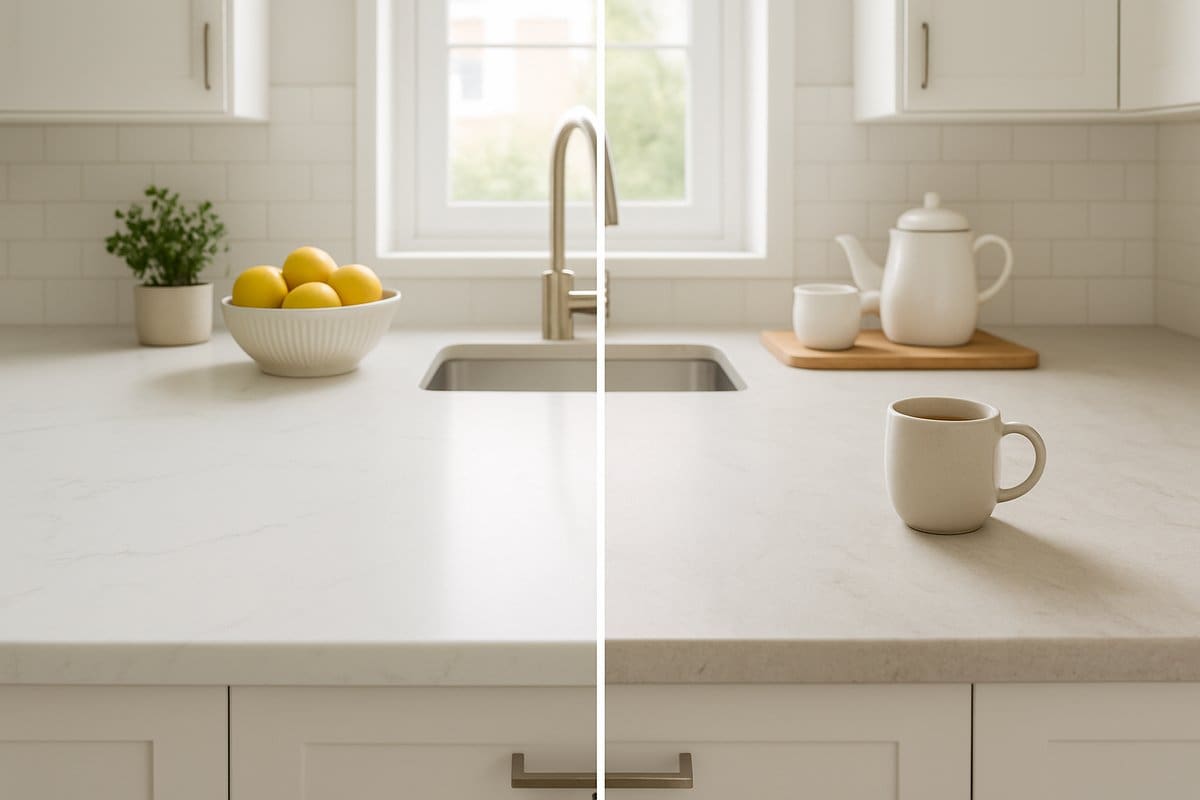
When people compare laminate and quartz countertops, they often talk about surfaces that “look the same.” But structurally, these are very different materials. Visual similarity — especially in modern collections — can create the impression that the materials are nearly the same.
Quartz countertops are made from a blend of crushed quartz, usually about 90–93%, combined with polymer resins and pigments. The mixture is compressed under high pressure into a solid slab. The surface is non-porous and uniform throughout.
Laminate countertops are built differently. Inside is particleboard or MDF. On top is a decorative layer infused with resins. This top layer creates the stone-, concrete-, or wood-look pattern. Visually and even tactually, it can be very convincing. But the structure remains layered.
1. What Are Quartz and Laminate Countertops?
1.1 Core Materials and Manufacturing Process
Sometimes choosing a countertop feels like a matter of taste: you like white with veining — go for it, prefer something darker — search for a concrete look. But once you start using it every day, it becomes clear: a countertop isn’t just decoration. It’s a work surface that needs to handle everything — from hot pans to spilled juice. And that’s where the material really matters.
Quartz countertops are made from a mix of crushed quartz (around 90–93%), polymer resins, and color pigments. These components are compressed into a solid, durable slab. The result is non-porous, doesn’t absorb stains, resists everyday damage, and holds up under daily pressure. It’s a consistent surface with no weak spots and has the look of natural stone — only it’s easier to care for.
I often get asked, “Is quartz better than granite?” — and the answer depends on the situation. But when comparing quartz and laminate, the first thing you’ll notice is the weight and overall feel. Quartz is heavy, sturdy, and gives off a sense of durability from the first touch.
Laminate countertops are built differently. The core is made from particleboard or MDF, topped with a decorative layer soaked in resins. That top layer creates the design: it could look like marble, wood, concrete, even fabric. The surface can feel smooth, warm, or textured — modern laminate can be surprisingly impressive.
Of course, laminate has its traits. It’s lighter, easier to install, and more affordable. But because of its layered structure, it can be vulnerable to moisture and high heat. Still, if used with care, it can last for many years.
And here’s something important: modern Formica countertops and other similar options are way better than they used to be. Manufacturers have improved their water resistance, durability, and textures. Sometimes laminate looks so realistic, it’s hard to tell it apart from stone — especially in photos or from a distance. Many brands now offer collections that blend easily into modern interiors without stretching your budget.
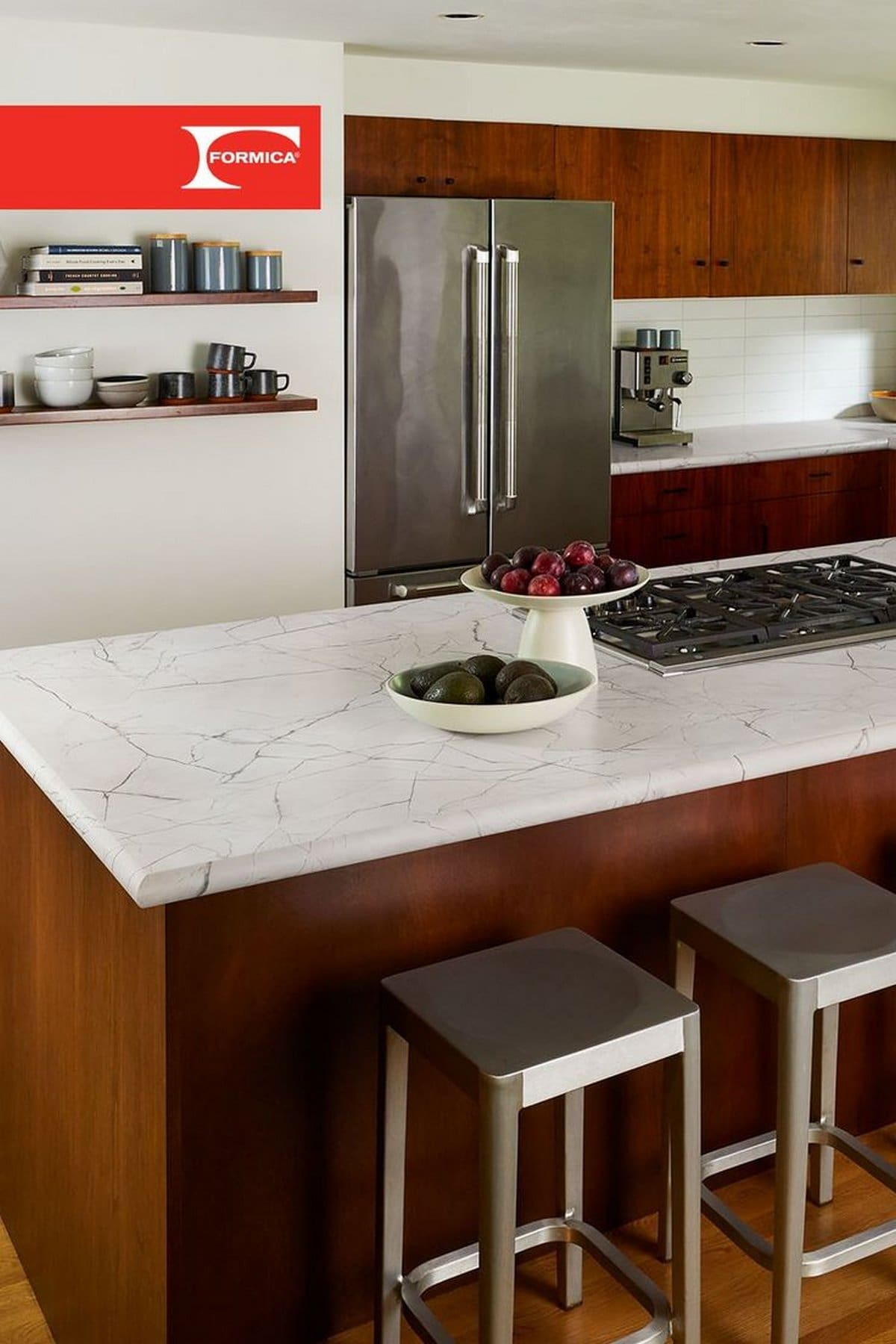
Laminate countertop. Source: @formicagroup (Pinterest)
If you’ve ever thought about laminate countertops, you’ve probably heard the name Formica. For many, it’s almost a generic term — like “Xerox” for printers. But in reality, Formica countertops are just one brand, although the most famous. There are other competitors too, each with its own features.
If this is the first time you’re hearing about it, here’s a quick breakdown. Formica is an American company that’s been making laminate since the early 1900s. Today, they have hundreds of designs: marble-look, granite-look, wood-look, solid colors, textures, glossy finishes. I once came across their 180fx series — visually, it’s almost impossible to distinguish it from real stone, especially in kitchens with neutral lighting. And the price is far lower than quartz or granite.
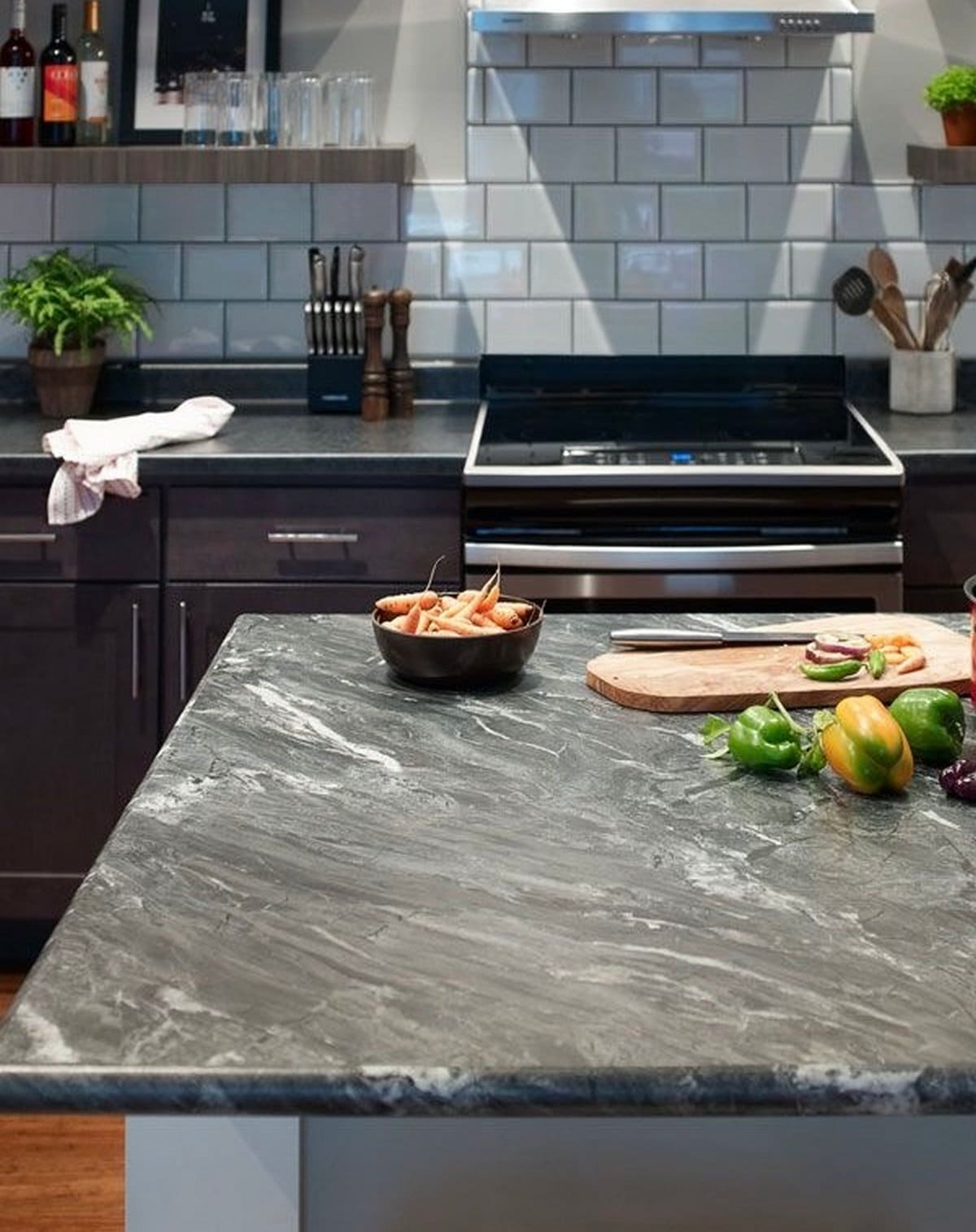
Formica 180fx laminate countertop. Source: @formicagroup (Pinterest)
Other major players in the laminate market include Wilsonart, Pionite, and Nevamar. Wilsonart offers interesting matte finishes with a soft-touch effect, while Pionite focuses on unique textures and rich colors. All of them strive to satisfy modern buyers by offering “stone-look” or “wood-look” styles without breaking the budget.
When it comes to quartz brands, the leaders are Caesarstone, Silestone, Cambria, MSI Q Quartz, and HanStone. I wrote about them in the article “How to choose a stylish and durable countertop for your kitchen: Trendy Solutions for 2025.” I highly recommend reading it if you want inspiration and color comparisons. These companies offer collections ranging from ultra-minimalist styles to complex designs with deep veining. Marble-effect quartz is especially popular — for example, Calacatta Nuvo from Caesarstone or Eternal Calacatta Gold from Silestone.
Not all brands are equally strong and durable. When choosing, look beyond appearance — check reviews, warranties, UV resistance, and whether installation is available in your area. For example, for us, Cambria was harder to order than MSI or Silestone.
2. Appearance and Aesthetics
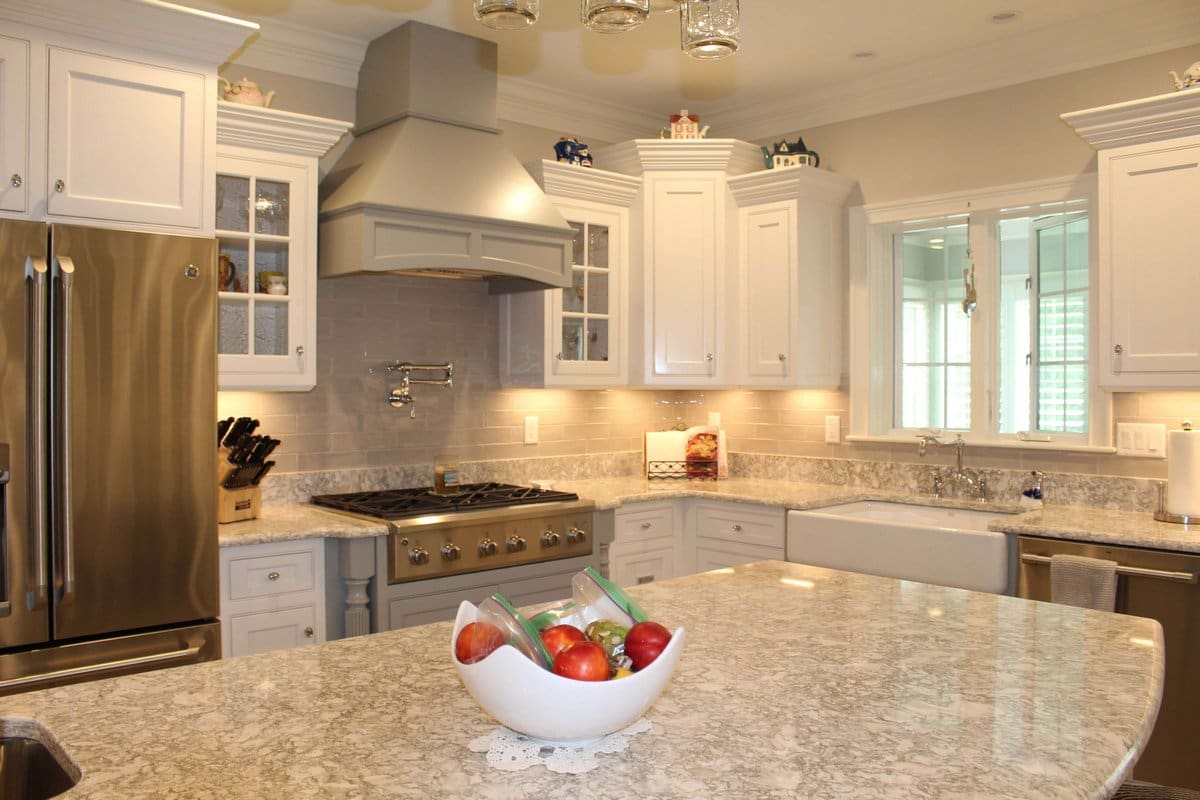
Quartz countertop. Source: The Stone Cobblers Counters and Cabinets (thestonecobblers.com)
2.1 Colors, Textures, and Imitations
When my husband and I decided to replace our old ceramic countertop, I started gathering references. Pinterest, showrooms, designer accounts on Instagram — everything looked amazing. I was especially inspired by kitchens with white marble-style countertops: light veining, natural patterns, and a slight depth of color. These surfaces visually make the kitchen look larger and brighter — especially when combined with white cabinets and warm lighting.
Turns out, you can achieve this effect with both quartz and laminate. And at first glance, it’s not so easy to tell them apart — especially in modern collections. With quartz countertops, the veining actually goes all the way through the material, not just printed on the surface. Because of this, the veins look natural, and the depth of texture feels real. This is especially noticeable in styles like Calacatta or Statuario, which create that “luxury marble” look.
But even plastic countertops, like Formica countertops, have come a long way. Formica, Wilsonart, and other brands now offer stone, wood, and concrete imitations that are in no way inferior to natural materials in appearance. Their layered construction and new texturing technologies create not only a realistic look but also a realistic feel. Many finishes are slightly rough, like polished stone, or velvety matte.
The difference becomes noticeable in the details: quartz feels cooler to the touch, heavier, and has a strong “stone” character. Laminate is warmer and slightly softer. For some, that’s a plus — especially if you often cook with kids or don’t like cold surfaces.
So if you’re looking for a light, stylish look and don’t want to spend tens of thousands of dollars, laminate might surprise you. But if your goal is to visually emphasize status, add a sense of solidity to your interior, and invest in durability, quartz will be a more suitable choice. It all depends on your lifestyle and what you prioritize most.
2.2 How the Surface Looks Over Time
Everything looks perfect in the catalog photos. But how does the material behave after a year, two, or five? This question became decisive for me, especially after a few stories from friends whose laminate swelled from something as simple as a water container or warped when they accidentally placed a hot pot on it without a trivet.
Quartz holds its shape and appearance very well: it doesn’t fade, is resistant to stains and moisture, and is easy to clean. A friend of mine has a white quartz countertop with subtle gray veining in her kitchen — after four years, it still looks almost like new. Even coffee and tea don’t leave marks, as long as you wipe them up right away.
Laminate is more sensitive. If the surface is regularly exposed to moisture, hot items, or cutting, it can develop swelling, chips, or wear marks. Edges and seams near the sink are especially vulnerable. But here, too, much depends on quality. Modern plastic countertops (formica countertops) are much more durable than older models. They’re better protected against moisture, less prone to scratches, and their decorative layer doesn’t wear down as quickly.
Here’s a Reddit comment I remembered: “I have a Formica under marble. 3 years of use — no marks. The main thing is not to put a hot pan on and not to cut without a cutting board.” That’s solid advice, really — and it applies to just about any surface.
3. Durability and Resistance to Damage
3.1 Resistance to Moisture, Scratches, and Heat
If you have kids at home, cook daily, or simply have a habit of placing hot pans straight onto the countertop (like I do), durability becomes critically important. I realized this the moment my old tile cracked under a hot baking dish. Since then, I’ve been very careful when choosing countertop materials.
Quartz countertops are rightfully considered some of the most durable. Water splashes near the sink don’t bother them, nor do accidental wine or sauce stains. They don’t get scratched by a fork, they don’t lose their shine from frequent wiping, and as long as you don’t place a pan straight off the burner onto them, there won’t be any issues. Another plus — there are no seams that could come apart over time.
Laminate countertops are more sensitive to stress. Water that gets into the seams can eventually cause swelling. A hot mug can leave a mark. And if you use a knife directly on the surface instead of a cutting board, it will likely leave a groove. Edges and areas near the cooktop and sink are especially vulnerable. But to be fair, not all laminate countertops are the same. Modern collections, especially from Formica, are much stronger than the old ones. They just require a bit more careful handling.
If you cook often and your kitchen is always bustling with activity, quartz will be more reliable. But if your kitchen is mostly for aesthetics and light breakfasts, and your budget is limited, laminate can be a good option — as long as you handle it with care.
3.2 Repairability
Here’s where surprises begin. Many people think that if laminate gets damaged, it’s easy to replace. And that’s partly true. You can remove and swap out a single panel, especially if you ordered modular blocks. But keep in mind: finding the exact same decor a few years later might not be easy — collections change quickly. And if the damage is in the middle rather than on the edge, replacement will be more difficult, especially if the countertop is glued down or has a decorative edge.
Quartz, on the other hand, is hard to damage. But if it does crack, you’ll need to call in a professional. It may require sanding, special adhesive, and sometimes even replacing the entire section. It’s more expensive and takes time. That said, such cases are rare — realistically, a quartz countertop will probably outlast you.
Based on my own experience and conversations with other homeowners, if your family has a habit of “working directly on the surface,” it’s better to invest in a more durable material. But if being careful is your strong suit, formica countertops can easily handle everyday use.
4. Maintenance and Hygiene
4.1 Daily Care: What’s Easy and What Takes Effort
I often get questions like, “Mary, what’s the best cleaner to use on quartz?” or “Laminate is easy to clean, but doesn’t water damage it over time?” Let’s take a look at how these materials actually perform in daily life.
Quartz countertops really are considered low-maintenance. I wipe mine down with a regular soft cloth and water — and most of the time, that’s all it takes. If something sticks, a bit of dish soap or a neutral cleaner removes it in seconds. One of my favorite options is Weiman Quartz Countertop Cleaner: it’s safe, doesn’t leave streaks, and gives a pleasant, subtle shine.

Source: amazon.com
Laminate countertops also behave well in daily use — as long as you follow a few simple rules. A damp sponge and a drop of cleaner, and it’s clean. The main thing is not to leave water sitting on the edges or let liquid seep into the seams. Laminate isn’t afraid of water itself, but of prolonged contact with moisture.
One household product I like is Hope’s Perfect Countertop Cleaner — it works well on laminate, doesn’t leave a film, and easily handles fingerprints, grease, and splashes. It has a neutral pH, and after using it, the surface stays clean and matte.
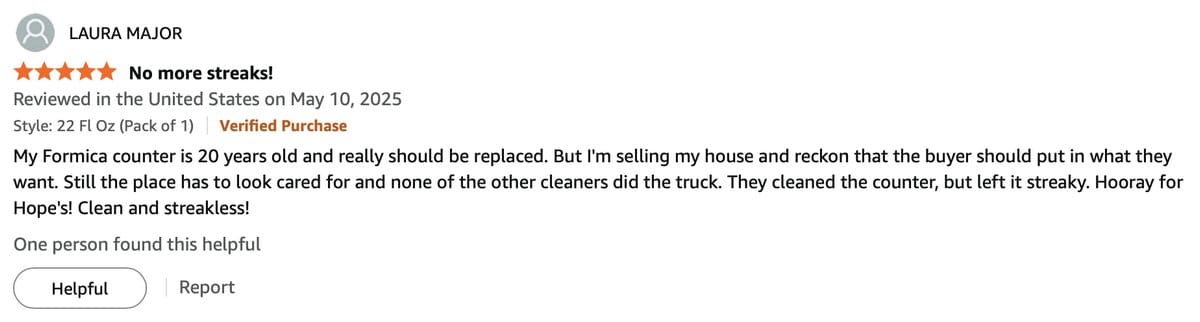
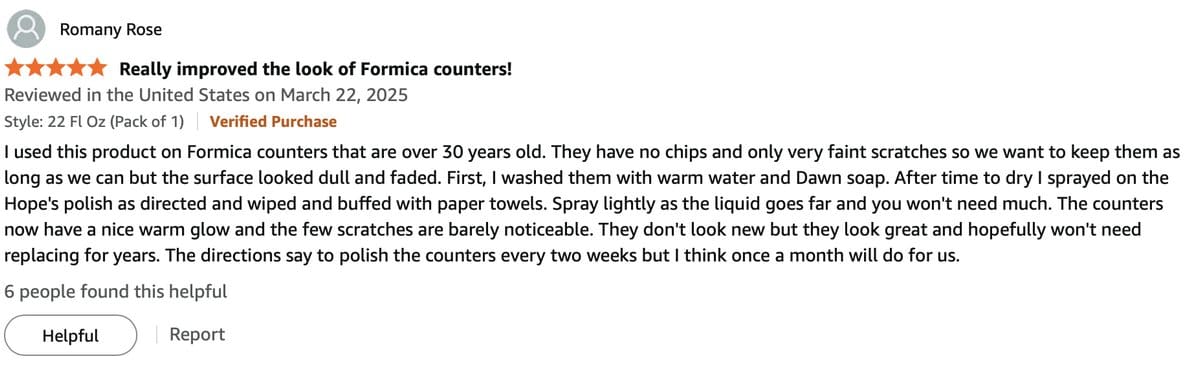
Source: amazon.com
Manufacturers generally give similar recommendations: don’t use abrasive powders, don’t scrub with steel wool, and avoid harsh household chemicals. It’s simple — just a bit of extra care, and your countertop will last for many years.
4.2 Hygiene and Stain Resistance
When we’re choosing a countertop, our inner designer always wakes up: imagining how everything will match, where the lighting will look best. But in reality… kids are molding clay right on the countertop, someone’s cutting meat without a board, or coffee gets spilled while rushing out the door. It’s in those moments that you truly see how hygienic and practical your choice is.
Quartz is unbeatable when it comes to protecting against stains and bacteria. Thanks to its non-porous structure, liquids don’t get absorbed, smells don’t linger, and microbes don’t have a chance to “settle in.” For disinfecting, you can use mild solutions: diluted vinegar, alcohol-based sprays, or — as I do myself — Method Daily Granite Cleaner. It works on both quartz and granite and smells great.
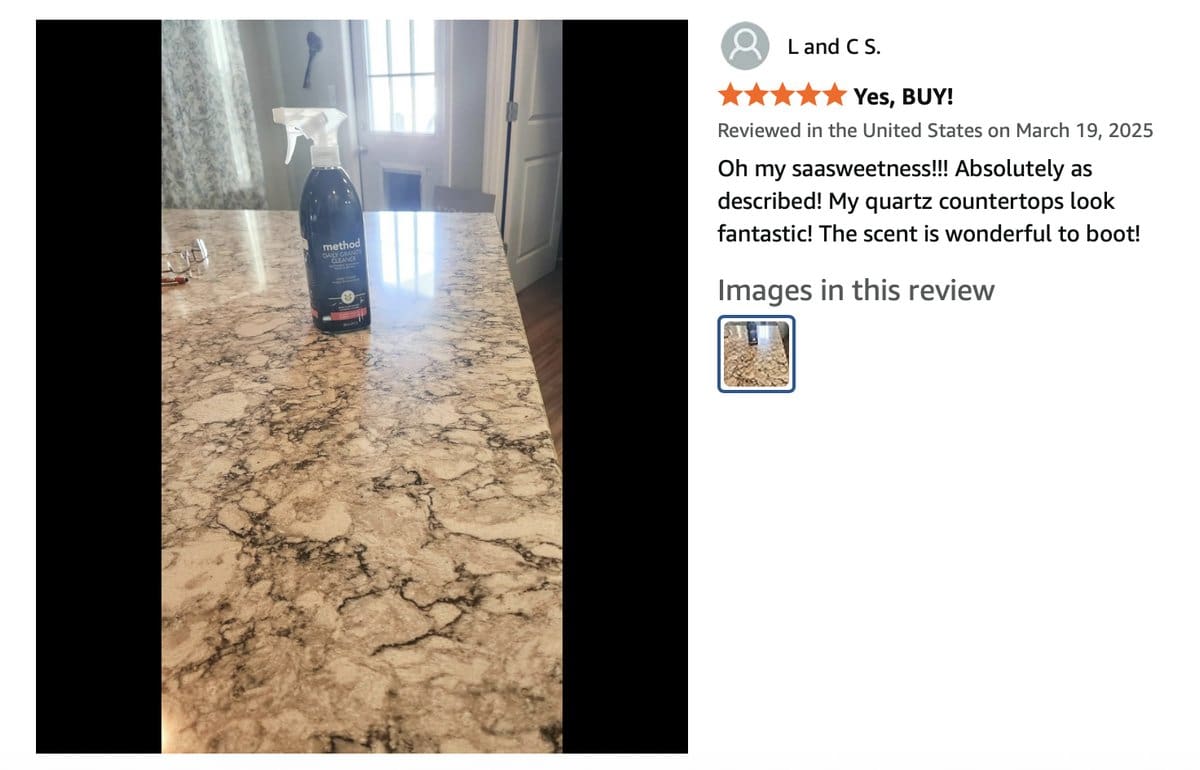
Source: amazon.com
Laminate also performs well under normal conditions. Modern finishes have basic stain protection, and as long as you don’t let spills sit for too long, everything cleans up easily. But it’s important to remember: in micro-cracks, chips, and seams, prolonged contact with moisture can lead to bacteria growth. This is especially true if the countertop is installed right up against the sink without a proper seal.
Many homeowners say laminate just needs a little more attention — but that’s really a matter of habit. One Reddit user wrote: “We have three kids and the laminate does a great job — we just wipe it all down at once. And even ketchup and soy sauce don't leave a mark.” I completely agree: as long as you clean as you go, it’s no problem.
5. Which Material Works Best for Your Situation?
5.1 When You're on a Budget
When we first started planning our kitchen remodel, I made a list of priorities that would shape our final decision. At the top: “I want a marble-look quartz countertop.” At the bottom: “our actual budget.” I’m sure that feeling is familiar — you want it to look amazing, but you also want to stay realistic.
If you’re on a tight budget, laminate countertops vs quartz almost always win on price. And the difference can be huge — especially when you factor in both material and installation. For example, in an average 12-foot kitchen, you could save between $1,500 and $3,000 by going with laminate instead of quartz.
That’s where formica countertops come into play: they do an excellent job mimicking natural materials while keeping installation fast and affordable. Especially if you need a temporary kitchen or are upgrading a rental unit.
Here’s a great tip from one of my followers: she ordered Formica in a white marble look and swapped out the hardware for brass — the kitchen looks like it cost three times more than it actually did.
5.2 For Families with Kids
When you’ve got kids at home, the countertop becomes a full-blown workstation. There’s dough to knead, crafts to cut, juice to spill, teddy bear tea parties to host. In these situations, it’s crucial that the surface holds up without causing panic for the parents.
Quartz is my go-to in this case. It doesn’t absorb anything, wipes clean easily, and doesn’t stain from markers or berries. Even if your kid makes a “soup” from whatever they can find — just wipe it down, and it’s like it never happened.
Laminate can handle it too, especially if you don’t overload it: no hot pots, wipe spills right away, don’t let water pool. The main thing is teaching your kids that the countertop isn’t for scissors and Play-Doh. Then again, my nephews managed to dent a glass tabletop — so let’s be honest, a lot depends on discipline, not just materials.
If you plan to cook actively with your kids, I’d still recommend quartz — just for peace of mind, so you’re not constantly wondering what could go wrong.
5.3 For the Kitchen, Bathroom, or Laundry Room
Each space in your home has different needs. A countertop that works great in the kitchen might not be right for the bathroom or laundry. It’s not just about how it looks — it’s about how it handles moisture, heat, cleaners, and overall use.
The kitchen is command central. Here’s my take: if you cook often — especially near the stove or on an island with a cooktop — go for quartz. It can take anything you throw at it. But if your kitchen use is more low-key — coffee, breakfast, getting kids ready for school — laminate should be fine. Just be gentle with it.
The bathroom is trickier. Lots of steam, humidity, temperature swings. If the countertop sits right by the sink — especially if kids are using it — I wouldn’t risk it. Quartz is the safer choice here; it holds up even with constant water exposure. Laminate can work too, but only if you seal the seams properly, stay neat, and avoid ongoing drips. A friend of mine installed Formica in her bathroom but added a tall backsplash and edge protection — two years in, it still looks great.
The laundry room is the wild card. Splashes of detergent, bleach, buckets… If you’re really using this area — hand washing, soaking clothes, dealing with strong cleaners — quartz is the smarter pick. It’s tougher and doesn’t mind chemicals. But if it’s just a folding shelf and a hamper zone — a well-installed laminate surface can totally do the job.
6. Cost Comparison: Quartz vs. Laminate
When we were planning our kitchen upgrade, I came across a huge range of countertop prices. The price gap was significant, and I needed to understand what exactly I’d be paying for.
Laminate countertops remain one of the most budget-friendly options. In 2025, the average installed cost ranges from $20 to $80* per square foot, including materials and labor. Basic materials go for about $10 to $50* per square foot, with installation running $10 to $30* per square foot.
Quartz countertops are significantly more expensive. In 2025, the average installed cost runs from $50 to $200* per square foot, depending on the quality, brand, and complexity of the job.
If you want to see accurate prices in your area, check out the Price Insights in the U.S. section — it compiles real contractor data from different cities across the country.
6.2 Installation and Hidden Costs
When it comes to installation, it’s not just the material cost that matters — you’ll need to account for extra expenses too.
Laminate is lighter and easier to install. Many contractors offer affordable installation packages, and in some cases, you can even install it yourself — especially if it’s a straight countertop with no tricky cutouts.
Quartz requires professional installation. It’s heavier and needs precise cutting, leveling, and sealing. Installation can cost $70 to $100* per square foot depending on the complexity of the project and your location.
7. Resale Value: Does It Matter to Homebuyers?
7.1 Does Quartz Increase Property Value?
“Will the countertop affect our home’s value if we ever decide to sell?” It’s a fair question — especially when your renovation budget runs into the thousands.
Quartz countertops are now seen as one of the most desirable, premium kitchen features. Real estate agents often note that homes with quartz surfaces sell faster — especially when the kitchen is done in light tones and neutral materials.
According to Zillow (one of the most popular real estate platforms in the U.S.), kitchen upgrades with stone countertops can add between $1,500 and $2,500 to the home’s total value, depending on location.
«Buyers are clearly willing to pay more for an upgraded kitchen, and that includes countertops. Quartz and soapstone countertops were each associated with a 2.5% premium, terrazzo brought in 2.65% more and butcher block 1.25% more.»
Quartz is seen as durable, hygienic, and move-in ready — which is a big deal for buyers who don’t want to start a remodel right away. So if you plan to sell in the next 3–5 years, quartz could give you a real edge.
7.2 What Do Buyers Really Notice — Style or Functionality?
But it’s not always just about the price tag. Sometimes the buyer is more focused on the overall condition and style of the kitchen. And in those cases, laminate — especially modern and well-installed — can work just as well.
For example, if you swapped out old tile for marble-look laminate, finished the edges nicely, and added a neutral backsplash — your kitchen will look fresh and well-kept. For buyers shopping in the $400–500K price range, that’s a big plus. The key is: no damage and no signs of wear on the surface.
Pro tip: if you’re preparing to sell and want to refresh the look of your kitchen or bathroom without a major investment, try this combo — quality stone-look laminate + clean installation + new hardware. It makes a great impression without draining your wallet.
Expert Conversation: The Stone Magazine — Mary Jones
The Stone Magazine (TSM):
Mary, what most often causes confusion when choosing between quartz and laminate?
Mary Jones (MJ):
People focus primarily on appearance. Modern laminate and quartz countertops can look almost identical, especially in marble- or stone-look designs. But internally, they’re completely different materials.
TSM:
What fundamentally sets quartz countertops apart?
MJ:
Quartz is a solid, non-porous material. Its pattern runs through the entire slab, not just on the surface. That affects both how it looks and how it behaves in everyday use.
TSM:
And what’s the key characteristic of laminate countertops?
MJ:
Laminate is lighter and easier to install. The decorative layer provides the design, while the core provides shape. That’s why laminate is more sensitive to moisture and heat, especially at seams and edges.
TSM:
Are Formica countertops often confused with other materials?
MJ:
Yes. Formica has become a generic term for laminate, even though it’s a specific brand. Modern collections look much better than older versions and often visually mimic stone.
TSM:
When does it make sense to consider an alternative to quartz?
MJ:
When the budget is limited or the project is temporary. Laminate allows you to achieve a clean, finished look without the high material and installation costs.
FAQ — Frequently Asked Questions
To be honest — quartz lasts longer. It resists water, stains, heat, and is less likely to show damage over time. Plastic countertops, like formica, can also last for years, but only if you treat them carefully: don’t let water soak into seams, don’t place hot items directly on the surface, and don’t cut without a board. Quartz is more of a “set it and forget it” material, while laminate requires a bit more attention.
Which is cheaper to install: laminate or quartz?
Formica and other types of laminate are by far the more budget-friendly option. Installing a basic laminate countertop can cost two to three times less than quartz. Plus, many laminate countertops come in pre-cut modules, making them ideal for DIY installation — especially in straight kitchens with minimal cuts.
Can you use laminate countertops in the bathroom?
Yes — but with caution. The most important thing is to properly seal the edges and seams against moisture and make sure there are no constant drips around the sink. Quartz is more reliable in these conditions: it won’t absorb water, swell, or react to steam and temperature swings. If you’re renovating a bathroom to last for years — I’d go with quartz.
What’s better for a kitchen with kids: quartz or laminate countertops?
If your kitchen sees constant spills, chopping, and messes — and your kids love helping you cook — quartz is easier and more forgiving. It’s more durable, doesn’t stain, and is simpler to clean. But if you’re ready to be careful and want to save some money — a good-quality laminate can do the job, especially if you pick a model with enhanced moisture and scratch resistance.
What adds more resale value: Laminate vs granite vs quartz cost?
When buyers see quartz or granite, they instantly register it as a more expensive, solid material. These surfaces add a sense of luxury and can affect your home’s market price. Laminate may not have the same wow factor, but it can still look very appealing if installed cleanly and paired with the right kitchen features. For a budget or rental property, it’s a smart choice. For a home you’re marketing as move-in ready and high quality — go with stone.
How-To: How to Choose Between Quartz and Laminate
Step 1. Determine How Intensively the Kitchen Is Used
A kitchen with frequent cooking puts more stress on the surface. In these conditions, quartz performs more reliably. With lighter use, laminate can be a practical option.
Step 2. Evaluate Exposure to Moisture and Heat
Constant contact with water and hot items affects laminate more. Quartz is less sensitive to these factors.
Step 3. Consider the Project Budget
Laminate countertops allow for significant savings on both material and installation. Quartz increases the overall project budget.
Step 4. Think About the Expected Lifespan
Quartz is usually chosen as a long-term solution. Laminate works well for temporary updates or budget-conscious renovations.
The Stone Magazine Editorial Tip
When choosing between quartz and laminate, most mistakes come not from the material itself, but from expectations. In photos, modern quartz and laminate surfaces can look nearly identical. In everyday use, the differences become noticeable fairly quickly.
Quartz is often perceived as a stable, low-maintenance material that doesn’t require constant attention. Laminate demands more care around seams, edges, and hot items, but with careful use, it can maintain its appearance.
Warranties and real customer reviews remain important reference points when choosing a contractor for installing quartz or laminate countertops. They help reveal how consistently a company delivers quality work.
One helpful benchmark is the CountertopsContractors ranking — an independent list of contractors across the U.S., based on installation quality, experience, and market reputation. This makes it easier to compare professionals and choose the right specialist for your project.
Conclusion
When I first started choosing between quartz vs laminate countertops, it all seemed simple: one is more expensive, the other more affordable. But the more I explored, the more I realized — each option comes with its own philosophy. It depends on how you live, how you use your kitchen, how much maintenance you’re okay with, how long you want it to last — and even how the surface feels under your hand.
If you care about durability, easy upkeep, and peace of mind, knowing your countertop won’t let you down at the worst possible moment — quartz is a great choice. It’s strong, hygienic, ages well, and feels like a smart investment in your home.
But if you want to renovate without overspending, and still get a countertop that looks great — modern laminate, especially in the form of formica countertops, can really surprise you. It’s far more wear-resistant than it used to be, comes in hundreds of designs, and creates a solid impression when installed right.
And if you’re at the stage of choosing professionals, check out The First National Ranking of Stone Countertop Fabricators and Installers in the U.S. — there you’ll find only reliable companies, evaluated across many criteria.
Choosing a countertop is not just about the material — it’s about your lifestyle too. And now that you know everything that matters, I’m sure you’ll choose exactly what’s right for you and your home!
Also read:
- “How to choose a stylish and durable countertop for your kitchen: Trendy Solutions for 2025”
- Granite vs. Quartz Countertops: Cost, Durability, and Style
- Best Cleaners for Quartz Countertops: What to Use and What to Avoid
- Price Insights in the U.S.
*Prices are valid as of May 2025, provided for informational purposes only, and may vary at the time of reading. Estimates are based on average data from Home Depot, Houzz, HomeAdvisor, and other relevant sources in the U.S.
All images are sourced from Unsplash photo stock or publicly available contractor portfolios. If you believe any image is privately owned and used without proper credit, please contact us at contact@countertopcontractors.com.
Some authors may write under a pseudonym and choose not to disclose their identities for personal reasons. We respect their privacy and simply provide a platform for professional, educational use. We are not responsible for name coincidences with real individuals. All contributors are vetted for expertise, but we advocate for freedom of expression.
Author: Mary Jones