

I Ask Every Client to Run Their Hand Across Both Finishes Before They Choose

A client stood in my stone yard three weeks ago and ran her palm across a honed slab. Then she asked if it needed to be sealed differently than the leathered one sitting two feet away. That single question tells me more about whether someone is ready to pick a finish than any conversation about color ever does.
The Difference Isn't the Look: It's What Happens the Night You Forget to Wipe Up Wine
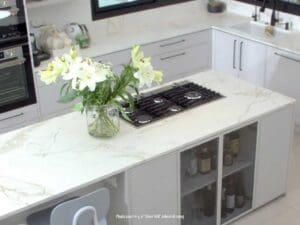
Honed granite comes from stopping the polishing process before the stone ever picks up a gloss. What's left is flat and matte, with light spreading evenly across the surface instead of bouncing off a shine. It feels almost velvety under a palm, which is exactly why it shows up so often in modern and transitional kitchens where someone wants the stone to read a little quieter. The tradeoff sits in the pores. A honed surface is slightly more open than a polished one, so a spill of wine or oil left sitting overnight is the surface's real weak point, not scratches or heat.
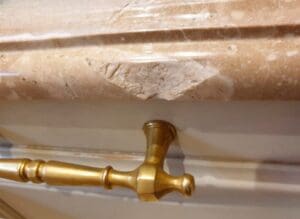
Leathered granite starts as that same honed or matte base, then goes through a second pass with diamond-tipped brushes that erode the softer minerals in the stone while leaving the harder crystals standing. What's left behind is a texture close to leather or heavy fabric, with a wavy, dimensional surface you can actually feel the mineral structure through. That same texture breaks up reflections well enough to hide fingerprints and water marks almost completely, which is part of why leathered finishes show up so often on darker granite, where the brushing pulls out depth in the veining that a flat polish would flatten right back down.
Stand both slabs side by side and the differences show up fast. A honed surface reflects light evenly across one flat matte plane. A leathered surface catches light unevenly across its tiny peaks and valleys, which reads as a rougher, more textured shine. Run a hand across each and a honed slab feels smooth and cool, while a leathered slab feels dimensional, almost like it has a grain running through it. Honed tends to soften the overall pattern on a busy stone with a lot of movement, while leathered pulls the mineral structure forward and deepens the contrast instead.
Granite is one of the hardest, most durable stones available for a kitchen, and that holds true regardless of which finish sits on top. Both finishes shrug off scratches from ordinary kitchen knives and utensils, and both handle the everyday heat of cooking without trouble, though neither one is meant to take a cast-iron pan straight off a burner. That kind of sudden temperature swing can crack any natural stone, honed or leathered, so a trivet stays cheap insurance either way. Heavy unglazed ceramic dragged across a matte surface can occasionally leave a faint mark, and structurally both finishes hold up the same over years of daily impact. They diverge most in how wear shows up over time. A honed countertop can develop a slightly uneven sheen in heavy-use zones near a sink or range after years of scrubbing in the same spot. A leathered surface's texture tends to absorb that same wear into its existing grain instead of showing it as a distinct patch.
The Real Decision Is Your Cleaning Habits
Maintenance is usually what actually decides this for a client, more than the photo they walked in with. A honed countertop needs a bit of vigilance. Light-colored honed granite that is unsealed or under-sealed can pick up an oil stain if a spill sits overnight, which means regular wipe-downs with a mild, pH-balanced stone cleaner, not just an occasional deep clean. Leathered granite is far more forgiving day to day. Its texture hides fingerprints and water spots in the grain so well that a lot of owners go days between a real cleaning and never notice. That same texture means the sealant has to reach fully into every crevice during application, or liquid finds its way into the valleys instead of sitting on top where it wipes off easily.
I ask two questions before anyone signs off on a finish. Do you want a countertop with real tactile personality, or a smooth plane that quietly disappears into the room? And how forgiving does your kitchen need to be on a night when nobody feels like wiping the counter down right away? A busy household cooking daily most often ends up choosing leathered. A calmer kitchen with someone who wipes up spills as they happen can go either way on looks alone.
No photo settles this the way five minutes in the yard does. I still ask every client to run a hand across both finishes and watch how the light catches whichever slab they're actually considering, because a phone screen flattens exactly the texture that makes leathered granite worth choosing in the first place.
We handle the full job in-house across Charleston, Mount Pleasant, Summerville, and Beaufort, from digital template measurements through fabrication and installation, whether the material ends up being granite, quartz, quartzite, or marble. Our granite materials page has current slabs in both finishes if you want to start narrowing things down before you come in, and the full comparison we published goes deeper into each finish if you want more detail first.