

Granite Countertops in 2026: What Homeowners Are Actually Choosing
Every year there is a new list of countertop colors that are supposedly taking over kitchens, but that is not really how I see homeowners choose stone. A slab can be popular online and still be completely wrong for the house in front of me.
I’m Iurii Pirogov, owner and CEO of Perfect Stones Countertops, and I have worked with natural stone for more than 12 years. In 2026, lighter kitchens are still very common around Charleston and the Lowcountry, especially white and soft neutral surfaces with gray, gold, or subtle blue movement. That does not mean everybody should buy a light granite. Some kitchens look much better with a dark island or a stronger natural pattern. I normally start with the room itself, and then we look at the stone.
The other thing I tell homeowners is that granite is only part of the conversation now. Someone may walk in asking for granite and end up comparing it with quartzite, marble, or quartz because they like a particular look more. Viola marble is one of the materials getting much more attention this year, while Taj Mahal quartzite, which was everywhere in our work in 2025, is showing up much less often now.
Light Stone Is Still Popular, but Contrast Is Coming Back
Light granite continues to work because it is easy to combine with many cabinet colors and does not dominate the room. Stones such as Viscone White and River White can make a kitchen feel brighter, especially when there is good natural light. They also work well with both white cabinetry and darker wood, so homeowners have more flexibility if other parts of the kitchen change later. I would not choose a light stone just because the kitchen is small, though. Room size is only one part of the decision. Flooring and cabinet color matter, and the amount of natural light can completely change how the slab looks once it is installed.
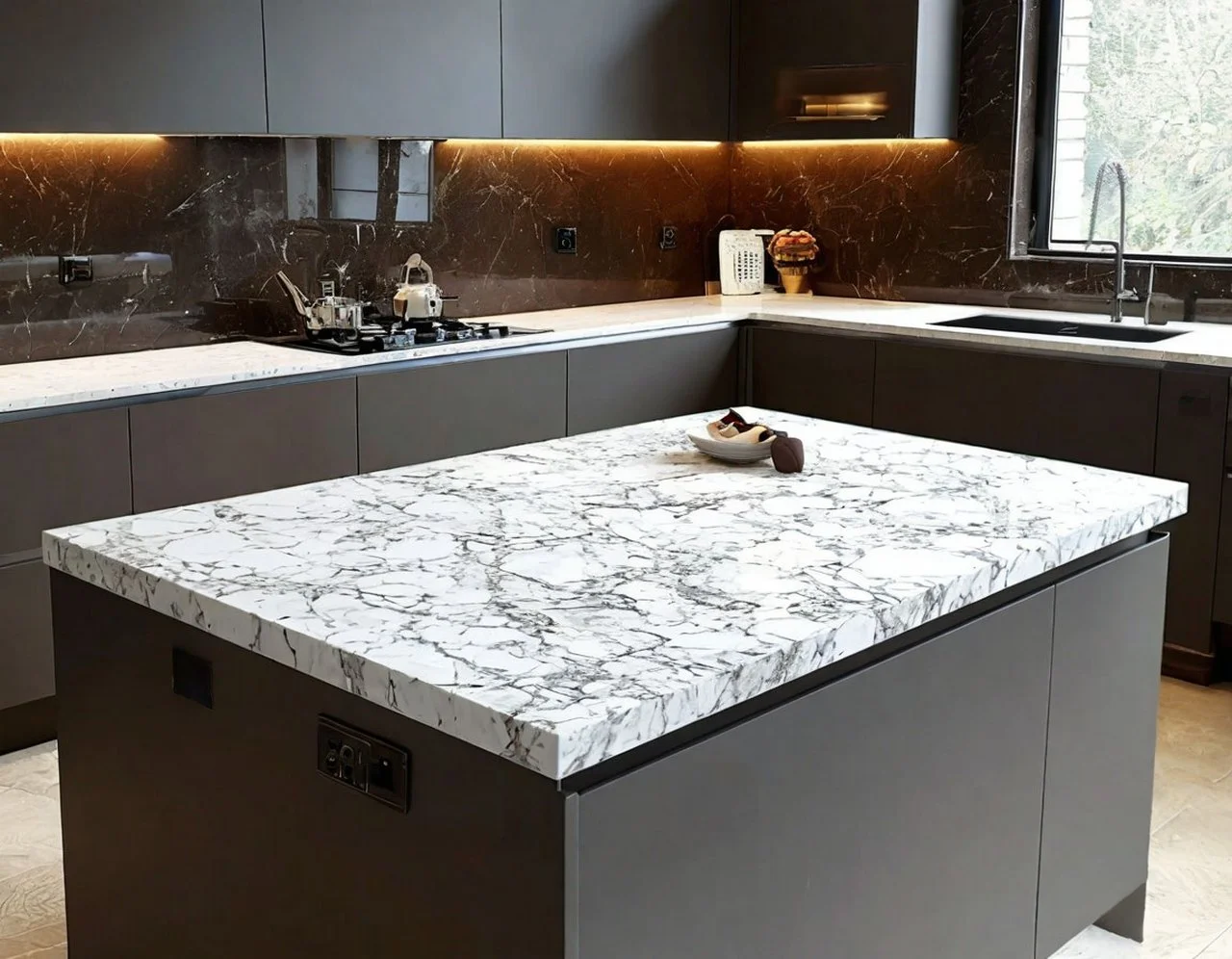
Dark granite can be just as successful when the room can carry the contrast. Absolute Black and Black Pearl Leather give a very different look from a light granite, while materials such as Black Titanium introduce much stronger gold and white movement. A darker island with lighter perimeter countertops can also work very well because the island becomes the visual anchor rather than making every surface in the room compete for attention.
Warm brown and earth-tone granite never disappeared either. Tan Brown and similar materials still make sense in homes with stained wood cabinetry or warmer finishes. I would not call them the main trend of 2026, but trends do not automatically make an existing design wrong. This is where I think people get into trouble when they shop only from inspiration photos. The goal is not to find the slab that appears most often on social media. The goal is to find one that works with the rest of the kitchen.
The Bigger Change Is Happening Outside Granite
One of the more interesting shifts we are seeing this year is how quickly homeowners move between material categories.
Viola marble has become much more visible in our projects in 2026. A few years ago, Calacatta was the marble name everybody seemed to know. Now customers come in asking about Viola because they have seen the dramatic white background with darker, sometimes almost purple movement. The look has become popular enough that quartz manufacturers are producing patterns inspired by it.
Taj Mahal quartzite has moved in the opposite direction in our recent work. It is still a beautiful stone, and people still ask for it, but I would say we are seeing it about one-quarter as often as we did last year. That does not mean the material suddenly became bad or outdated. It means homeowners are looking at a broader range of stone again instead of everybody asking for the same slab.
I prefer that, frankly. Natural stone is interesting because slabs are different. If every kitchen ends up with the same material because somebody declared it the stone of the year, you lose some of that individuality.
The practical differences still matter. Granite generally handles heat better than resin-based engineered quartz, although I still recommend using a trivet or hot pad under very hot cookware because concentrated temperature changes can create stress in natural stone. Marble needs more care because it can etch and scratch more easily. Quartz is easier for many homeowners to maintain day to day. The right choice depends on how much maintenance someone is comfortable with as much as it depends on color.
The Finish and Slab Size Can Change the Project More Than People Expect
Homeowners tend to focus first on the color of the stone, but the finish can change how that color reads. A polished granite reflects more light and usually makes the color and mineral movement look stronger. A honed or leathered finish is softer and less reflective. It can also make everyday fingerprints and water spots less noticeable, which some homeowners prefer in a kitchen that gets a lot of use. I always want people to look at the finish in the lighting that resembles their actual kitchen as closely as possible. A black polished slab under showroom lights can feel completely different from the same stone with a leathered finish in a room with softer daylight.
Slab size is another thing homeowners do not always think about until we start planning the layout. A regular slab typically gives us around 40 to 45 square feet, while a super jumbo slab may provide around 50 to 55 square feet. That does not mean a 45-square-foot kitchen automatically fits onto one regular slab because the pieces still have to be arranged around the shape of the kitchen, sink openings, and seam locations. That is why measuring and layout planning matter early. If the design needs slightly more material than one slab provides, the budget can change quickly because we may need to buy another full slab for a relatively small missing piece.
Sometimes remnants solve that problem. If a homeowner needs a smaller additional top for a laundry room, vanity, or backsplash, I always suggest checking what we already have before ordering more material. A matching remnant can save a meaningful amount of money.
Cost Depends on the Whole Layout, Not Just the Granite Name
For a typical granite kitchen of around 45 square feet, our 2026 pricing range is roughly $4,500 to $7,000 for material, fabrication, and installation. That is a useful benchmark, but it is not a universal price because the final number depends on the stone and what we have to fabricate. A full-height stone backsplash around 30 square feet can be about $1,400 when enough matching material remains from the countertop project. If we need another full slab specifically for that backsplash, the starting point can move to around $3,400.
Edge details can change the labor too. A standard flat edge still accounts for about 75% of our countertop work, and with 3 cm stone it already has enough thickness for most kitchens. A double bullnose requires more fabrication and can add roughly 25% to 30% to that portion of the job. A mitered edge can add around 50% to the fabrication involved because we are creating the appearance of a much thicker countertop from pieces cut and joined at 45 degrees. A two-sided waterfall can add around 30% to the overall project cost, depending on how efficiently the pieces fit onto the slab and whether more material has to be purchased.
This is why I do not think countertop shopping should start and end with “How much per square foot?” Two stones with the same square-foot price can produce very different final project costs once slab usage and fabrication are taken into account.
We had an outdoor kitchen for Kelly Chang that illustrates this well. The project covered about 47 square feet and included a long run, a sink, and a 16 1/4-inch angled transition. We templated the actual installed cabinets, planned two seam locations, and laid the pieces out digitally on one slab of White Ice Premium granite before cutting. Everything fit onto that one slab, but only because the shapes and seams were planned around the real geometry of the kitchen. From the homeowner’s perspective, the finished countertop looks straightforward. From my side, the important part was making sure that angle and the seam positions were resolved before fabrication. That is also why I prefer working directly through our fabrication shop rather than treating stone selection and fabrication as separate conversations. We take the preliminary information, create the final template, and cut and polish the material ourselves. If the slab has important movement, we can work through the layout before anything reaches the saw.
In my experience, some projects that go through an intermediary add roughly 20% to 40% over the underlying trade costs. That does not mean every contractor adds the same markup, but homeowners should understand who is actually fabricating their stone and how many layers sit between them and that shop.
Granite is still a very relevant countertop material in 2026, but I would not choose it because a particular color made a trend list. Look at the real slab and how it works with the room. Think about how much maintenance you want and how the pieces will fit into the material you are buying. Those decisions will matter much longer than whether the stone happened to be fashionable in the year it was installed.
Homeowners comparing granite, quartzite, marble, or quartz can see current materials and completed countertop projects at Perfect Stones Countertops.
Expert Conversation: The Stone Magazine and Iurii Pirogov
The Stone Magazine (TSM): Iurii, are white and light countertops still the main request you hear in 2026?
Iurii Pirogov (IP): Yes, lighter materials are still very common for us. White with gray or gold movement is easy to use in a lot of kitchens. But I would not tell everybody to buy white granite just because that is what we are seeing most often.
TSM: Do clients still ask specifically for granite, or do they usually compare several materials?
IP: They compare everything now. Someone might start by saying granite and then see a quartzite or marble they like more. People know more material names than they used to.
TSM: What has changed the most from last year?
IP: Viola marble is getting much more attention. Taj Mahal quartzite is still requested, but for us it is maybe around a quarter of what we were seeing last year. Last year it was everywhere.
TSM: Does that mean Taj Mahal is going out of style?
IP: I would not say that. It is still a good-looking stone. People are just looking at other things again. I never tell somebody not to use a stone because it is less trendy this year.
TSM: Is polished granite still the default finish?
IP: It is very common, but leathered and honed finishes can be great, especially with darker materials. They do not reflect everything the same way and can hide fingerprints or water spots better. It depends on the look the homeowner wants.
TSM: How important is slab size when somebody is budgeting?
IP: Very important. A normal slab might cover forty to forty-five square feet and a super jumbo around fifty to fifty-five, but you still have to fit the kitchen pieces onto it. Square footage alone does not guarantee one slab will work.
TSM: So a 45-square-foot kitchen might still require two slabs?
IP: Yes. Maybe the island is long, or the sink cutout changes the layout, or the veins need to run in a certain direction. You cannot just divide the kitchen square footage by the slab square footage and assume that is the answer.
TSM: Is that where remnants become useful?
IP: Absolutely. If you only need another small piece and I have the right remnant in the shop, I would rather use that than make you buy another complete slab.
TSM: About 75% of your work still uses a flat edge. Why is it so dominant?
IP: Because with 3 cm material it already looks good. You do not need to complicate the edge just to make the countertop feel finished. If somebody wants something more decorative or wants the countertop to look thicker, then we can talk about bullnose or a miter.
TSM: What is the biggest mistake homeowners make when choosing granite?
IP: Choosing from a small sample without thinking about the whole slab and the whole room. I want to see what the stone is doing across the slab and how it works with the cabinets and floor. A small sample cannot tell you all of that.