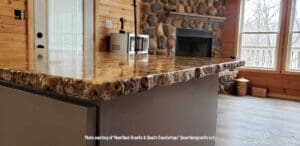


DIY countertops: Affordable Ways to Transform Any Kitchen
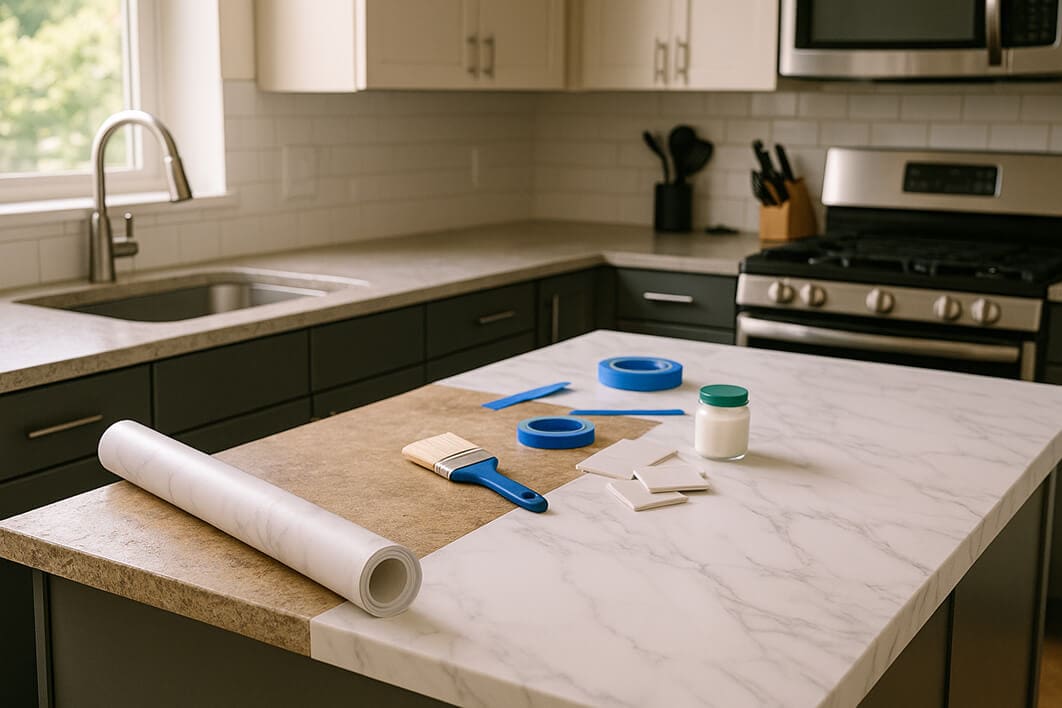
Introduction
The kitchen isn’t just a place for cooking. It’s the heart of the home — where the family gathers, laughter fills the space, and the aroma of favorite meals fills the air. But when your countertop is scratched, cracked, or simply outdated, everything around it starts to look dull and messy too… Which naturally raises the question: is it possible to update your kitchen without breaking the bank? Absolutely!
Even better — you can do it yourself, with your own hands, even if you have zero renovation experience. This article is packed with all the essentials: affordable ideas, real-life examples, tips on what to choose and what to avoid, so you don’t end up wasting your time and money. This isn’t just an inspirational list with those pretty pictures like on Pinterest — it’s an honest, in-depth guide for anyone looking to upgrade their kitchen beautifully, smartly, and on a budget.
Open your Notes app or grab a pen and paper — you’re about to discover some seriously cool ideas!
Why You Should Update Your Countertop Yourself
Refreshing your countertop is one of the quickest and most affordable ways to transform the look of your kitchen. Even if you don’t have a big budget or prior experience, a countertop DIY project can be just the thing that inspires you to take on even bigger home improvements.
What’s in it for you?
- Cost savings. Hiring a contractor to replace a countertop can cost anywhere from $1,500* to $3,000* or more. A DIY project, on the other hand, can cost just $30–300* — depending on the material and size.
- Control over the outcome. You get to decide what the final design looks like — from color to texture.
- Creative satisfaction. Doing something with your own hands means putting a piece of yourself into the result. And honestly, it’s something to be proud of!
What are your options?
From temporary upgrades using contact paper to full-on replacements with concrete or wood — there are tons of possibilities. The key is to pick a cheap way to redo countertops that matches your skills, expectations, and how your kitchen is used.
How do you decide?
Ask yourself three simple questions:
- How much are you willing to spend?
- Are you looking for a temporary update or a long-lasting solution?
- How confident do you feel in your skills (or how ready are you to learn as you go)?
If you have answers to these — you’re already halfway there. In the next sections, we’ll break down each material, its characteristics, installation difficulty, and real budget examples.
Comparison of Popular Materials
Before choosing a style or color, you should decide on the material. Not all surfaces are equally durable, and not every option is suitable for a humid kitchen or daily cooking. Below is a table that compares the most popular DIY countertop ideas based on key factors: cost, installation difficulty, appearance, and lifespan.
|
Material |
Approximate Cost* |
Installation Difficulty |
Appearance |
Wear Resistance |
Durability |
|
Laminate |
$80–120 |
Easy |
Versatile — looks like stone or wood |
Moderate: stain-resistant but vulnerable to moisture and scratches |
3–7 years |
|
Wood (butcher block, plywood) |
$150–300 |
Moderate |
Warm, natural look |
Moderate: needs regular oiling, prone to moisture and scratches |
5–10 years |
|
Concrete |
$200–400 |
Difficult |
Modern, industrial |
High: durable, heat- and water-resistant, can crack without reinforcement |
10–15 years |
|
Tile |
$60–150 |
Moderate |
Bold, decorative |
Moderate: tile is durable, but grout lines may darken and stain |
7–10 years |
|
Contact paper |
$15–40 |
Very easy |
Striking, temporary |
Low: scratches easily, not moisture- or heat-resistant |
6–18 months |
|
Epoxy resin |
$180–350 |
Difficult |
Glossy, deep color effects |
High: moisture-, stain-, scratch-, and heat-resistant |
10+ years |
|
Laminate flooring |
$100–200 |
Moderate |
Blends with interior styles |
Moderate: moisture resistance depends on quality, wears over time |
3–5 years |
How to Choose?
- If you’re on a tight budget, check out cheap countertops DIY like contact paper or tile.
- Want something durable and tough? Look into concrete or epoxy resin.
- Looking for a balance between looks and price? Wood and laminate are your best bets.
Tip: Always try a test area first — especially if you're using a new material. This helps you avoid disappointment and common mistakes.
Best DIY Countertop Ideas
In this section, we’ll explore 7 of the most popular options that work for any kitchen style and budget. Each one is more than just a homemade countertop — it’s a real opportunity to refresh your space with your own hands and enjoy the process.
Laminate — A Classic Budget Makeover
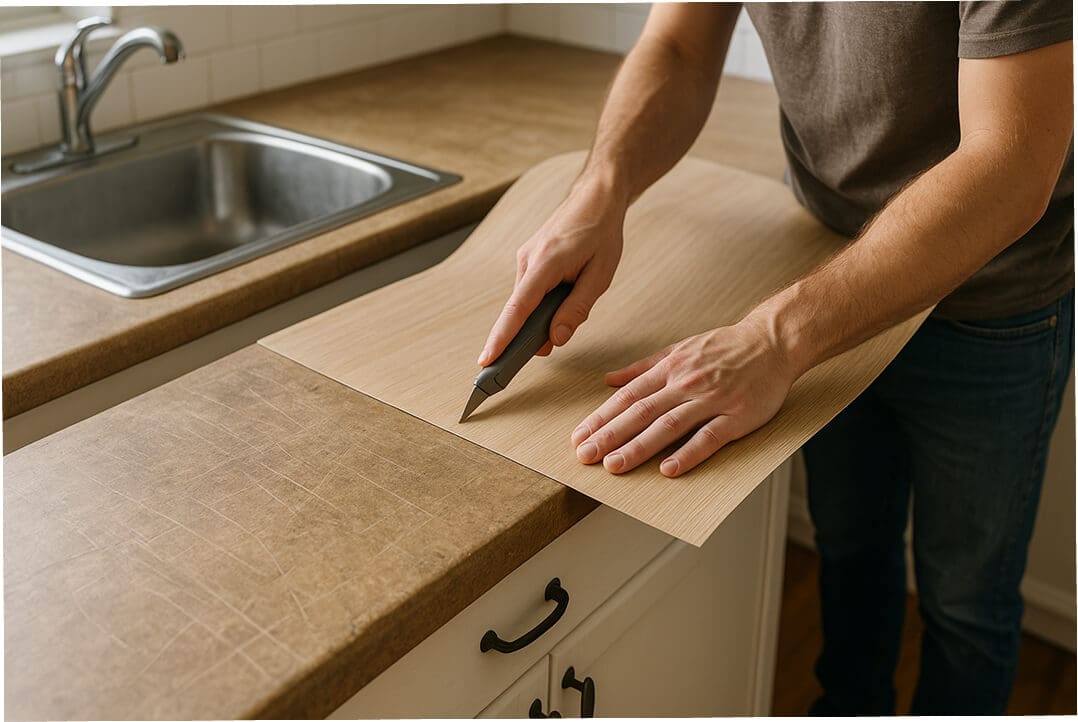
Laminate countertops are made from particleboard or MDF, topped with a durable high-pressure decorative layer (HPL). This isn’t peel-and-stick paper or a temporary fix — it’s a full-fledged countertop you can buy pre-made or assemble yourself. In the U.S., these remain popular as cheap countertops DIY, especially for budget kitchens, cottages, and workshops.
Pros:
- Affordable: most models range from $80–150 — one of the cheapest ways to replace a countertop;
- DIY-friendly: lightweight, easy to cut, ideal for self-installation even without prior experience;
- Design variety: comes in finishes like marble, wood, granite, concrete, and more;
- Can be installed over an existing base: no need to remove the old countertop if it’s flat and solid.
Cons:
- Vulnerable to water at the edges;
- May bubble or peel if not cared for properly.
"I replaced my old countertop with laminate for only $90. The installation took one day and the result exceeded expectations. The key is to prepare the surface thoroughly and use a quality adhesive." – @AndyGillyyy (Reddit)
Wood — Warmth and Natural Texture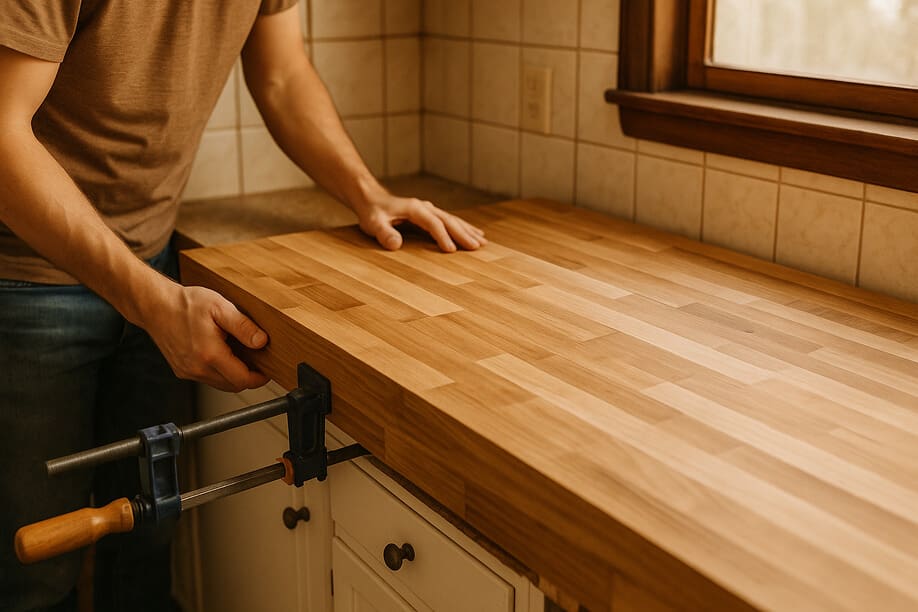
If you want to add warmth and texture to your kitchen, consider a DIY kitchen countertop made from wood. Options include solid wood, laminated timber, plywood, or pre-made butcher block panels.
Pros:
- Natural beauty and warmth of real wood;
- Easy to sand or repaint;
- Eco-friendly.
Cons:
- Requires regular maintenance (oil, wax);
- Sensitive to moisture and hot pans.
A friend of mine has had a wood countertop in their office kitchen for five years — and it still looks nearly new. The secret? They treat the surface every 2–3 months with linseed or mineral oil. It forms a protective barrier that prevents moisture, grease, and stains from penetrating and helps avoid cracking or darkening over time. Even with heavy use, it hasn’t warped, bubbled, or stained.
Concrete — Strength and Industrial Style
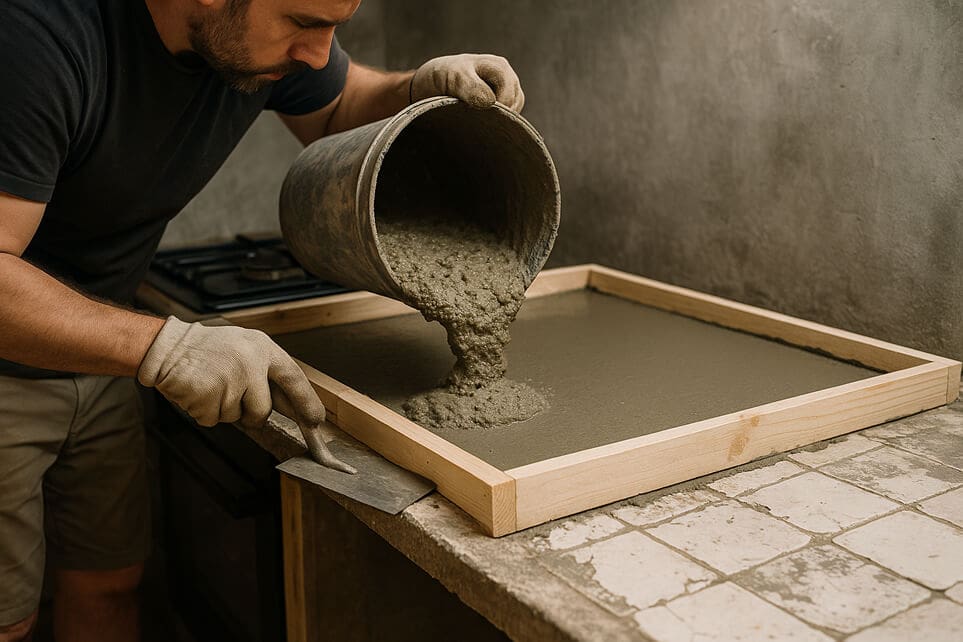
If you're into the raw, loft-style aesthetic, concrete is a great fit. It’s not just a cheap way to redo countertops, but also a chance to create an almost indestructible surface.
Pros:
- Extremely durable and heat-resistant;
- Fully customizable (color pigments, embedded elements, marble effects);
- Impervious to water and grease.
Cons:
- Heavy and labor-intensive to install;
- Requires precision during mixing and pouring.
Tile — Creativity and Flexibility
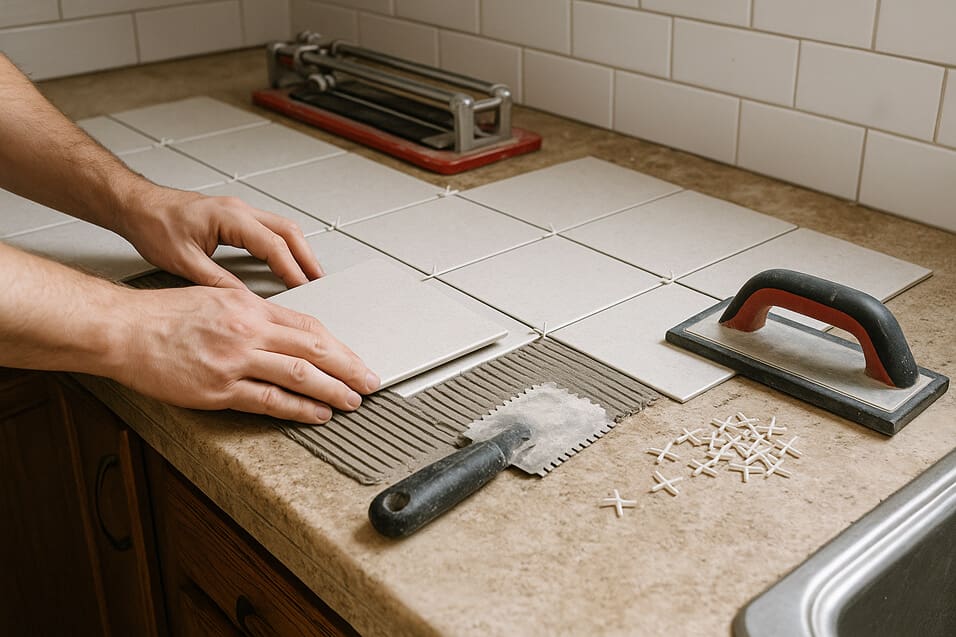
Love that cozy, handmade vibe in your kitchen? Then tile is for you. It’s one of the easiest yet most expressive DIY countertop ideas out there.
Pros:
- Affordable with endless design options;
- You can mix and match colors and shapes;
- Looks great in vintage and farmhouse-style kitchens.
Cons:
- Requires an even surface and precise grouting;
- Grout lines can easily get dirty.
Tip: Use waterproof grout with anti-mold additives — it will help the countertop last longer.
"Decided to tile the old countertop - the old surface was all stained and cracked and I didn't want to replace it completely. I found some ceramic remnants on sale for $1.50 a piece and bought moisture-resistant adhesive and grout.
It took three days: first - preparation and priming, second - laying, third - grouting the joints. The hardest thing was to level the base, because the old surface “walked” in the corners. But with plywood and a level, everything worked out.
The result? I really didn't expect the tile to look so great. It added texture and visual volume. The only downside is that the grout started to darken near the sink after a couple months, so I had to reapply the sealer. But still happy with it, especially for $95. It's a great option if you're not afraid to work with your hands." – @TommyBaham96 (Reddit)
Contact Paper — Fast and Cheap
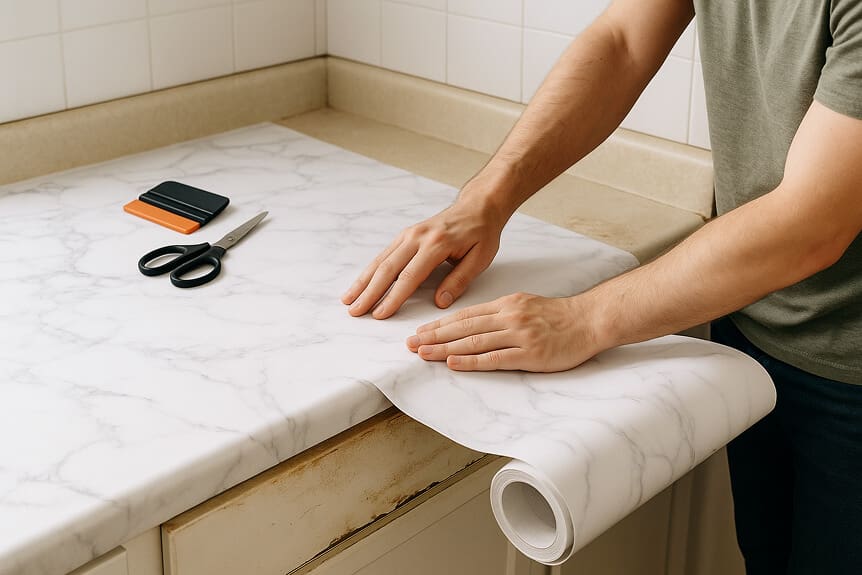
Looking for cheap kitchen countertops DIY that can be done in a single day? Contact paper is the perfect solution.
Pros:
- Costs just $10–30*;
- Mimics marble, concrete, or wood;
- Easy to replace anytime.
Cons:
- Low durability;
- Sensitive to moisture and heat. You’ll need to wipe spills immediately and use trivets for hot items.
Epoxy Resin — Not Just for Shine, but for Long-Lasting Durability
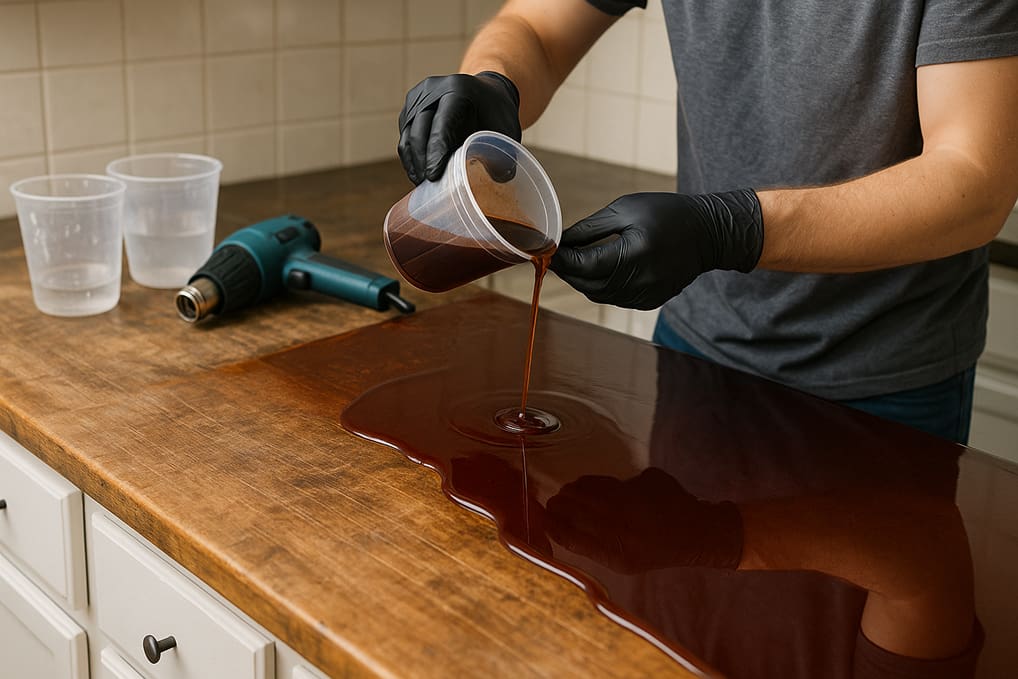
Epoxy resin isn’t a standalone countertop material — it’s a strong, decorative topcoat applied over a base: plywood, MDF, concrete, or even an old countertop. It creates a glossy, richly colored surface with marble, stone, or metallic effects — and can totally transform your space.
It’s not a cheap DIY countertop idea and definitely not for beginners. But the results can be stunning.
Pros:
- Produces a smooth, shiny, water-resistant surface;
- Allows for unique designs: veining, depth effects, embedded details;
- Resists moisture, heat, and stains (if poured and cured correctly);
- Great for kitchens, bathrooms, and bar tops.
Cons:
- Requires skill and precision: correct proportions and technique are crucial;
- Mistakes (dust, bubbles, unevenness, drips) are hard to fix;
- Labor-intensive: can take up to 72 hours from prep to full cure;
- You’ll need gear: gloves, scale, mixer, heat gun, tarp, and forming strips.
Use an Unconventional Option — Laminate Flooring
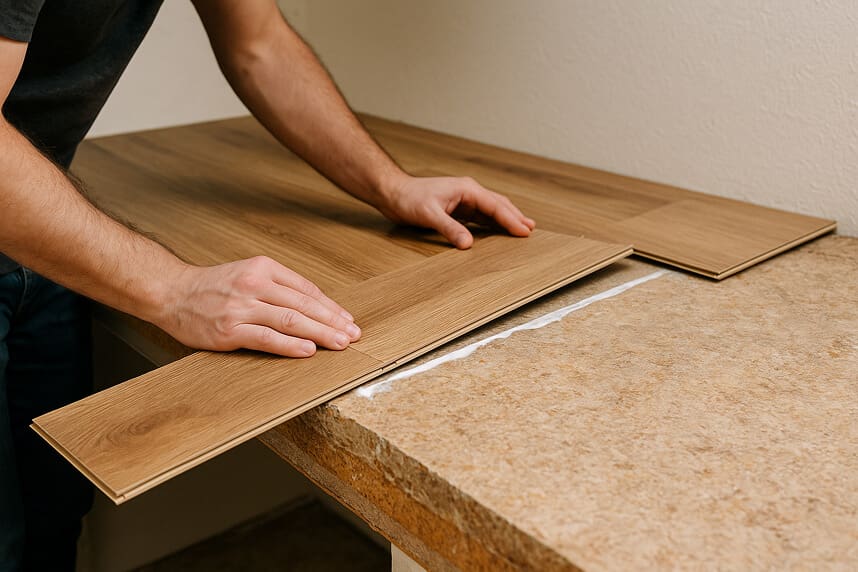
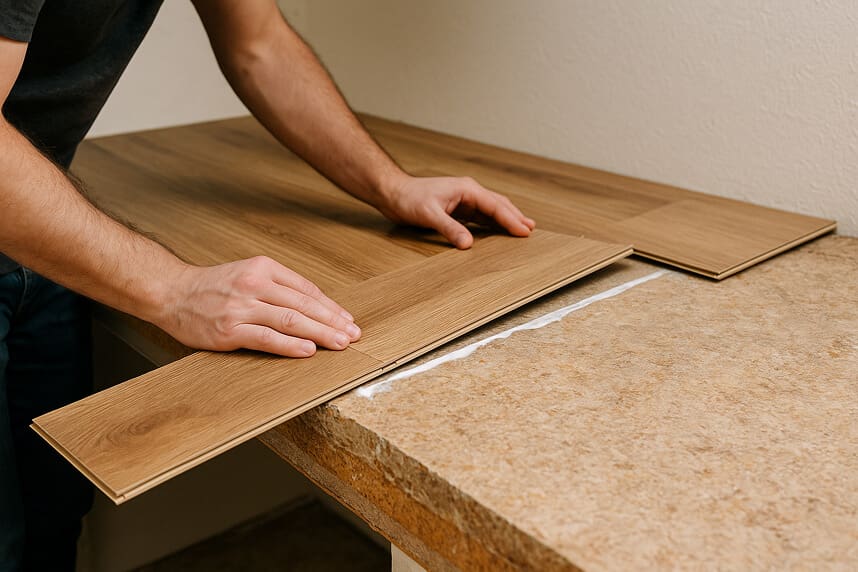
One of the most popular DIY hacks: using laminate flooring planks as a countertop surface. This type of homemade countertop works especially well for workshops or vacation homes.
Pros:
- Easy to find and budget-friendly;
- Straightforward installation;
- Matches easily with existing interior colors.
Cons:
- Less resistant to moisture;
- Requires additional edge sealing and finishing.
“I built a countertop using leftover laminate flooring. Got it on clearance at Home Depot for $1.19 per square foot — the whole thing cost me about $85. Honestly, it looks amazing, like a high-end wood panel. As long as you glue everything down properly and seal the edges, moisture won’t be an issue. For a temporary setup or a workshop, it’s absolutely perfect!” – @BuggyWoo (Reddit)
As you can see, there’s no shortage of affordable DIY countertops — from quick and temporary to durable and impressive. The key is to choose not just based on pictures, but based on your skills, goals, and living conditions.
But even the best idea can go wrong if you fall into one of the common pitfalls. Before you pick your materials and start planning, let’s go over what typically goes sideways — and how to avoid it.
Common Mistakes and How to Avoid Them
Even the most detailed plan can fall apart if you overlook key details. In this section, we’ll go over the most common mistakes people make during a DIY kitchen countertop makeover, and give you clear tips on how to avoid them.
Mistake #1: Uneven or Weak Base
Many people try to install a new surface directly on top of an old countertop or uneven plywood without checking the level. The result? Chips, cracks, and wobbly appliances.
What to do:
Use a construction level across the entire surface. If it’s uneven, add a leveling layer (Medium Density Fiberboard, plywood, or self-leveling compound).
Mistake #2: Ignoring Edges and Seams
Especially common with contact paper, tile, or laminate. Moisture often seeps in through the edges, causing bubbles, peeling, or even mold.
What to do:
- Always seal the edges and seams with silicone or construction sealant;
- Cover corners with PVC trim or aluminum strips for extra protection.
Mistake #3: Using the Wrong Adhesive or Too Little of It
Reddit users often complain: “It peeled off after a month” or “the glue bled through the tile.”
What to do:
- Don’t use wallpaper paste or regular white glue — they can’t handle moisture;
- Match your adhesive to the material: tile = tile adhesive, wood = carpenter’s glue, laminate = construction adhesive.
“I used regular white glue to stick down the tile — big mistake. After a month, it started to shift and come loose. I had to redo the whole thing with proper tile adhesive and mesh backing. Lesson learned — never cutting corners again.” – @MaybleMableFree (Reddit)
Mistake #4: Improper Wood Protection
Some people think a simple coat of varnish or paint is enough. In reality, wood absorbs moisture, grease, and stains easily.
What to do:
- Use mineral or tung oil for kitchen surfaces;
- Reapply every 2–3 months for best protection.
Mistake #5: Too Complicated, Totally Confused?
Many DIY projects are abandoned halfway through — not enough time, tools, knowledge, or patience.
What to do:
- Start simple: tile, laminate, contact paper;
- Break the project into stages — spread it out over a few evenings or weekends;
- If in doubt, don’t hesitate to call a pro.
If you're looking for a reliable professional, be sure to check out The First National Ranking of Stone Countertop Fabricators and Installers in the U.S. — it features only vetted companies from across the country.
Ready for the next step? Let’s find out where to get countertop materials at good prices — and how to avoid overpaying for something you might score for next to nothing.
Where to Find Cheap Materials
Quality materials for a countertop remodel don’t have to be expensive. If you know where to look, you can save dozens — even hundreds — of dollars, especially if you’re tackling the project yourself and don’t mind doing a bit of digging.
Here are tried-and-true sources frequently mentioned on Reddit and in DIY communities:
Clearance Sections at Home Improvement Stores
Big-box retailers often run clearance sales on leftover inventory. Reddit users frequently report finding tile, laminate, and countertop panels for under $1 per square foot in the “Clearance” section at the back of the store.
Tip: Don’t hesitate to ask employees — they often know about unmarked discounts or slow-selling batches.
ReStore by Habitat for Humanity
These nonprofit stores sell surplus building materials, furniture, and decor donated by companies or individuals. You can find laminate, wood, epoxy resin, and even gently used countertops from dismantled kitchens — all in good condition and at symbolic prices.
One Reddit user shared that they bought a full section of butcher block for $30 — “just sanded and oiled it, and it looks like new.”
Online Platforms: Craigslist, Facebook Marketplace
Don’t overlook the secondhand market. People often give away leftovers from their renovation projects for next to nothing — like contact paper, plywood, laminate, adhesive, or tile that didn’t make the final cut.
Search with phrases like “leftover tile,” “countertop laminate,” or “wood slab” to quickly find local listings.
Auctions and Warehouse Closeouts
In some states, there are auctions for surplus construction materials or bulk warehouse sales — especially during seasonal inventory turnover. These are great for scoring DIY countertop refinishing kits at cost or less.
This is especially helpful for projects involving concrete or epoxy, where tools like mixing containers, spatulas, and forms are just as important as the materials.
How to Avoid Overpaying
- Compare prices by ZIP code on store websites — pricing can vary significantly by region;
- Look for coupons and promo codes (Reddit threads like “Home Depot Hacks” and “Lowes Deals” are goldmines);
- Visit forums and DIY Facebook groups — members often share “hot finds” and deals.
Which Material Should You Choose
With so many ideas and materials out there, it’s easy to feel overwhelmed. Especially when Pinterest is packed with “perfect” photos, and in real life — your kitchen is small, the kids are running around, the dog is barking, and you’ve got maybe a couple of free hours each week. That’s why, before jumping into making countertops, you should ask yourself a few simple but important questions.
What’s your budget for updating the kitchen countertop?
- Up to $50: Contact paper, clearance tile, laminate panels from Facebook Marketplace.
- $50–150: Plywood, laminate, discounted butcher block.
- $150–300+: Concrete, epoxy resin, custom wood pieces.
If your budget is tight, focus on cheap DIY countertop ideas and choose materials that don’t require expensive tools.
How much time do you have?
- A couple of hours: Contact paper, trimming laminate, cosmetic touch-ups.
- One weekend: Laying tile, installing ready-made butcher block, working with plywood or laminate.
- Several days: Concrete or epoxy countertops, full demo and reinstall.
Keep in mind that some materials (like concrete or resin) need drying time — not just installation.
What’s your kitchen style?
- Modern: Concrete, epoxy, plain laminate.
- Classic: Wood, stone-look tile, light butcher block.
- Farmhouse/Scandinavian: Solid wood, rustic tile, exposed-edge plywood.
- Temporary/rental: Contact paper, removable panels, budget laminate.
If you’re leaning toward a more advanced project — but not totally confident yet — don’t hesitate to ask for advice. Reddit threads, YouTube tutorials, and Facebook DIY groups are great places to learn. And if you decide a pro would be better — don’t forget about The First National Ranking of Stone Countertop Fabricators and Installers in the U.S.There you’ll find contractors you can trust for even the most complex job.
FAQ – Frequently Asked Questions
What’s the cheapest way to redo a countertop?
If you’re on a super tight budget, your best bet is contact paper or leftover laminate. Marble-, wood-, or concrete-look contact film starts at just $10*, and even a beginner can install it in one evening. Just avoid using it near water or high heat. You can also find laminate in clearance sections or secondhand — install it over an existing surface and seal the edges.
What materials work best for cheap DIY kitchen countertops?
Top materials in this category include: laminate, tile, plywood, and contact paper. They’re affordable, easy to install, and can deliver a visually appealing finish. Many DIY projects begin with these — especially in rental properties or when remodeling on a strict budget.
How much does it cost to build a kitchen countertop yourself?
It depends on the material and square footage. On average*:
- Contact paper — $10–30
- Tile — $60–120
- Laminate — $80–150
- Wood — $150–300
- Concrete/epoxy — $200–400
It’s easy to keep costs in check, especially if you shop sales or use leftovers.
What DIY countertop ideas are best for beginners?
Look for projects with minimal cutting and no complicated sealing:
- Applying contact paper;
- Installing a ready-made laminate or wood panel;
- Tile using pre-set mesh sheets (like mosaic).
Whatever you do — don’t start with concrete or epoxy unless you’ve prepared properly: they require precision and experience.
Conclusion
We started with a question: is it possible to transform a kitchen without a full remodel or a big investment? And now you have all the proof that yes — it absolutely is. DIY countertops aren’t just a trendy idea or pretty Pinterest inspiration. They’re a real, practical way to refresh your space without blowing your budget.
You’ve learned which materials are best for different goals — from temporary fixes to long-term solutions, from quick jobs to ambitious projects. You’ve seen real-life examples, expert tips, and even a list of common mistakes you now know how to avoid. Most importantly, you’ve learned how to choose based not just on aesthetics, but on your own goals, skill level, and household needs.
And remember: in a project like this, perfection isn’t the goal. What matters is being happy with the result and proud of the time and effort you've invested. And if at some point you decide that it's easier to trust the professionals, choose only trusted contractors.
May your kitchen become the kind of place you love coming back to — not because of how much you spent, but because of the heart you put into it.
* The price is valid as of May, 2025, published for informational purposes and may differ on the day the article is read. Prices are based on average data from Home Depot, Houzz, HomeAdvisor, and other relevant sources in the U.S.
All images are sourced from Unsplash and Pinterest photo stock or publicly available contractor portfolios. If you believe any image is privately owned and used without proper credit, please contact us at contact@countertopcontractors.com.
Some authors may write under a pseudonym and choose not to disclose their identities for personal reasons. We respect their privacy and simply provide a platform for professional, educational use. We are not responsible for name coincidences with real individuals. All contributors are vetted for expertise, but we advocate for freedom of expression.