Introduction
What should you choose for your future countertop: soapstone or quartz? I’ve got an answer for you, because this is one of the most common dilemmas my clients face during consultations. I often hear other questions as well: Isn’t soapstone too high-maintenance for daily use? Quartz is beautiful, but does it really look too artificial? What’s better for a family with kids—something low-maintenance or a natural stone?
Choosing a countertop isn’t just about color and texture. It’s about your lifestyle, routine, aesthetics, and how you want to feel in your kitchen every day.
Here you’ll find real reviews, as well as practical tips on what to look for when choosing the right material for your future countertop.
I’ll share real-life examples, feedback from actual homeowners, and explain what to pay attention to so you can choose the option that truly fits you.
What You Should Know If This Is New to You
When choosing a kitchen countertop, materials are often confused based on appearance alone. Terms like “natural stone” and “engineered stone” sound vague, but they represent fundamentally different properties and usage scenarios.
Soapstone is a fully natural stone composed primarily of talc, with magnesite and chlorite inclusions. The surface is matte, soft to the touch, and comes in muted tones ranging from light gray to nearly black. Over time, soapstone darkens and changes in appearance.
Quartz is an engineered material made from crushed quartz, resins, and pigments. The surface is non-porous, uniform, and color-stable. Quartz is available in a wide range of shades and textures, including designs that closely mimic natural stone.
1. What Are Soapstone and Quartz?
When choosing a countertop, it’s important to understand the material you’re working with. Its composition, origin, and structure influence everything else—from how it looks to how easy it is to care for. That’s why understanding the key differences between soapstone and quartz is the first step toward making the right choice.
Soapstone is a 100% natural mineral, primarily made up of talc with traces of magnesite and chlorite. It has a soft, matte texture, muted earth tones (ranging from light gray to nearly black), and gentle natural veining. People often choose soapstone for its authenticity, warm feel, and the way it ages gracefully—darkening over time and acquiring a rich, noble patina.
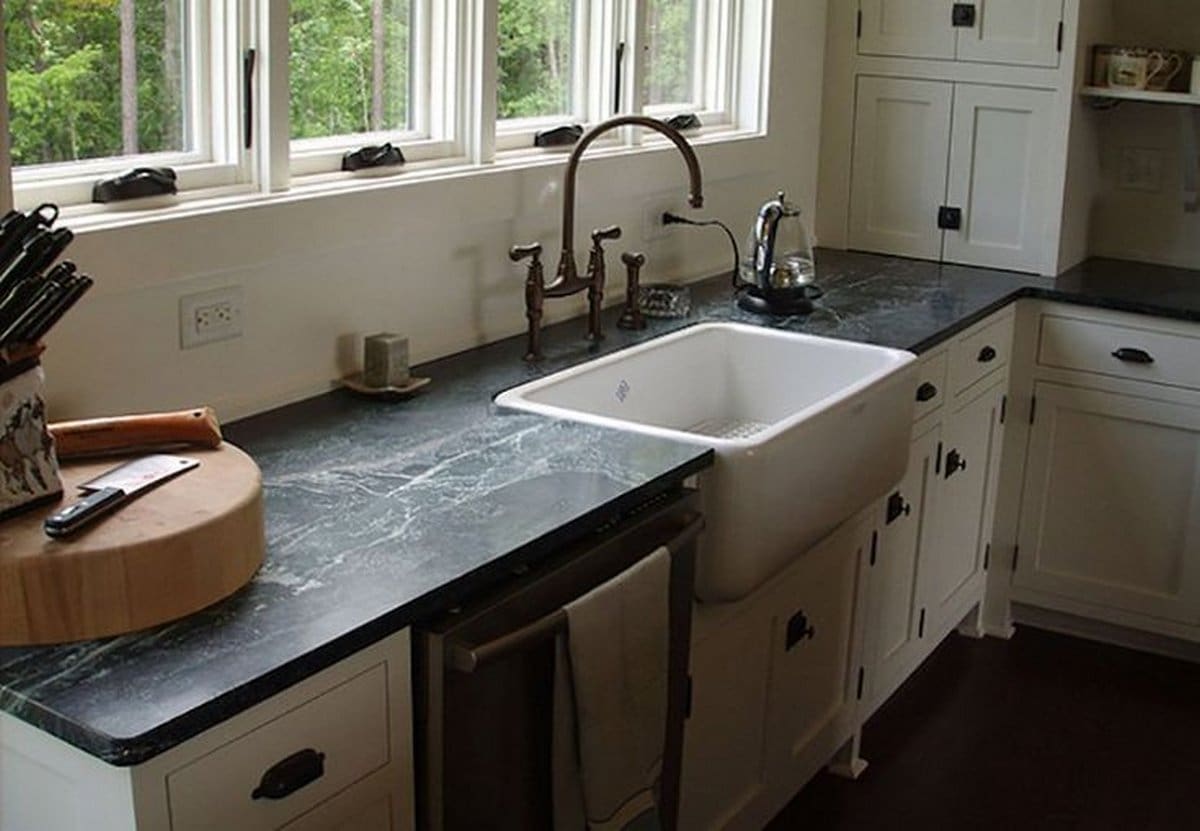
Soapstone kitchen countertop. Source: @cabinetkings (Pinterest)
Quartz, on the other hand, is an engineered stone—made by compressing natural quartz particles with polymer resins and pigments. This process makes quartz exceptionally durable, non-porous, and available in a wide range of colors and textures—from realistic marble-like designs to sleek, ultra-modern minimalist tones.
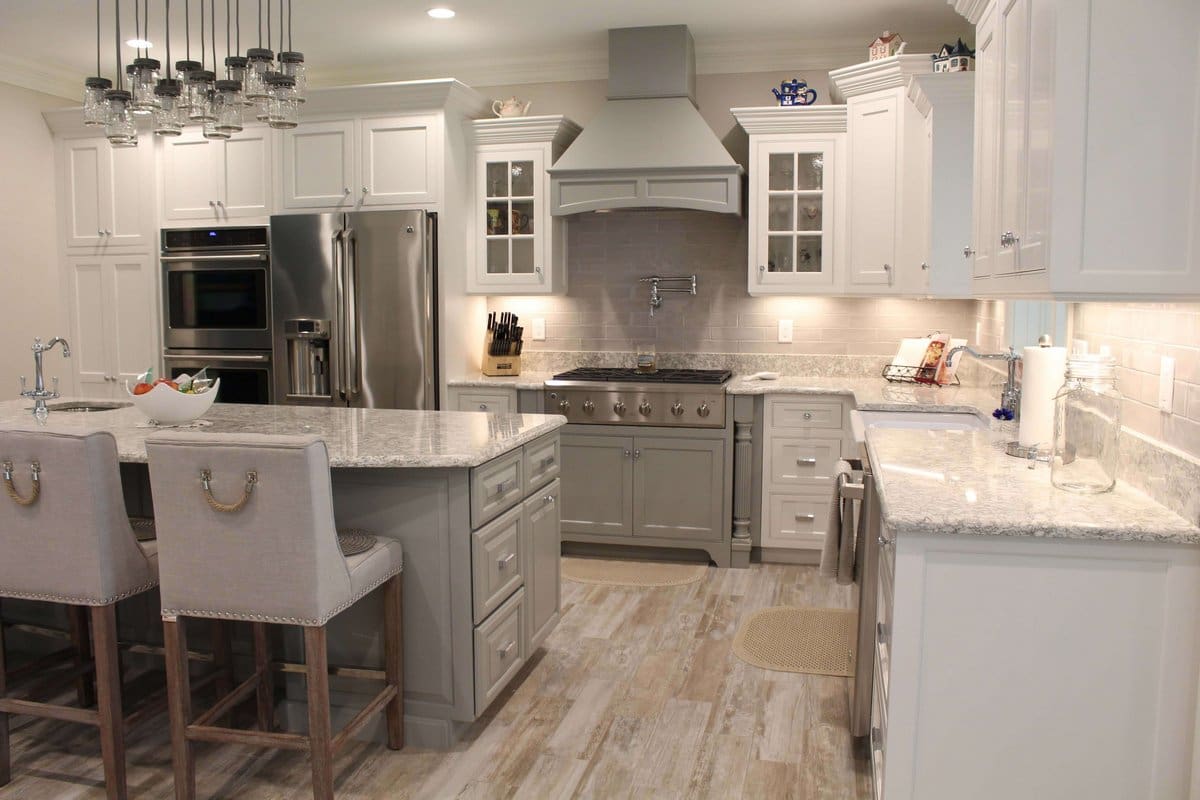 Quartz kitchen countertop. Source: The Stone Cobblers Counters and Cabinets (thestonecobblers.com)
Why do these differences matter?
Because everything starts here. When you understand what the material is made of, how it behaves in an interior, and how it changes over time, it becomes easier to assess its practicality, appearance, and maintenance needs. And that means making a well-informed choice that suits your lifestyle.
2. Durability and Wear Resistance: Soapstone vs Quartz
If you frequently prepare breakfasts, dinners, snacks, or host family nights at home, your countertop is truly doing some heavy lifting. It needs to handle knives, cookware, heavy pots, and the occasional accidental bump. That’s why it’s so important to understand how durable a material is before making your choice.
Soapstone is soft and pliable. This means it easily shows marks—knife scratches, scuffs from pans, and so on. But here’s the upside: most of those marks can be fixed. A light sanding or a coat of mineral oil can quickly restore the surface’s clean look. Over time, soapstone naturally darkens and develops a vintage character. Some see this as a downside, while others consider it the stone’s greatest charm.
Quartz, in contrast, is much harder. It doesn’t scratch under normal kitchen use and remains smooth and even for years. It’s an excellent choice if you don’t want to worry about whether your knife, a can of beans, or the espresso machine might leave a mark.
In short: quartz is the better choice if you value durability and minimal upkeep. But if you're willing to live with some scratches in exchange for a natural feel and warm texture, soapstone might be a good fit. Still, don’t rush to conclusions. In the next section, we’ll look at how both materials handle moisture, stains, and heat — which also makes a big difference.
3. Heat and Moisture Resistance: Heat and Moisture Resistance: What Can Withstand the Demands of a Kitchen
In the kitchen, things don’t always go according to plan. A hot pan might land on the countertop without a trivet. Something spills, something drips. And ideally, the surface shouldn’t get damaged by these everyday moments. So how do soapstone and quartz handle moisture, stains, and heat?
Soapstone handles high temperatures extremely well. It’s truly heat-resistant. A hot baking tray, pot, or kettle can be placed directly on the surface without leaving a burn or mark. This makes soapstone especially convenient for those who cook often and don’t want to worry about hot cookware.
However, soapstone is a porous material. It absorbs moisture and oils, especially during the first few months after installation. To protect the surface, it should be treated regularly with mineral oil. It’s not difficult, but it does require attention and consistency.
“I adore my soapstone countertop - it's like a living, warm, not at all glossy. But I confess: I ruined my first one with ordinary vegetable oil. I put it on as if it were mineral oil, and then all summer I fought with a grease stain in the center. I was never able to remove it completely...” – @sarryJonesss (Reddit)
Quartz, on the other hand, doesn’t mind water or stains. It’s non-porous, which means liquids don’t soak in. Spilled juice, sauce, or coffee can simply be wiped away — no problem. But heat is a different story: quartz is sensitive to high temperatures. Placing a hot skillet or pot straight from the stove can damage the surface. That’s why it’s best to always use a trivet or heat pad.
“I've cut with a knife right on the countertop and spilled water - nothing happens to quartz. We're very happy with it. But once my husband put a hot frying pan directly on the surface - and there was a trace, as if the top layer had melted a little. Of course, we still love the kitchen, but we've been more careful since then.” – @JaneOstost (Reddit)
To sum up:
- Soapstone — heat-resistant but requires care when it comes to moisture and oils.
- Quartz — perfectly protected from stains and moisture but vulnerable to high heat.
Now let’s see how much daily effort these materials require to stay clean and beautiful.
4. Maintenance and Care: How Much Time and Effort Will Your Countertop Require
A beautiful countertop is important—but just as important is how much work it takes to maintain it day to day. After all, if you need to polish, wipe down, or oil it after every meal, the appearance alone might not be worth the hassle.
Caring for Soapstone
Soapstone requires regular attention. To keep the surface looking rich and even, you need to treat it with mineral oil. Especially in the first few months after installation—about once a month. Over time, the stone darkens, becomes more saturated in color, and needs oiling less often. But without maintenance, it can appear blotchy and uneven.
That said, soapstone has a big advantage: minor scratches, scuffs, and even light stains can be easily repaired. If you scuff it with a pan—just apply oil or lightly sand the area, and the surface will look neat again. Just make sure not to confuse mineral oil with cooking oil.
“At first I was angry that the soapstone required so much maintenance. But then I got used to it. The main thing is not to mix up the oil. The first time I applied regular sunflower oil, I got a sticky spot that never completely went away. In my new kitchen, I do everything according to the instructions and it looks great!”— @wood_andwhite (Reddit)
Recommended products:
- The Original Soapstone Oil — a specialized oil that enhances soapstone’s natural beauty.
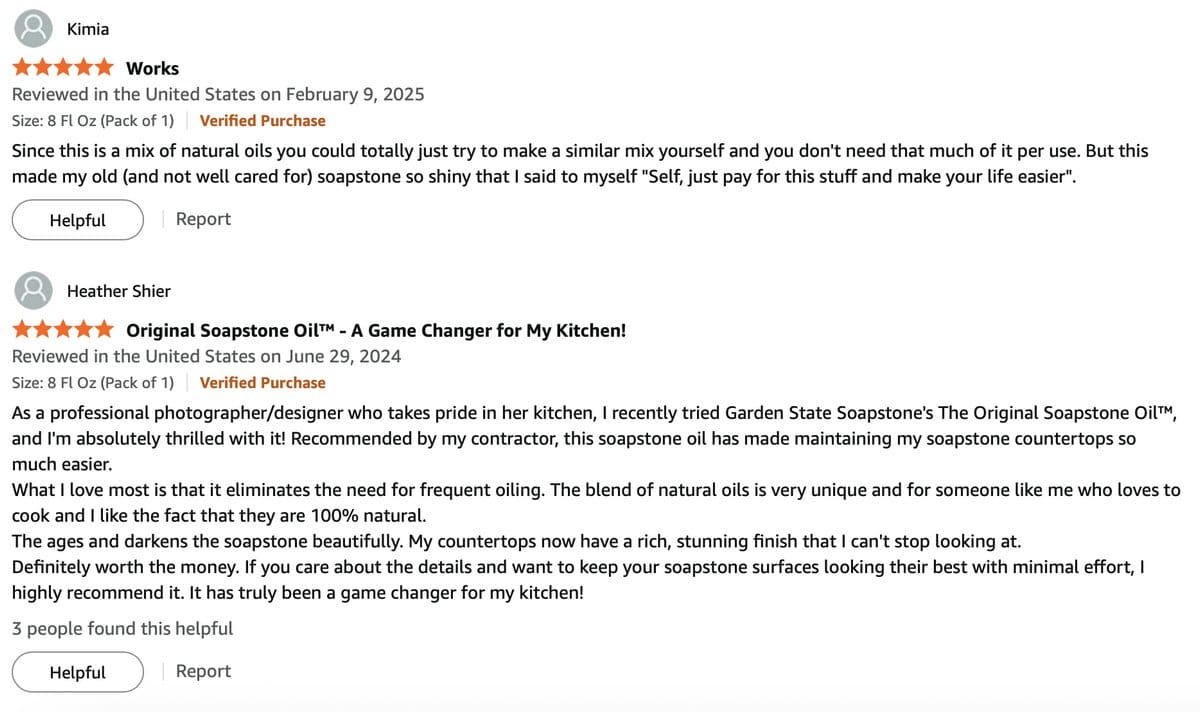
Source: amazon.com
- Thirteen Chefs Mineral Oil — a universal food-safe mineral oil suitable for various surfaces, including soapstone.
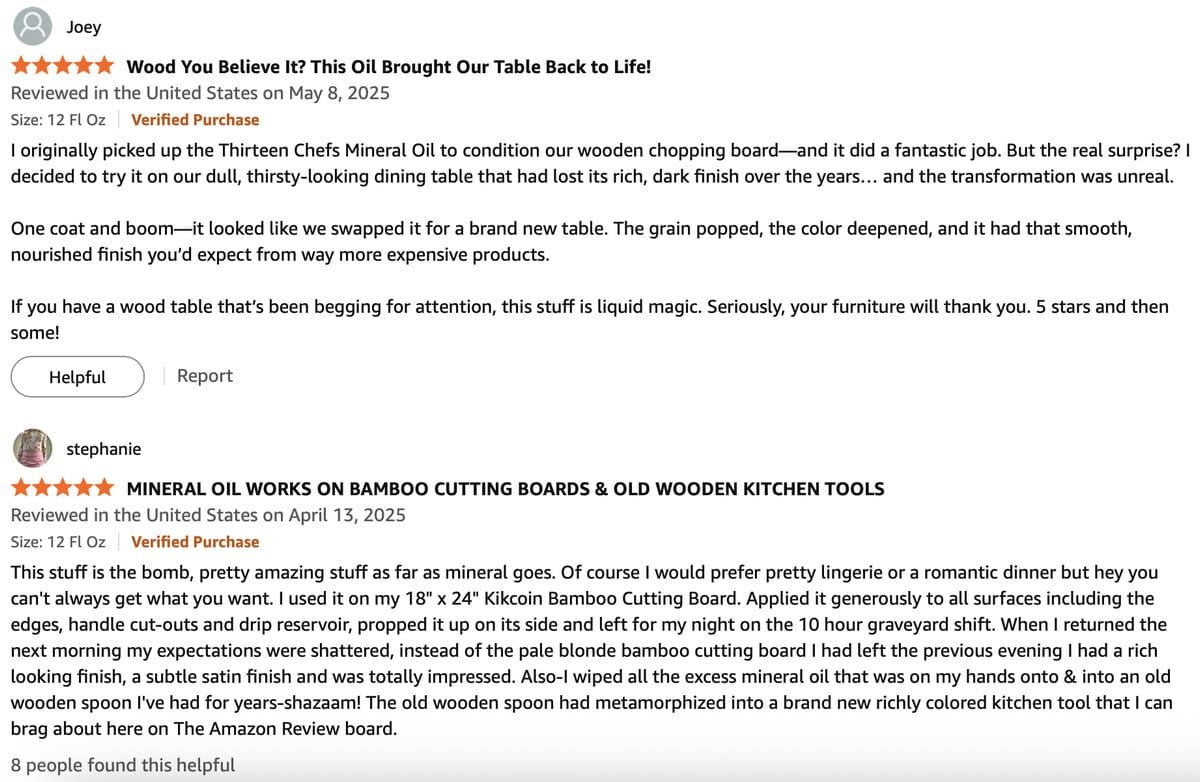
Source: amazon.com
Caring for Quartz
Quartz, by contrast, requires almost no maintenance. It doesn’t need sealing, doesn’t absorb liquids, and resists most stains. To keep it clean, just wipe it with a damp cloth and a mild cleaner. Even if something sticks or dries on, it’s easy to remove—with no special treatments required.
Like any material, quartz has its nuances. It’s highly durable under typical use, but it’s still not meant to be used as a cutting board or scrubbed with metal scouring pads. That’s not what it was designed for.
“My husband and I both work and cook fast - we don't bother with quartz at all. Everything comes off in a second. Once I cut a lemon right on the countertop - not a stain or scratch. But we try not to put anything hot on it or cut it without a board - it's a good habit.” — u/rachel_adamms (Reddit)
Recommended products:
- Weiman Quartz Countertop Cleaner and Polish — cleans and polishes quartz surfaces with UV protection.
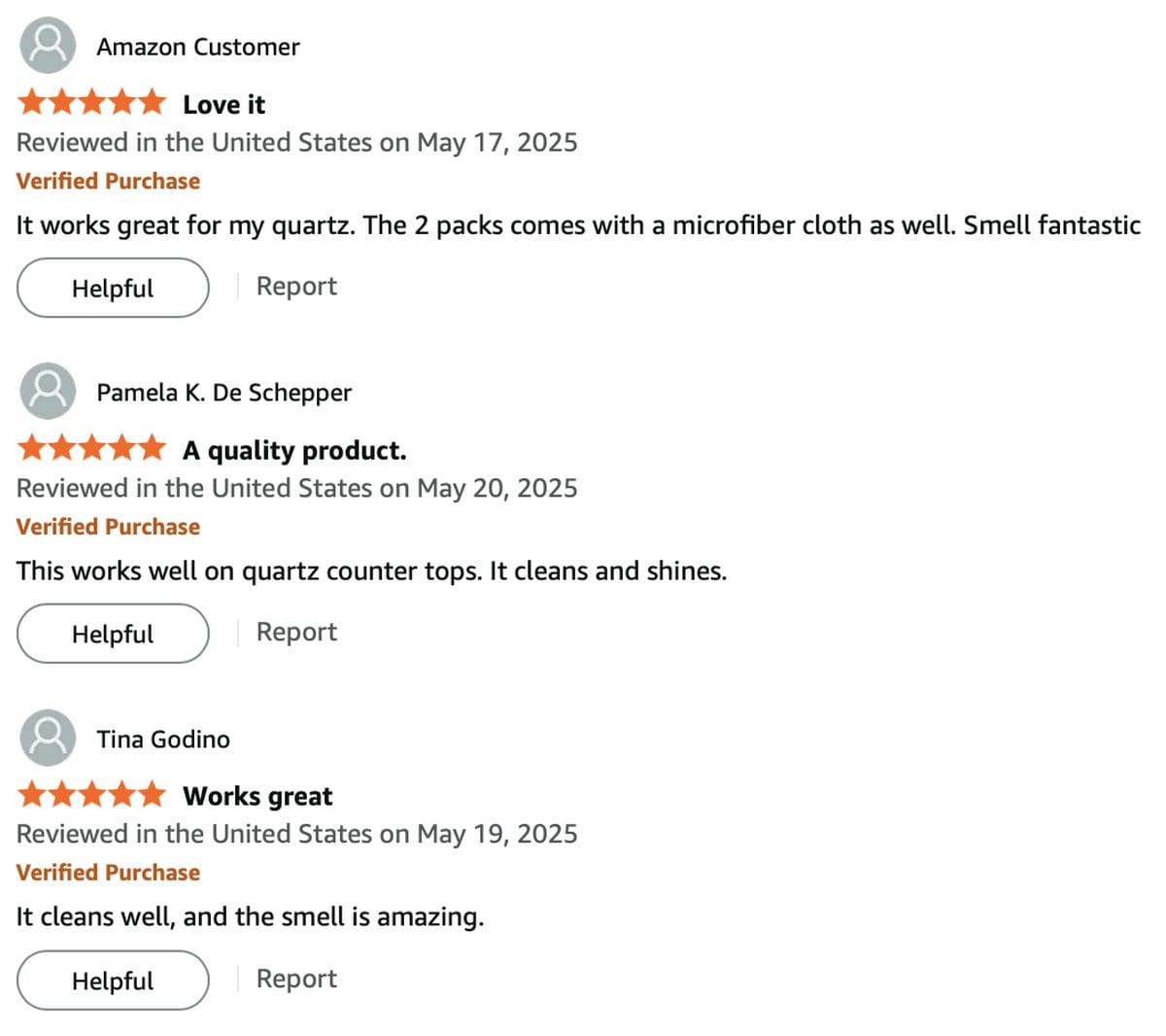
Source: amazon.com
- HOPE'S Perfect Quartz Countertop Cleaner — a food-safe cleaner that leaves no streaks or residue.
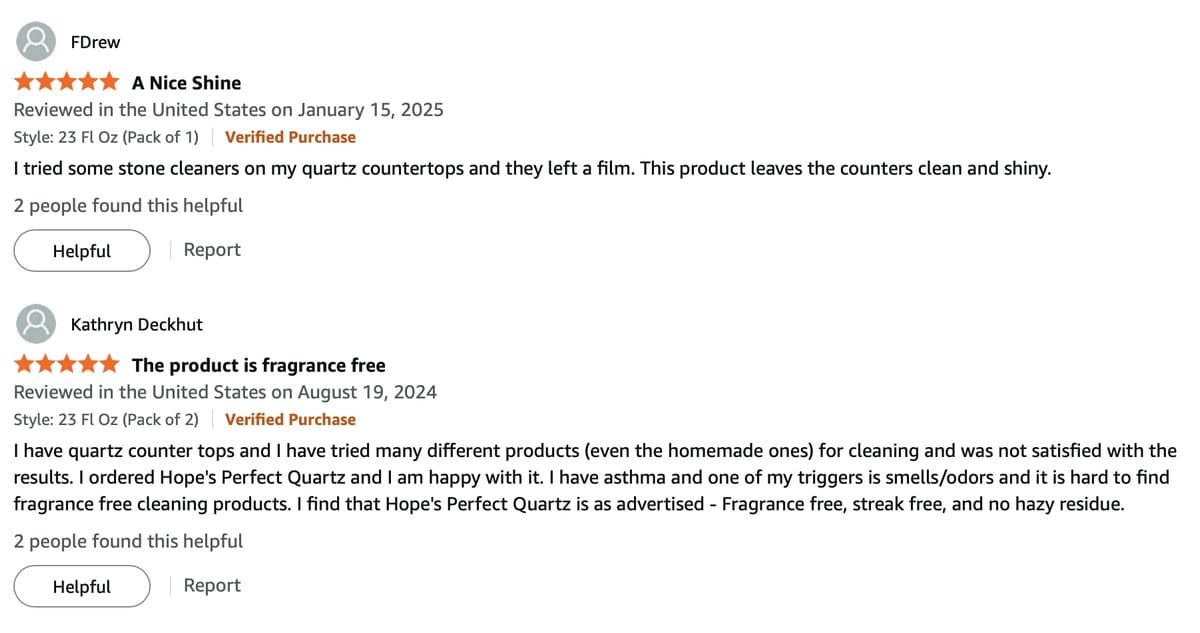
Source: amazon.com
For more tips and details on caring for quartz surfaces, check out the article “Best Cleaners for Quartz Countertops: What to Use and What to Avoid”
In general, soapstone will require a bit more care—but most issues can be restored. Quartz is better suited for those who want simplicity and consistency without extra fuss.
5. Cost of Soapstone vs Quartz
When choosing a countertop, it’s important to consider not only its appearance and features but also the cost—both upfront and over time. Let’s take a closer look at what soapstone and quartz will actually cost, including installation and maintenance.
Soapstone typically costs between $70 and $120* per square foot, including installation.* However, in some areas—such as Boston and Chicago—prices can reach $140–$150* per square foot due to local conditions and transportation fees.
Additional costs may include:
- Mineral oil for routine treatment of the surface
- Special tools for care and polishing
- Possible touch-ups if scratches or stains occur.
Quartz usually ranges from $50 to $200* per square foot, including installation.* The average price is around $125* per square foot.
Factors that influence cost:
- The quality and brand of the quartz
- The complexity of the installation and number of cutouts
- Additional elements like backsplashes or decorative edges.
If you want to know the exact pricing of quartz countertops in your region, we recommend checking out the article “Price Insights in the U.S.”.
So, the cost of soapstone vs quartz can vary greatly depending on many factors. It’s important to take into account not only the initial cost but also long-term maintenance and upkeep.
If you’re looking for a reliable contractor, check out The First National Ranking of Stone Countertop Fabricators and Installers in the U.S. — it features only verified companies from across the country.
6. Appearance and Style: How Soapstone and Quartz Differ Visually
Sometimes, the decision to choose a countertop doesn’t start with practicality—it starts with emotion. We’re simply drawn to the way a certain stone looks. And that’s absolutely valid. A countertop is a prominent feature of your kitchen, and it should make you happy every time you walk in. That’s why it’s important to understand what each option looks like—and how it fits with the rest of your space.
Soapstone is all about a matte, natural finish. Its colors are usually muted: gray, graphite, dark green, with white or light gray veining. It has a refined yet understated look. This surface doesn’t reflect light—it absorbs it, creating a cozy, earthy feel. It looks especially beautiful in farmhouse kitchens, industrial interiors, or vintage-inspired spaces.
Many people choose soapstone specifically for its organic, ever-changing texture: every slab is unique, and over time, the surface “matures,” becoming darker and more saturated. But this isn’t for everyone. Some prefer a surface that looks exactly the same years later as it did on installation day.
Quartz, on the other hand, offers nearly unlimited design possibilities. Want a white countertop with marble-like veining? Or a black surface with a subtle shimmer? Or a concrete-inspired color for a minimalist kitchen? All of it is possible. Thanks to pigments and controlled production, quartz is available in any shade, with consistent color throughout.
«Soapstone gave our kitchen that ‘old-school lab’ vibe we were going for. It’s subtle, deep, and doesn’t scream for attention — just quietly elegant.» — @annasteel86 (Reddit)
If you want your countertop to look like natural stone but don’t want the fuss, quartz with a marble pattern can be a fantastic choice. This is especially true if you want a light color—since soapstone is almost always dark.
From a design perspective, soapstone is perfect for those who love warm, subdued, natural finishes, while quartz suits anyone who wants control over the look and more freedom in terms of color and texture.
Style isn’t just about aesthetics—it’s about how you want to feel in your kitchen. And that’s a very personal decision.
7. How to Decide: Soapstone vs Quartz
After everything we’ve covered, the choice might seem even harder. But in reality—it’s the opposite. The more you understand how each material behaves, what it requires, and how it looks in real life, the easier it becomes to make a decision that’s truly right for you.
Think about what matters more to you:
- Do you value natural materials, love tactile, “living” surfaces, and don’t mind giving your countertop a little care? Then soapstone might be a great option.
- Prefer minimal upkeep, consistency, and design flexibility? Then quartz is likely to be your favorite.
Here’s a quick table to help you recall the main differences:
|
Feature
|
Soapstone
|
Quartz
|
|
Natural composition
|
✅ 100% natural
|
❌ Engineered material
|
|
Scratch resistance
|
❌ Soft, prone to scratches
|
✅ Very durable
|
|
Heat resistance
|
✅ Withstands high heat
|
❌ Sensitive to heat
|
|
Moisture resistance
|
❌ Porous, absorbs liquids
|
✅ Non-porous, doesn’t absorb
|
|
Maintenance
|
Needs regular mineral oil treatment
|
Minimal, easy care
|
|
Color palette
|
Limited, mostly darker tones
|
Wide range of colors
|
|
Longevity
|
Ages gracefully, darkens over time
|
Retains original color over the years
|
|
Average cost
|
$70–$120+ per sq. ft.
|
$50–$125 per sq. ft.
|
The key isn’t to find the “perfect” material—it’s to choose one that works for you: your lifestyle, your kitchen’s design, and your approach to home care.
Sometimes, all it takes is asking yourself one honest question:
Do you want a countertop that lives and changes with time—or one that stays exactly the same as the day it was installed?
Both are great choices. They just offer different experiences.
If at this point you’re leaning toward quartz, I highly recommend reading the article “Quartz Countertops: Pros, Cons, and Whether They’re the Right Choice for Your Kitchen, Bathroom, and Other Spaces?”—where the author shares personal insights to help you decide if it’s the 100% right fit.
Expert Conversation: The Stone Magazine — Debra Morgan
The Stone Magazine (TSM):
What’s the most important thing to understand when choosing between soapstone and quartz?
Debra Morgan (DM):
You need to understand the origin of the material. Soapstone is natural and relatively soft. Quartz is engineered and significantly harder. That difference affects maintenance, wear, and how the surface behaves over time.
TSM:
How does soapstone perform in daily use?
DM:
Soapstone scratches easily, but most marks can be corrected. The surface can be sanded or treated with mineral oil. Over time, the stone darkens and develops a patina.
TSM:
And how does quartz behave?
DM:
Quartz is resistant to scratches and everyday wear. It doesn’t absorb liquids and maintains its appearance for many years with minimal maintenance.
TSM:
Do these materials have limitations?
DM:
Soapstone is low-porosity, but periodic treatment with mineral oil is recommended to maintain an even color. Quartz is sensitive to high temperatures and can be damaged by contact with hot cookware.
TSM:
When does it make sense to consider an alternative?
DM:
If heat resistance is a priority and regular maintenance is acceptable, soapstone is worth considering. If ease of care and visual stability matter more, quartz is usually the better choice.
FAQ: Frequently Asked Questions
What’s better: soapstone or quartz for a kitchen countertop?
Both materials are great—but they have very different personalities. Soapstone is natural, warm, with a living texture, but it requires some care. Quartz is strong, stable, and low-maintenance. It all depends on how important natural materials are to you—and whether you’re willing to put in a bit of effort to maintain the surface.
Is there a big difference in the cost of soapstone vs quartz?
On average, yes. Soapstone usually costs more per square foot, and installation and maintenance also require extra investment. Quartz may be more affordable both initially and over time—especially considering it doesn’t require regular upkeep.
How does soapstone hold up against scratches compared to quartz?
Quartz is much more scratch-resistant and durable overall. Soapstone is soft and scratches easily—but small imperfections can often be buffed out or treated with mineral oil.
Can you use soapstone in a bathroom?
Yes, and it can look stunning—especially in vintage, industrial, or minimalist designs. Just keep in mind that soapstone is porous and will still require occasional oil treatment, even in a bathroom environment.
Where can I find up-to-date pricing for quartz countertops in my area?
As mentioned earlier, check out the “Price Insights in the U.S.” section. There you’ll find detailed information about the average cost of quartz countertops across different U.S. cities. It’s all transparent and explained with real examples.
The Stone Magazine Editorial Tip
When choosing between soapstone and quartz, most mistakes stem not from the materials themselves, but from expectations. In photos, the surfaces can look similar. In real-world use, the differences become noticeable fairly quickly.
Soapstone is often labeled as “high-maintenance,” even though many signs of wear can be corrected. Quartz is frequently seen as completely worry-free, while its sensitivity to high heat is overlooked. These nuances are rarely obvious during the selection process, yet they shape the long-term kitchen experience.
Warranties and real customer reviews remain important reference points when choosing a contractor for stone countertop installation. They help reveal how a company performs in practice and how consistently it delivers quality results.
One useful benchmark is the CountertopsContractors ranking — an independent list of contractors across the U.S., based on installation quality, experience, and market reputation. This format makes it easier to compare professionals and choose the right specialist for a specific project.
Conclusion
Choosing between soapstone and quartz isn’t just about materials. It’s about lifestyle, your relationship with the things in your home, how you care for your space, and how you want to feel in your kitchen.
If you want a surface that feels alive, natural, with warmth and character—soapstone offers exactly that. It demands attention, but rewards you with depth, calmness, and a comforting presence.
If you’re looking for a material that will last, look flawless, and require almost no maintenance—quartz will be your reliable partner. It’s modern, durable, and endlessly versatile in style.
There’s no right or wrong answer here. There’s only the choice that fits you best. And I hope this article helped you find it.
Also read:
- “Quartz Countertops: Pros, Cons, and Whether They’re the Right Choice for Your Kitchen, Bathroom, and Other Spaces?”
- “Best Cleaners for Quartz Countertops: What to Use and What to Avoid”
- “Price Insights in the U.S.”
*The price is valid as of March, 2025, published for informational purposes and may differ on the day the article is read. Prices are based on average data from Home Depot, Houzz, HomeAdvisor, and other relevant sources in the U.S.
All images are sourced from Unsplash photo stock or publicly available contractor portfolios. If you believe any image is privately owned and used without proper credit, please contact us at contact@countertopcontractors.com.
Some authors may write under a pseudonym and choose not to disclose their identities for personal reasons. We respect their privacy and simply provide a platform for professional, educational use. We are not responsible for name coincidences with real individuals. All contributors are vetted for expertise, but we advocate for freedom of expression.