Introduction
Have you ever seen a surface that reflects light in a way that makes the kitchen feel brighter all on its own? That’s exactly what recycled glass is all about. It looks fresh and modern, and it also helps make a home more environmentally friendly.
If you’re wondering whether this type of countertop works for a kitchen or a bathroom, this article is for you. In short, it’s durable, visually striking, and opens up a lot of interesting interior design possibilities. Now let’s take a closer look at how to use it effectively.
What You Should Know About Recycled Glass Countertops If You’re New to Them
If you opened this article, you’ve probably already seen beautiful photos of glass countertops. And the first logical question is: what exactly are they?
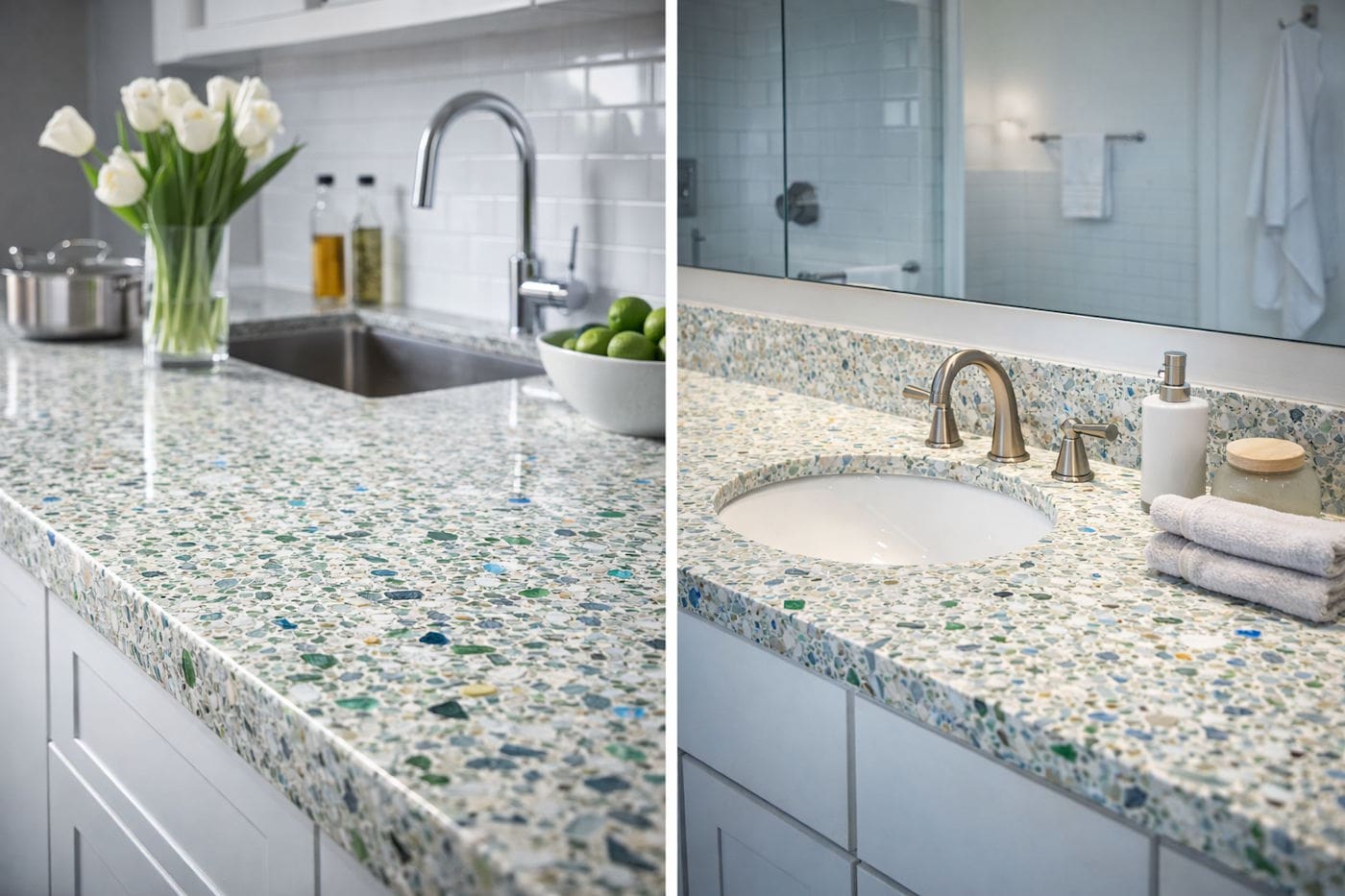
At their core, they’re made from recycled glass — bottles, architectural glass, and decorative fragments that are crushed, mixed with resin, and formed into a smooth, glossy surface. Essentially, it’s a composite material where glass provides the visual appeal, and the resin ensures strength and durability.
After that, new questions usually follow. How strong is it? Is it too shiny? How does it behave in a kitchen during cooking, or in a bathroom with constant steam? And the most important one: does it look just as impressive in real life as it does in photos?
Even though this material may seem new, it has actually been used in the U.S. for many years.
To help you understand whether a glass countertop fits your home, lifestyle, and daily habits, we’ve gathered all the essential information in one place — in clear, simple language. To make the picture complete, we also invited interior designer Debra Morgan to our editorial office. She shared how these surfaces perform in real kitchens and bathrooms, not in staged photos, but in everyday use.
Light, Shine, and Expectations. Does the Result Live Up to Them?
The Stone Magazine (TSM): Debra, many people choose glass countertops because of their shine and visual depth. But if we put emotions aside, what does a homeowner really get?
Debra Morgan (DM): I’d say they get a combination of aesthetics and practicality that’s hard to replicate with other materials. The glass fragments act like tiny lenses. They catch and reflect light, making the surface appear more dimensional than it actually is. This effect is especially noticeable in bright kitchens.
But what matters most is that the material is resistant to moisture and stains. It doesn’t darken or change color over time. When clients ask me whether this material is truly relevant long term, I always say that here, visual appeal goes hand in hand with real reliability.
TSM: Some people worry that a glass countertop might feel “too busy” or too much of a statement. Do you encounter that concern?
DM: Yes, quite often. People see photos and assume the glass will be loud or overwhelming. In reality, it’s much softer. Even bold colors create a restrained shimmer rather than a harsh shine. It doesn’t look like a storefront display. It’s more of a calm glow that appears only in good lighting.
In everyday life, the surface feels closer to quartz with added depth. I often tell clients, “If you like clean, fresh kitchens, this material is for you. It doesn’t steal attention. It distributes it.”
TSM: If you had to name one main advantage of glass countertops, what would it be?
DM: The ability to change the atmosphere of a room without major renovations. Glass adds a sense of light, even in kitchens with limited natural daylight. In bathrooms, it makes the space feel visually cleaner, almost as if the air itself is brighter.
That’s not magic. It’s simple light refraction. And it’s a case where the material works for you every single day. It doesn’t require special care, doesn’t absorb moisture, and doesn’t react to cosmetics or food. For families with busy schedules, that’s a huge advantage.
Editorial Bonus: Dave Milligan’s Take, Bathroom Renovation Specialist
TSM: Dave, how do these countertops perform in bathrooms?
Dave: In bathrooms, glass countertops often shine even more than in kitchens. There’s a lot of steam and humidity, and this material handles it extremely well. It doesn’t absorb water, doesn’t darken, and doesn’t leave marks from cosmetics.
There’s also a visual aspect. When the room fills with steam, light starts to interact differently with the glass fragments, creating a soft, cloud-like effect. It’s similar to the atmosphere of a hammam, where steam and gentle lighting create a sense of relaxation.
People who enjoy long, hot showers as a way to unwind after a long day really appreciate this effect.
Frequently Asked Questions (FAQ)
Do recycled glass countertops scratch easily?
The glass fragments themselves are highly resistant to scratches. However, the binding resin can be softer. That’s why it’s important to choose brands that use high-quality, scratch-resistant resins.
With normal daily use, minor scratches are barely noticeable. For proper care, it’s enough to avoid abrasive metal scrubbers.
Can you place hot items on a glass countertop?
They can handle brief contact with hot cookware, but manufacturers still recommend using trivets. The resin that binds the glass fragments is more sensitive to heat than the glass itself.
If you want the longest possible lifespan, it’s best to avoid prolonged contact with very hot objects.
Is maintenance complicated?
No. Overall, care is similar to quartz countertops. Warm water, a soft sponge, and a standard kitchen cleaner are sufficient.
Stains, coffee marks, or cosmetic residue in bathrooms are easy to remove. The material doesn’t absorb moisture and doesn’t darken from humidity.
How to Choose and Use Recycled Glass Countertops: A Simple Step-by-Step Guide
Step 1. Decide What Effect You Want
Start by understanding why you want this countertop. Do you want a statement piece? More light? Or a calm, neutral surface?
Glass fragments reflect light, so the surface may appear brighter than in photos. This is especially important in small spaces. In compact kitchens, glass countertops often brighten the room compared to darker materials.
Step 2. Choose the Size of the Glass Fragments
So-called glass chips can be large or small.
- Large fragments create a mosaic effect and a bold, expressive surface.
- Small fragments produce a calmer, more uniform pattern, often resembling quartz or terrazzo.
If you’re unsure, choose a finer fraction. It’s versatile and works with almost any interior.
Step 3. Pick the Color
Manufacturers offer dozens of options. The most popular include:
- Clear glass — a neutral choice for any interior
- Blue and green tones — a fresh look for kitchens
- White and light gray palettes — ideal for bathrooms
- Bold mixes — for modern projects, islands, and bar tops
Glass colors look best in natural daylight. If your kitchen is dark, lighter shades help compensate for the lack of light.
Step 4. Think About Lighting
An important detail: glass fragments transmit light.
This means the countertop can be backlit from below, creating a soft glow. This works especially well:
-
- on kitchen islands
- on bar counters
- in modern bathroom designs
If backlighting isn’t something you want, choose opaque options. They feel calmer and more restrained.
Step 5. Choose the Shape and Edge Profile
For glass countertops, the most common options are:
- a thin, straight edge
- a slightly rounded edge for kitchens with heavy use
A thin edge makes the countertop feel lighter visually.
A rounded edge is more practical, as chips are less noticeable if something falls.
Step 6. Plan the Sink Area
Glass countertops pair well with undermount sinks. This creates a smooth transition with no visible seam.
In bathrooms, vessel sinks are also a great option. The glass surface reflects the sink’s shape and surrounding light beautifully.
For a minimalist look, consider an integrated sink with a hidden drain.
The Stone Magazine Editorial Tip
Recycled glass countertops are beautiful, but quality depends heavily on the manufacturer and installer. To ensure long-term performance, focus on three key factors.
First, the resin must be UV-resistant. High-quality formulas won’t yellow or become cloudy, even under strong lighting.
Second, the surface should have stain protection. Glass itself is durable, but the resin determines how easy maintenance will be.
Third, look for warranties and real customer reviews. That’s the best indicator that a company stands behind its work.
If you want to avoid mistakes, choose professionals who have already been vetted. The CountertopsContractors ranking includes only contractors who passed a multi-step evaluation process — from installation quality to reputation and experience with composite materials. It’s the simplest way to get a great countertop without costly rework or unnecessary stress.
Conclusion
Recycled glass countertops offer a rare combination of beauty and practicality. They reflect light, make spaces feel brighter and cleaner, and easily handle moisture, splashes, and daily use.
If you’re looking for a material that doesn’t require complex maintenance and still adds character to your interior, glass can be a reliable and predictable choice.
Now that you know how it looks, which colors work best, and what to pay attention to when choosing, the decision becomes much easier. This article covers everything that truly matters before buying. From here on, it’s simply a question of whether this aesthetic fits your home.
Also read: Affordable and Stylish Bathroom Countertop Ideas
Some authors/experts may write under a pseudonym and choose not to disclose their identities for personal reasons. We respect their privacy and simply provide a platform for professional, educational use. We are not responsible for name coincidences with real individuals. All contributors are vetted for expertise, but we advocate for freedom of expression.