

Quartz or Granite Countertops: Which Is Better for Your Kitchen? — An Expert’s Opinion
If you’ve decided it’s time to replace your kitchen countertops, chances are you’ve already spent hours online trying to answer one key question: Which countertop material is better — natural stone or engineered stone?
The two main contenders for the title of the perfect kitchen countertop are granite and quartz. Both are beautiful, durable, and capable of lasting for decades. Each has its own strengths and personality. But which one is right for you?
For this article, The Stone Magazine spoke with experienced interior designer Debra Morgan, who shared her professional perspective on the key features of both materials, how they perform in real kitchens, and how each can be used to its full potential in interior design. We’ll also compare durability, cost, and maintenance, and we genuinely hope this guide helps you choose a countertop that will serve you for many years — and earn an enthusiastic “wow” from your guests.
What to Consider First When Choosing a Countertop
When we think about a dream kitchen, the first thing that comes to mind is the countertop. It takes on the most wear and tear: hot pans, coffee spills, sharp knives, and endless grab-and-go breakfasts. So which one should you choose — granite or quartz?
On one side, granite is a natural giant with character. On the other, quartz is an engineered material designed for modern living. Both materials can last up to a hundred years with proper installation and care.
To take a closer look at the differences, we spoke with experienced designer Debra Morgan. We covered everything — from style and durability to stains and pricing.
Granite and Quartz: Two Materials, Two Mindsets
The Stone Magazine (TSM): Debra, be honest — which would you choose for your own kitchen, quartz or granite?
Debra Morgan (DM): That’s a tough question, because both are excellent in their own way. In my home, I actually have quartz. I love it because quartz is about convenience, hygiene, and visual order. It doesn’t stain easily, doesn’t require sealing, and it’s very easy to clean. I’m not the neatest cook — I get completely absorbed in the process and don’t even notice when sauce spills everywhere. With quartz, cleanup is quick, and I don’t enjoy spending a lot of time cleaning.
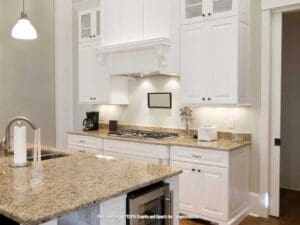
Granite, though, is a completely different story. It’s a stone with history and personality. Every slab has its own natural fingerprint, a pattern that will never be repeated. Yes, it requires a bit more care, but it’s worth it if you love natural materials and see your interior as a form of self-expression, not just a functional space.
TSM: What about practicality?
DM: Quartz wins in terms of practicality. But granite isn’t fussy either, as long as you’re willing to take care of it. Quartz was created with the idea of “maximum aesthetics, minimum maintenance.” Granite is a gift from nature — one you need to accept with all its quirks.
TSM: So quartz is for the rational, and granite is for connoisseurs?
DM: Exactly. Quartz is for those who value stability. Granite is for those who want soul in their kitchen. Both are great choices. What matters most is that it feels right for you — and fits your budget.
Frequently Asked Questions (FAQ)
TSM: Debra, you’ve already mentioned the differences between these materials. But can you sum it up clearly and concisely — which is better, granite or quartz?
DM: It all depends on your preferences. Choose quartz if you have kids and worry about stains or spending a lot of time cleaning the kitchen. Quartz is stain-resistant and requires little to no sealing.
Granite, on the other hand, is like a fine wine — it has character, mood, and texture. You need to understand it and care for it a bit more, but it feels alive. If you’re an aesthete who loves materials with history, granite may be the right choice for you. Just keep in mind that you’ll need to put in some effort to keep a granite countertop looking beautiful — natural stone can deteriorate quickly without proper care.
— Can you place hot cookware on stone countertops?
DM: Granite can handle heat, but you need to be smart about it. Don’t take a hot pan straight off the stove and then immediately pour ice-cold water on or near the surface. Sudden temperature changes can cause cracking. Also be careful if you have upper cabinets above the countertop — while reaching for something, there’s always a chance that a heavy item, like a jar of grains, could slip and damage the surface. Of course, it would have to be a heavy jar (laughs).
Quartz, on the other hand, isn’t as heat-resistant. It’s made from quartz particles and polymers pressed into a dense slab. If you absentmindedly place a hot pot directly on the surface without a trivet, there’s about a 60% chance the material will be damaged. You may end up with a visible ring from the bottom of the pot. If you choose quartz, it’s better to keep plenty of trivets on hand — they’ll save you time and nerves.
— Which is more expensive: quartz or granite?
DM: Granite is often cheaper, especially in basic collections. But if you’re looking for something special — a non-standard color or pattern, or a more complex installation — the price can even out. I always recommend considering not just the material itself, but the total project cost.
— Which is better for families with children?
DM: Without a doubt, quartz. It’s non-porous, bacteria don’t penetrate the surface, and stains are easy to remove. Most importantly, it doesn’t require routine maintenance. In a busy kitchen with kids, snacks, spilled juice, and yogurt accidents, you’ll thank yourself for choosing quartz.
— What about scratch and stain resistance?
DM: Both materials are strong. But granite is like silk clothing — beautiful, but it requires care. Without proper sealing, it can absorb stains from sauce, wine, or oil. Quartz is easier. Think of it like your favorite pair of jeans — it can handle almost anything and still look great.
How to Choose a Countertop: A Step-by-Step Guide
TSM: Debra, can you give our readers a simple framework? How do you choose between quartz and granite without regret?
DM: The key is to honestly answer four questions for yourself.
Step 1. What kind of cook are you?
- You cook quickly, don’t enjoy cleaning, and want everything to wipe down easily — quartz is your choice.
- Cooking feels like a ritual or even an art form — take a closer look at granite.
Step 2. What’s your interior style?
- Granite pairs beautifully with wood, warm lighting, and brass hardware. It works best in interiors with character.
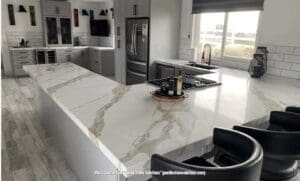
- Quartz comes in virtually any color and texture, from marble-look to smooth concrete. It’s ideal for modern, minimalist, and urban spaces.
Step 3. How much time are you willing to spend on maintenance?
|
Granite |
Quartz |
|
|
Sealing |
Once a year |
Not required |
|
Cleaning |
Specialty products recommended |
Any mild cleaner |
|
Hygiene |
Requires regular treatment |
Naturally antibacterial |
|
Stain resistance |
Possible without protection |
Non-porous, easy to clean |
DM: Quartz forgives almost everything. Granite needs a bit more love and attention.
Step 4. Budget
|
Material |
Base Price |
Designer Options |
|
Granite |
from $40 |
up to $150 |
|
Quartz |
from $50 |
up to $200 |
DM: These numbers are approximate and may vary depending on your specific project. The final cost includes not only the slab, but also installation, appliance cutouts, seams, edges, and additional elements such as lighting.
I recently read an article in The Stone Magazine, “Granite vs. Quartz Countertops: Cost, Durability, and Style,” which goes into pricing in more detail, and I highly recommend it.
Conclusion
If you’re looking for natural beauty, uniqueness, and warmth, granite can become a true centerpiece in your kitchen. It’s often chosen for high-end interiors, boutiques, and custom design projects.
If practicality, consistency, and a modern lifestyle matter most, quartz is worth your attention. It’s especially well suited for families with children, commercial spaces, and busy urban homes.
“It’s not about what’s better. It’s about who you are. Quartz is made for the rational maximalist. Granite is for the romantic who sees a soul in stone.”
— Debra Morgan
The Stone Magazine Editorial Tip
Before placing an order, see the slabs in person. Touch them and notice how they look in different lighting. And if you can’t decide, give yourself time. Or… use granite on the island and quartz along the walls. That’s not a compromise — it’s a thoughtful interior decision.
You can find a trusted contractor and contact them for a consultation through Countertop Contractors.
Also read:
- Granite vs. Quartz Countertops: Cost, Durability, and Style
- Best Cleaners for Quartz Countertops: What to Use and What to Avoid
- Do Granite Countertops Need Sealing? Busting Myths and Providing a Clear Answer
- How to Care for Granite Countertops: A Complete Guide to Maintenance and Upkeep
- How to choose a stylish and durable countertop for your kitchen: Trendy Solutions for 2025"
*Prices are valid as of July 2025, provided for informational purposes only, and may vary at the time of reading. Estimates are based on average data from Home Depot, Houzz, HomeAdvisor, and other relevant sources in the U.S.
All images are sourced from photo stock or publicly available contractor portfolios. If you believe any image is privately owned and used without proper credit, please contact us at contact@countertopcontractors.com.
Some authors/experts may write under a pseudonym and choose not to disclose their identities for personal reasons. We respect their privacy and simply provide a platform for professional, educational use. We are not responsible for name coincidences with real individuals. All contributors are vetted for expertise, but we advocate for freedom of expression.