Who Will Sharpen the Stone Tomorrow? The Workforce Crisis in the Stone Industry No One Is Shouting About—But It’s Already Disrupting Business
Introduction
More and more often, contractors and owners of natural stone fabrication shops are saying the same thing: “There’s no one to work.” Not because there are no orders—orders are still coming in, and for many, they’re even increasing. The problem lies elsewhere. Gradually, there’s simply no one left to stand at the machines, polish edges, cut sink openings, install countertops, load, deliver, and repair equipment.
At first glance, it may seem like nothing extraordinary is happening. The industry has always struggled with workforce challenges. However, in 2024 and 2025, the conversation sounds different. Quieter—but more concerning. The usual methods no longer work, and new ones have yet to emerge.
We set out to understand how serious the situation really is. Is this truly a crisis, or just temporary difficulties? Who is working in the stone industry today, who has already left, and who won’t be here tomorrow? What is happening to hired labor amid tightening immigration policies? Why aren’t young people entering the profession, and can the government help?
In this article, you’ll find not only an objective view of the situation, but also real numbers, opinions from colleagues, hidden risks, and possible paths that companies are already choosing so they won’t be left without a team.
Because while some hope that everything will somehow work itself out, others are already learning how to survive under new conditions.
1. Where Did the People Go? And Why Didn’t Anyone Replace Them
Ask contractors what they’ve struggled with most in recent months, and almost all of them will give the same answer. Not materials. Not pricing. Not even competition. The most pressing issue today is people—or more precisely, the lack of them.
And it’s not just about highly skilled specialists. The shortage is felt at every level: some can’t find experienced CNC operators, others lose installers just after training them, and some simply hope each day that their loader will show up for the shift.
According to the Home Builders Institute (editor’s note: a national nonprofit organization focused on workforce training for the construction industry), the U.S. construction industry needs 723,000 new workers annually to meet current and projected demand. This estimate is based on data from the Bureau of Labor Statistics and is cited in HBI’s fall report.
Source: “Strategies to address the industry’s workforce woes” (pitandquarry.com)
When you put all of this together, it becomes clear: this is not a temporary dip, but a systemic shift. Veteran workers are leaving, and younger ones are not rushing to replace them. And in an industry where natural stone production still requires craftsmanship and time, this level of turnover is no longer just visible in reports—it’s showing up in missed deadlines, overtime, and declining quality.
2. Raids Over Qualifications: How Immigration Policy Is Reshaping the Industry
The stone industry, like the entire construction sector, largely depends on those willing to work with their hands. Granite and marble fabrication shops involve physical labor: dust, noise, slabs weighing over 400 pounds, and constant attention to detail. Machine operators, installers, polishers, mechanics, and helpers work here—often people without college degrees, but with substantial experience and discipline.
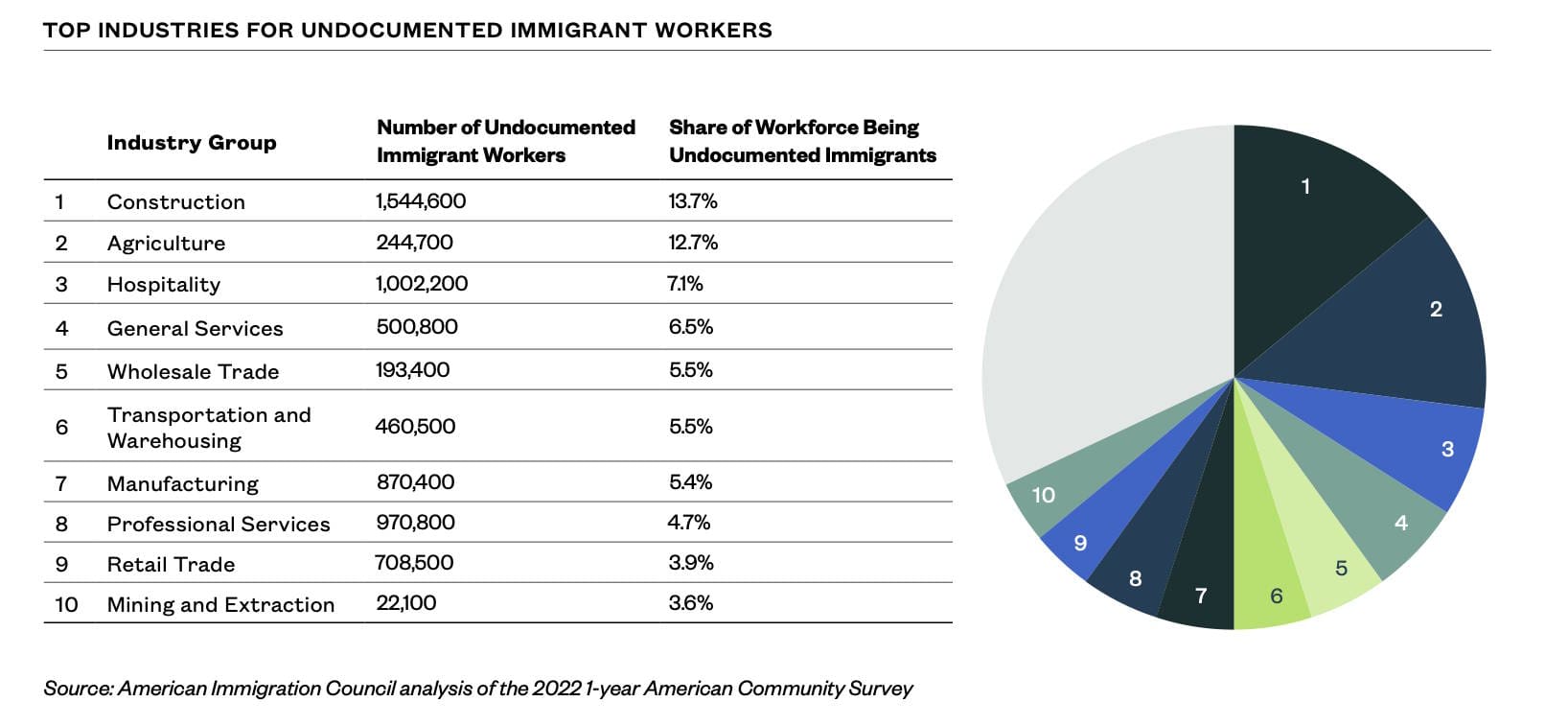
For a long time, immigrants played a key role in this system. According to the American Immigration Council (editor’s note: an independent nonprofit organization analyzing U.S. immigration policy), about 14% of construction workers are undocumented immigrants. These figures are cited in the 2024 report Mass Deportation: Devastating Costs to America, Its Budget and Economy. Given the total number of people employed in construction, this equates to roughly 1.5 million workers.
The share of Spanish-speaking immigrants—natives of Mexico, Colombia, and other Latin American countries—is especially high in southern states such as California, Texas, and Florida. In Florida, more than 70% of the population speaks Spanish, and these workers often perform the most physically demanding tasks: carrying slabs by hand, cutting, polishing, and installing. Many work double shifts and take on extra jobs over the weekend. They are the true backbone of the industry, and if deportation policies continue, the losses will be enormous.
In practice, in 2025, amid tighter immigration enforcement, the labor market situation has sharply intensified. According to Forbes, the U.S. construction industry loses more than $10.8 billion annually due to labor shortages directly linked to strict immigration measures.
Source: Mass Deportation: Devastating Costs to America, Its Budget and Economy
These policies have not only impacted those working without documentation—businesses themselves are operating under constant stress. Companies are forced to spend more resources on employee verification, comply with increasingly complex requirements, and at the same time deal with growing distrust among workers. This is especially painful for small shops and local operations, where the departure of even one employee disrupts the entire team.
As a result, thousands of small manufacturers across the country now face a labor shortage that is no longer temporary, but a permanent risk factor.
3. Is the Crisis Exaggerated? What Those Who Are Coping Have to Say
The word “crisis” sounds dramatic—especially in headlines. But if we step back from the emotion and look more closely, another side of the picture emerges. There are companies that continue to operate steadily, hire, train, and expand—even amid turnover, immigration restrictions, and rising wages.
According to several industry publications, some players have already adapted. Some are focusing on in-house training, others are revising working conditions, introducing tenure bonuses or flexible shifts, and some are implementing automation to free employees from routine heavy labor and retain them long term.
One contractor from our ranking shared his perspective as a business owner. Here’s what he says:
“Our company, PG Countertops, has been on the market for 11 years. Our main focus is natural stone countertops: marble, granite, engineered stone. We purchase the stone, fabricate it, customize it to the project dimensions, and install it ourselves. We also do floor and shower tile, install kitchens and bathrooms, including cabinetry.
I’ve gone from worker to manager and remain involved in all processes. We have about 15 employees. Materials are expensive, so I personally oversee every stage.
A workforce crisis? We operate in a southern U.S. city—Charleston, South Carolina—and here it’s easier. There are local guys and international specialists. I try to pay one of the highest wages in the city; otherwise, it’s impossible to retain good workers. If I evaluate the business by wage level and loyalty, I’d rate it 9 out of 10: there’s room to grow, but it’s already solid. I also chose a path—better good equipment and one capable specialist than flashy machines without the right people.
If something happens to one of our employees, we help. For example, there was a recent workplace injury—we covered sick leave and medical expenses. That’s normal: if we can help, we do.
As for work permits, everything depends on how legal a person’s status is in the U.S. and what the law allows. If everything is in order and the person is a good specialist, we’re ready to sponsor. But legalizing those who arrived illegally is very difficult—unfortunately, not everything is in our hands. I’d gladly hire all the skilled guys, but much depends on legislation.
Regarding the professional environment, we have a community, attend trade shows, follow trends. Honestly, I haven’t heard many complaints. Maybe in bigger cities the situation is different, but here it’s fairly calm.”
The current situation is not a catastrophe, but the result of the industry’s long-term dependence on cheap labor. If businesses begin restructuring internal processes, implementing mentorship programs, and investing more in workforce training, the shortage can be stabilized.
At the same time, it’s important to understand: even those who are coping are operating under new, more complex conditions. They have to train newcomers longer, focus more actively on retention, and adapt more frequently to a changing labor market. They simply started earlier—and gained time.
So to say “there is no crisis” would be inaccurate. It exists—but it looks different for everyone. For some, it’s just a slowdown. For others, it’s a complete production shutdown. And only those who began restructuring before the wave hit can now afford to plan for growth.
4. Waiting for Reform and Fighting for Workers: A Survival Strategy for Small Business
When a labor shortage becomes “chronic,” it’s natural to ask: can the government help? Are there tools small and mid-sized companies can use right now?
Unfortunately, the answer is mixed. Yes, there is the federal H-2B program, which allows companies to hire temporary foreign workers for seasonal jobs. Formally, it is available to the construction sector. But in practice, quotas fill quickly, competition is high, and the application process itself is complex and ill-suited for small stone fabrication shops where labor is needed year-round, not just seasonally.
While federal authorities have yet to offer solutions aligned with industry realities, professional associations are taking initiative. For example, the National Association of Home Builders (NAHB) advocates for immigration reform. The organization proposes creating a separate visa for construction workers, with caps based not on fixed quotas but on market demand. It also supports legalization opportunities for those already working and opposes rules that would hold contractors responsible for the immigration status of subcontractors’ employees. The goal of these initiatives is to strike a balance between border control and preserving the workforce necessary for real construction activity.
Until then, contractors and private clients alike remain in a battle for increasingly scarce workers.
What does this mean for business?
First and foremost, you can rely only on yourself. The government is not currently offering the industry anything that could radically change the situation. That means real solutions must be found within the company itself. And it’s not just about hiring—it’s about strategy: how to train, how to retain, how to motivate.
Companies that can consistently build teams, invest in people, rethink processes, and implement at least targeted automation will not only survive—they will grow stronger. Not because there is no crisis, but because they didn’t wait for someone else to solve it for them.
Conclusion
We can talk endlessly about the “labor market,” “immigration policy,” or “industry growth.” But when you’re a contractor or run a fabrication shop, everything takes on a different tone. In reality, it’s simple: there aren’t enough people. And that problem shows up every day in missed deadlines, overtime, fatigue, burnout, and the constant race to hold on to those still willing to work with their hands.
We don’t know when there will be a shift in public policy, and we can’t predict how severe the labor shortage will be a year from now. But one thing is clear: those who win won’t be the ones with the most machines or the largest stone inventory—but those who know how to work with people.
This is not an easy time. But it’s precisely in moments like these that character shows. A real business isn’t the one where everything is perfect—it’s the one that knows how to face challenges and adapt. Again and again, while others wait.
This is our price research for Carrara Moro and Calacatta Idillio countertops in Syracuse. Find out which companies took on our project and how much they paid for it
Dave Milligan
310
The Stone MagazineStone Countertop Prices and Installation Costs in the U.S.Analytics and Industry Trends
This is our pricing research on Carrara Moro and Calacatta Idillio countertops. Find out which companies took on our project and how much they quoted for it.
Max Kuchman
555
The Stone MagazineStone Countertop Prices and Installation Costs in the U.S.Analytics and Industry Trends
Anaheim is a city that blends entertainment attractions, cultural diversity, and a strong commitment to excellence in interior design. Updating your kitchen countertops is not only a way to improve the functionality of your kitchen, but also an opportunity to add aesthetic value to your home.