Introduction
Social media is not just your portfolio and videos. It’s systematic work that delivers results—if you approach it responsibly.
Social media has long become a normal part of business communication. It’s just as much a point of contact as a phone call or an in-person meeting. The only difference is that you have less time to make an impression—just a few seconds. In this format, simple things make all the difference: speed, tone, and whether the conversation continues after the first “Hi.”
At Countertops Contractors, we communicate daily with dozens of contractors from the national ranking. We see that companies that respond quickly, clearly, and thoughtfully receive more orders—and often win over competitors who offer lower prices. In this article, we’ll break down how to build this kind of communication: who should be responding, how to sound confident, which phrases work, and what helps you avoid losing clients even when you’re overloaded.
Many contractors still treat social media as a showcase. They post photos of countertops, short videos, and project highlights. Everything looks beautiful—but in 2025, that’s not enough. Simply showing your work isn’t sufficient; what matters is responding in time when a client shows interest.
Why Your Stone Countertop Business Won’t Thrive Without Social Media in 2025 read here.
Today’s clients don’t just scroll. They look, read, and ask themselves: “Can I trust this company?” If someone sends you a direct message, they’ve already taken the first step. They want to be heard. It matters to them that you respond, offer guidance, ask clarifying questions. Show that you’re truly ready to work with them.
According to Pew Research Center (editor’s note: a respected American research organization that has studied online user behavior since 2004), as of November 2024, about 83% of adults in the U.S. use YouTube, 68% use Facebook, and 47% use Instagram (see chart below). These platforms are no longer just “social media for entertainment”—they’ve become part of everyday life.
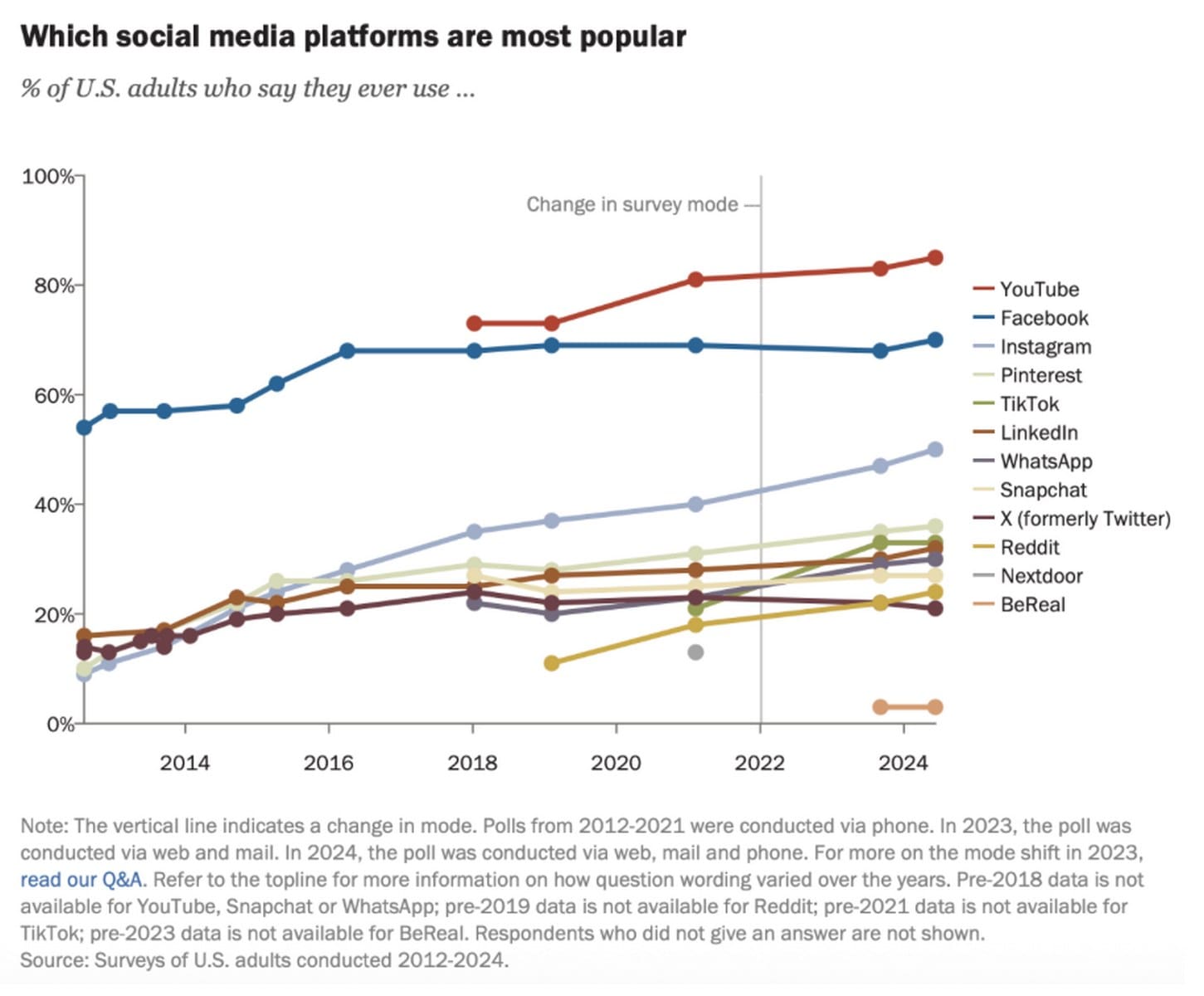
Source: Pew Research Center (pewresearch.org)
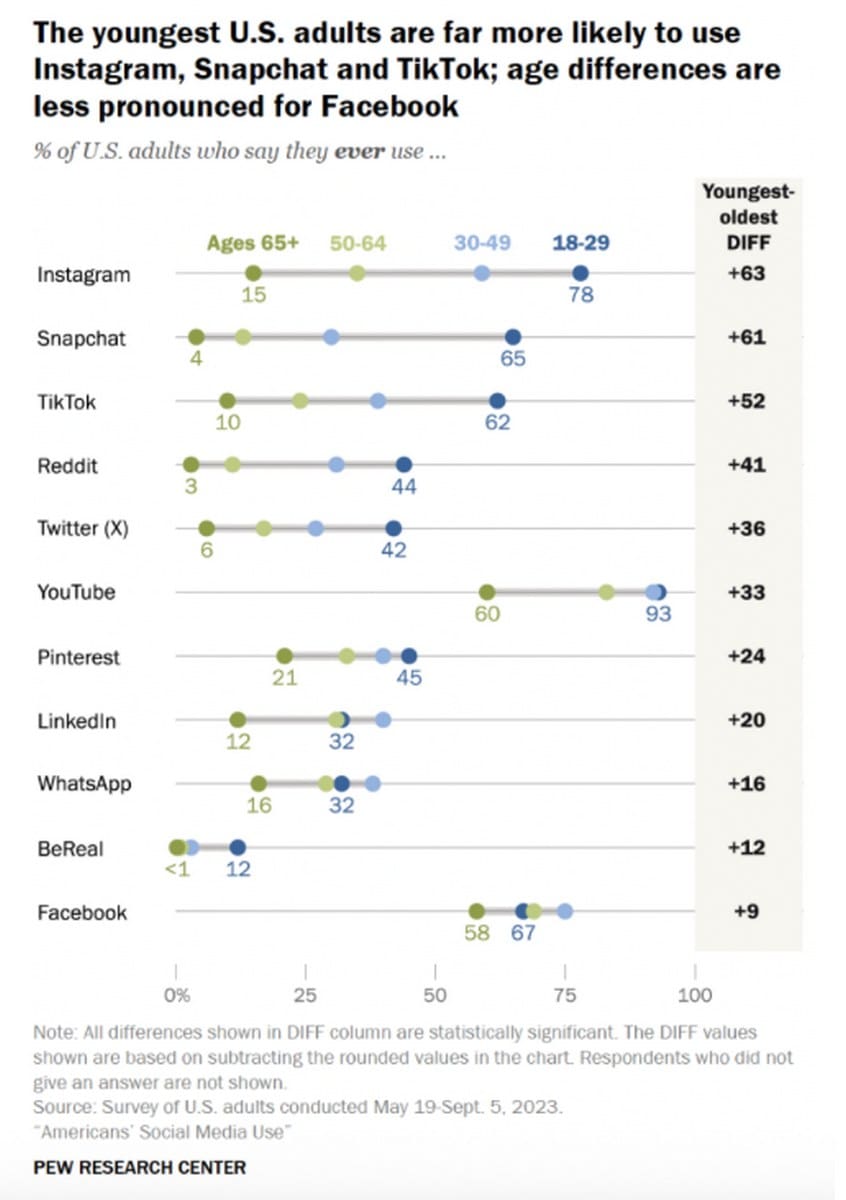
According to Pew Research Center’s latest report “How Americans Use Social Media” (January 2024), Americans aged 30 to 49 actively use various social platforms. In particular, 40% of them use LinkedIn—more than other age groups. In addition, YouTube and Facebook remain the most popular platforms across all age categories, including this group.
Source: Pew Research Center (pewresearch.org)
These data highlight that social media plays a significant role in the daily lives of people aged 30 to 49, making it an important channel for engaging potential clients in this demographic.
In other words, your future client is already on Instagram, Facebook, or other platforms—and may already be asking, “Who should I hire for countertops?” If someone messages you, it’s not random; it’s an invitation to start a conversation. And if you miss it or ignore it, the dialogue simply won’t happen. The most frustrating part? You won’t even know you just lost an order.
Every message in your DMs is not just a “follower question,” but a real opportunity to start a business conversation, demonstrate openness, engagement, and willingness to help. If you don’t take that opportunity, the client will go where they are heard and answered—and it will happen faster than you think.
Companies that build effective communication no longer see messaging as routine or secondary work. They view it as a crucial part of the sales funnel. And if you want to immediately find those who truly care about their clients, we’ve already done it for you: the list of such contractors is available in The First National Ranking of Stone Countertop Fabricators and Installers in the U.S.
2. What Actually Works: Bots, Auto-Replies, or a Human?
When direct messages start piling up, many contractors feel tempted to automate everything: set up an auto-reply, connect a bot, or move conversations into a CRM*. On paper, it sounds convenient. The system responds quickly, you don’t get distracted, and the client technically receives a response.
But in reality, automation is just a tool. It works only when you clearly understand where it’s appropriate—and where it can cause harm.
*CRM is a system for managing client data and conversations, allowing you to store communication history, automate certain processes, and avoid losing incoming messages.
Automation hurts when:
- clients receive generic replies with no clarifying questions;
- a bot pretends to be a real person and confuses users;
- no one manually follows up after the auto-reply.
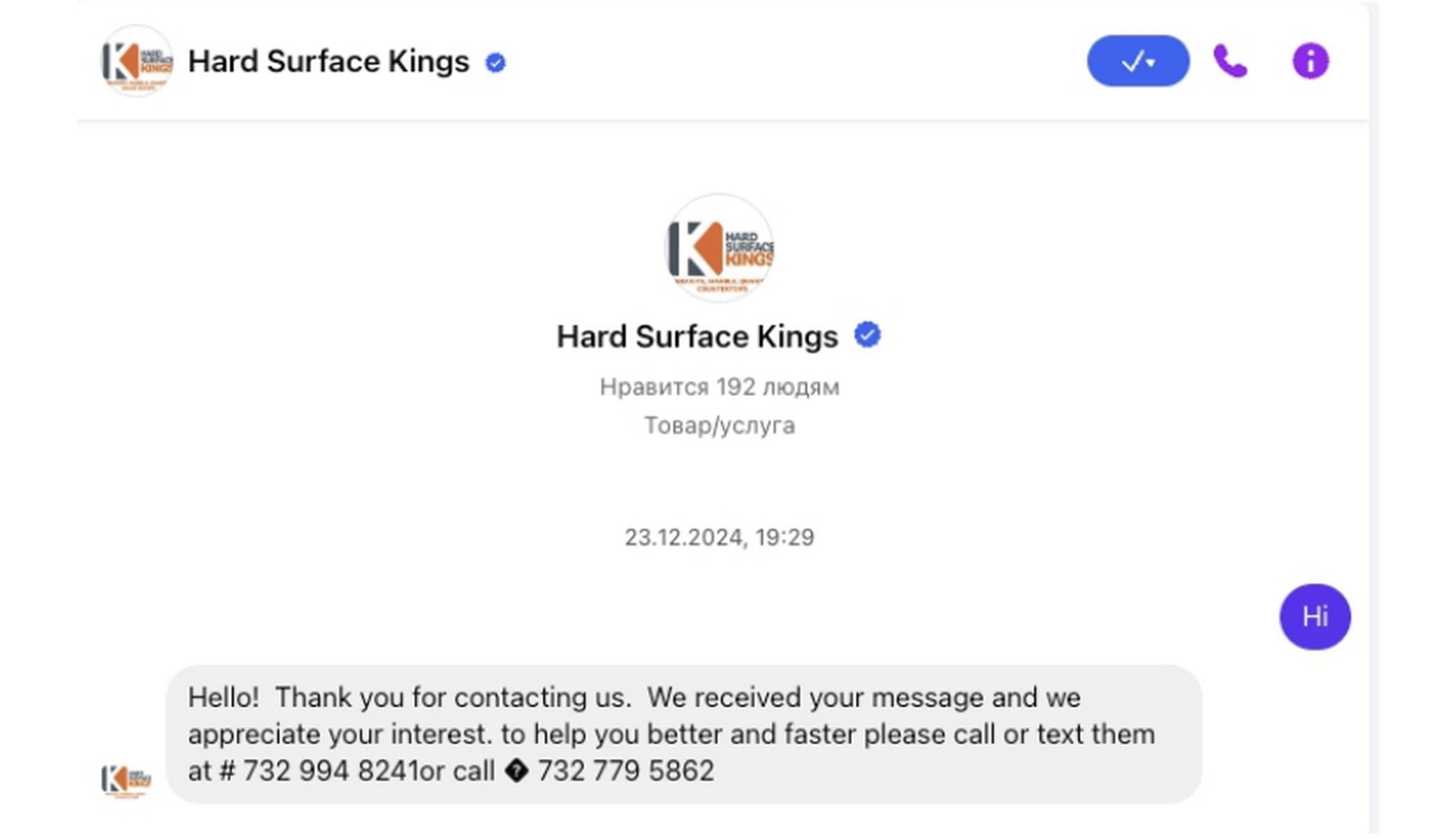
“Hello! Thank you for reaching out. We will contact you later.”
Or even worse:
Client: “Hi!”
Company (30 minutes later): “We received your message.”
And that’s it. No question. No engagement. No desire to help. This creates the impression that no one is actually managing the account—or worse, that the client doesn’t matter.
If all communication comes down to a template and nothing follows, it’s no longer a conversation—it’s a lost contact. Even if the client was a perfect fit for you.
Automation helps when it:
- immediately confirms the message was received;
- politely sets expectations about response time;
- offers an easy switch to a phone call or email.
An auto-reply can work well if it clearly explains what will happen next and includes a call to action.
Now imagine that the same person messages your competitor and receives a completely different reply (compared to the example above):
“Thanks for reaching out! We’re a bit busy at the moment, but we’ll definitely respond within the day. If your request is urgent, please call us at (number).”
Or:
“Hi! Thanks for your message—we’d be happy to help! Could you tell us what material or design you’re interested in? And please include your ZIP code so we can check availability in your area.”
The difference is obvious. This isn’t just a “reply”—it’s the continuation of a conversation. That’s how a good manager works: clarifies, engages, retains. This kind of response feels honest, personal, and keeps the connection alive.
The key to effective social media work is not replacing a human—but supporting one. A bot can assist, guide, and direct. But it cannot replace live communication. It won’t catch nuances, adjust tone, or clarify if the client expresses something unclearly. And that means conversations without human involvement almost never lead to a sale.
3. How to Build Online Communication: A Business Skill for Your Team
Online communication is not “a quick reply in DMs just to check the box.” It’s a skill—just like selling, negotiating, or consulting a client on-site. The difference is that on social media, you don’t have eye contact, tone of voice, or gestures. Here, every word, period, or emoji replaces intonation—and that’s what builds trust.
If no one is systematically responsible for social media replies, conversations break off, styles vary between employees, and some messages get lost altogether. That becomes a weak link in your business—because you’re literally losing clients without even knowing it.
That’s why companies working in the B2C segment (especially in custom solutions like countertops) should implement minimal but clear principles:
1. Assign Someone Responsible for Messaging
If you have a small business, you can handle messaging yourself as the owner. It helps you better understand client needs and see the most common questions. But if you already have a high volume of incoming messages, it’s better to assign someone specifically for this. It can be a sales manager, an assistant, or a trained employee who monitors all incoming conversations and moves them toward a result. The key is that this becomes a regular responsibility—not something done “when there’s time.”
2. Set and Communicate a Response Time Standard
In practice, not every company can respond instantly—and that’s normal. What matters is letting clients know when they can expect a reply. If you respond during business hours, your auto-message can clarify this in advance:
“Thank you for reaching out! Our social media manager will respond during business hours: Monday through Saturday, 9:00 AM to 8:00 PM. We’ll be in touch soon!”
This simple phrase reduces anxiety and shows you’re available—you’re just not online at this exact moment.
3. Train Employees on a Basic Response Structure
A good social media reply is not “OK” and not “Call this number.” It’s a short, friendly, and polite message that includes:
- gratitude for reaching out;
- a clarifying question;
- a logical next step (call, examples, consultation).
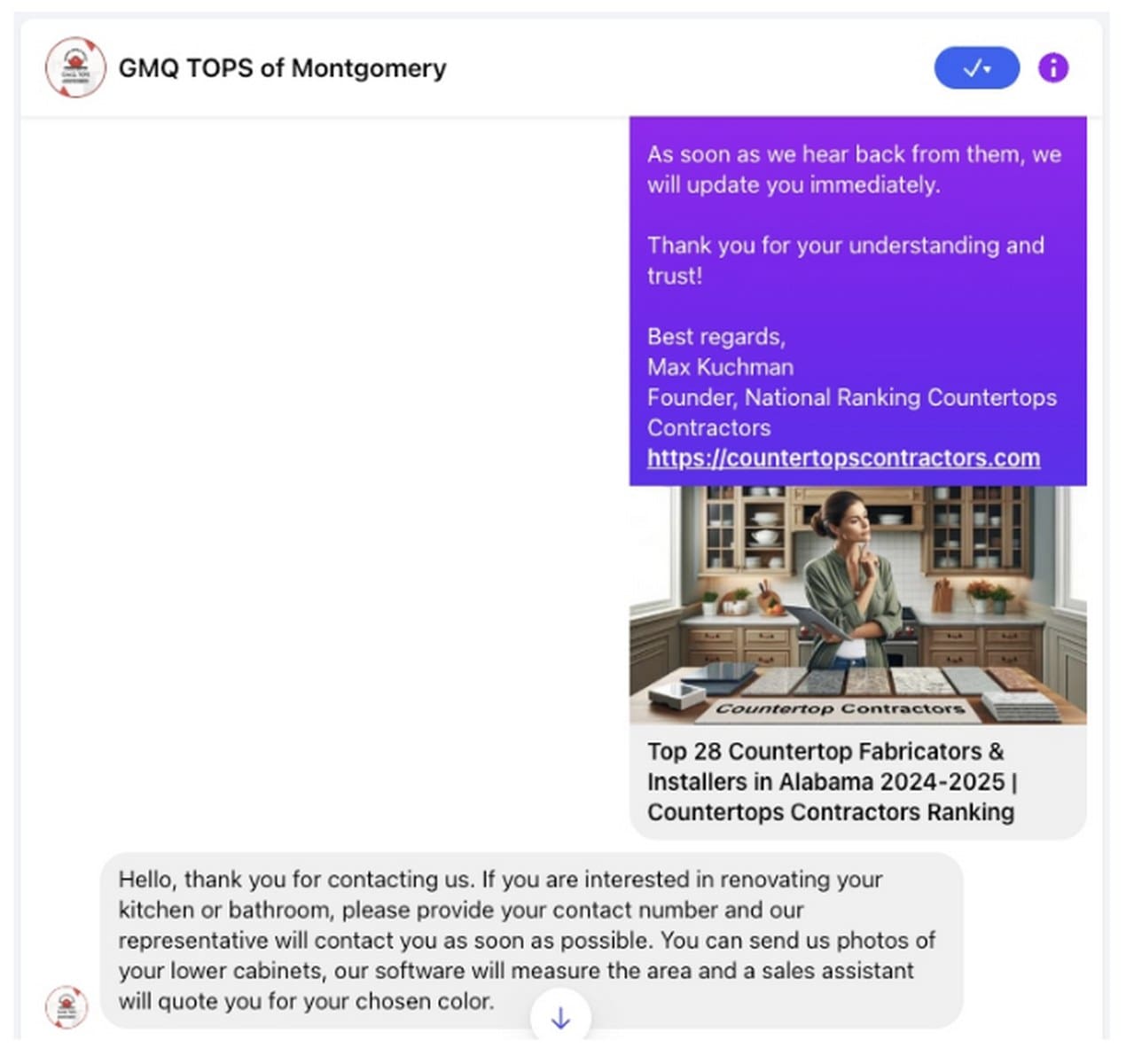
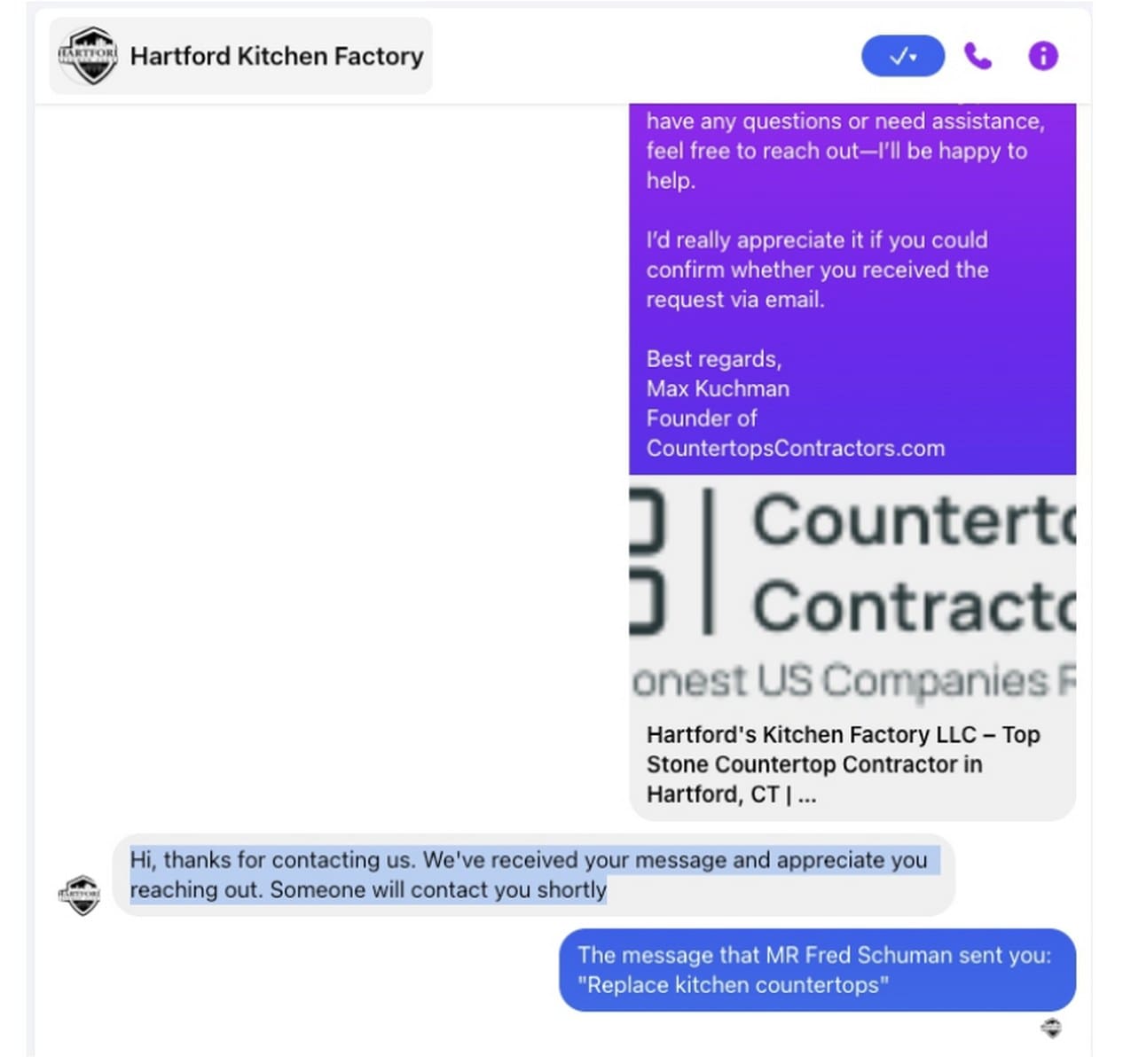
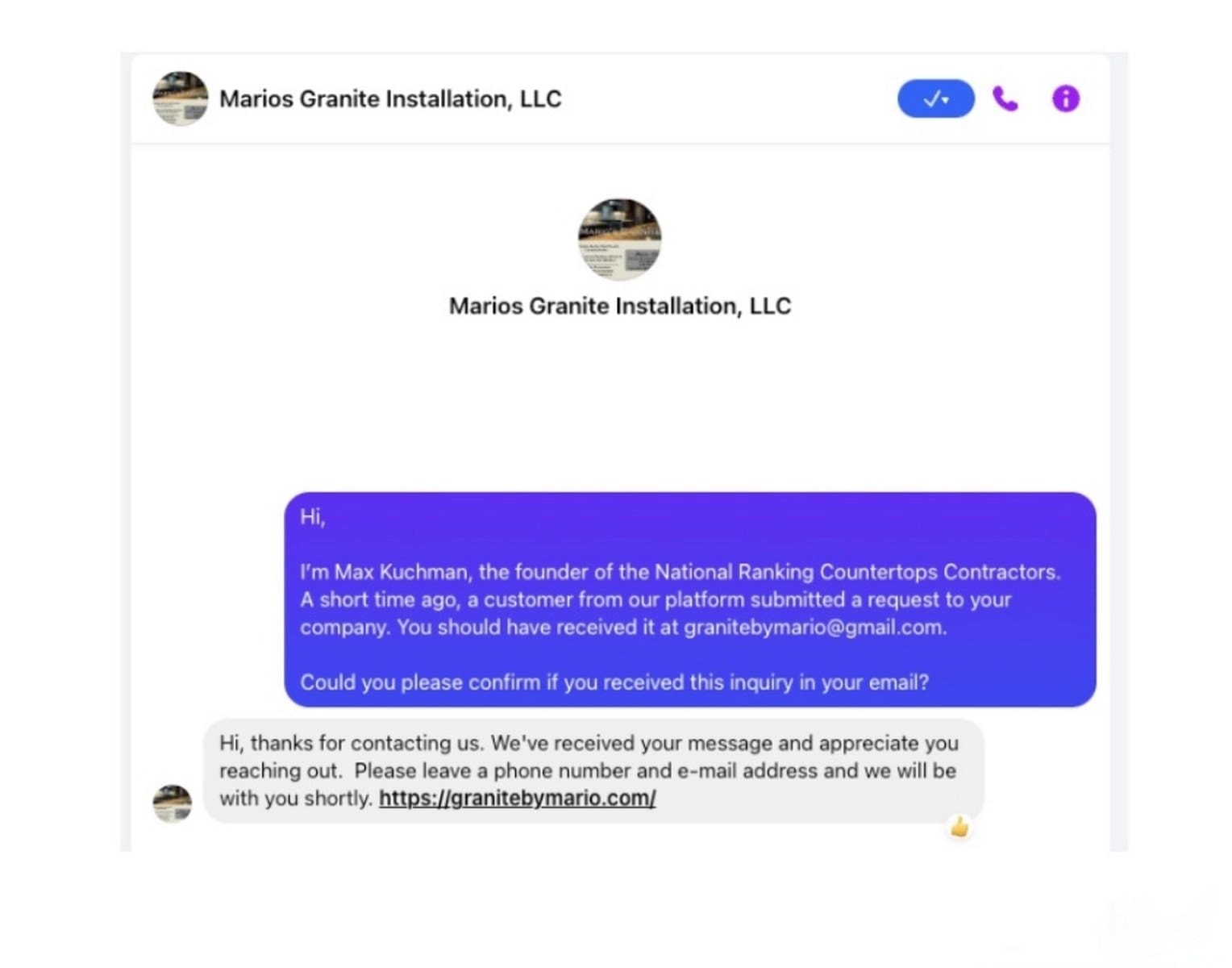
This doesn’t take much time—but it completely changes the tone of communication.
Online communication requires attention, consistency, and intention. The good news is that even a small team can build this system. One person, 15–20 minutes a day, a few prepared phrases—and your business will look twice as professional as most competitors in the client’s eyes. And that’s already a step toward closing a deal.
4. Increase Sales Through Messaging: One Person on Your Team Is Enough
Many contractors underestimate how powerful the sales channel they already have can be—Instagram DMs, Facebook messages, comments under posts. These aren’t just platforms for dialogue; they’re the real beginning of negotiations that lead to a deal.
To understand how messaging affects sales, it’s helpful to recall what a sales funnel is. It’s a model that describes a client’s journey from first contact with your company to purchase. At the top are those who simply saw your post or story. Next are those who wrote, asked a question, or requested an estimate. And only a portion of them ultimately become buyers. Your task is to smoothly and competently guide a person through these levels without losing them along the way.
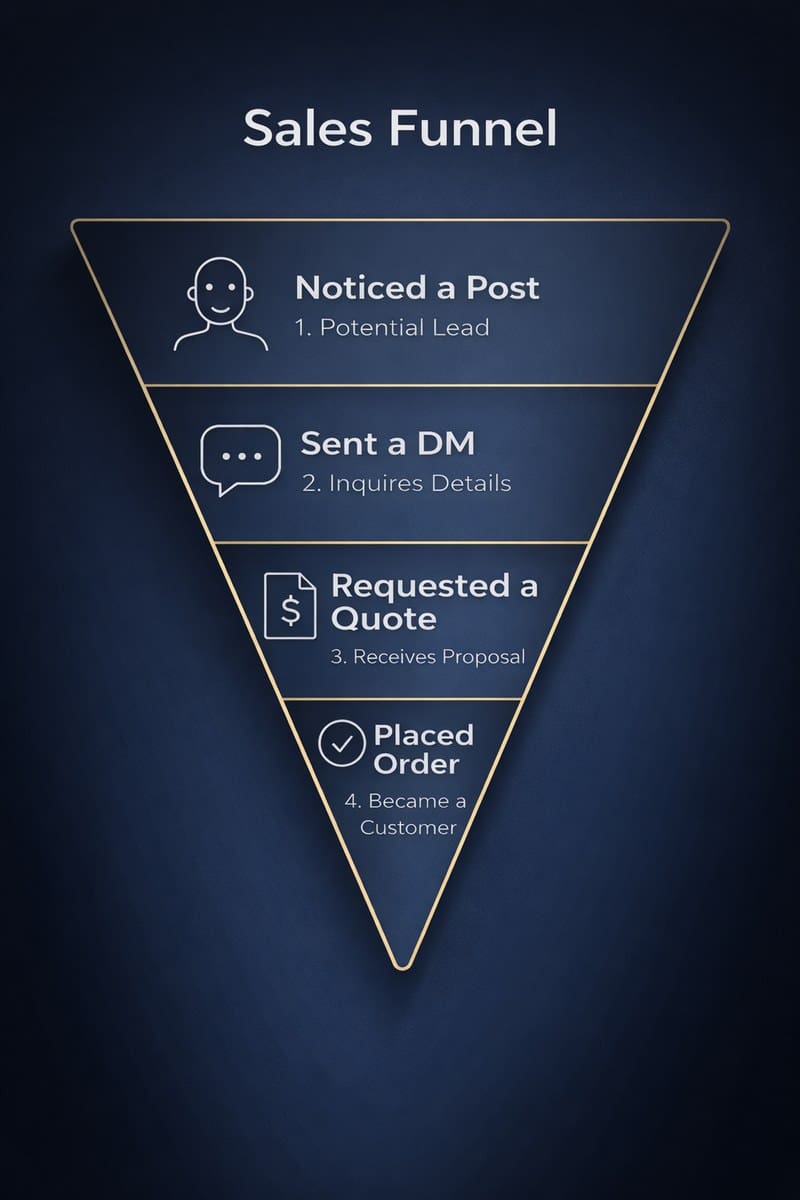
Contractors often focus only on the bottom of the funnel—those ready to order. But those who write in DMs and ask questions are in the middle—and this is exactly where the decision is made whether they become your clients.
For this funnel to work effectively—even with a minimal budget and small staff—you need just one person who understands the process and follows a clear system.
Here’s how to structure it:
1. Work With Scripts (Scenarios), Not Mood
An employee shouldn’t have their “own” communication style unless it’s tested and approved. Every reply is part of your positioning. One poorly written template can damage your brand impression.
Example of a working mini-script:
Client:
“Hi! I'm looking for countertops.”
Manager:
«Hi! Thanks for reaching out — happy to help!
Could you tell us what material or style you're interested in (quartz, granite, marble, etc.) and your ZIP code?
That way, we can check options and availability near you.»This template gives direction: you clarify the request, localize it, and prepare the ground for an offer.
What to include in scripts:
- Greeting and gratitude
- Clarification of the request
- Transition to action: consultation, call, scheduling
2. Maintain a Tracking Table (or CRM)
What happens without tracking:
Messages get lost. Clients don’t receive follow-ups. The manager forgets what was offered and to whom.
What you need:
Even a simple Google Sheet or Excel file allows you to track:
- Client name
- Date of inquiry
- Type of request (material interest, measurement booking, etc.)
- Stage: “Awaiting response,” “Estimate sent,” “No reply,” “Consultation scheduled”
Example table:
|
Name
|
Inquiry Date
|
Interested In
|
ZIP Code
|
Status
|
|
Sarah M.
|
2025-06-01
|
Quartz, Kitchen
|
98052
|
Awaiting consultation
|
|
Alex D.
|
2025-06-03
|
Granite, Vanity
|
90210
|
Estimate sent
|
|
Lisa W.
|
2025-06-04
|
Marble backsplash
|
60614
|
No reply
|
If the company uses a CRM (for example, HubSpot, Bitrix24), this can all be automated—but starting with a simple table is already a big step forward.
3. Monitor Conversations—Not for Control, but for Growth
What to do:
Once a week, the responsible person (or business owner) reviews conversations. Look at:
- Where communication broke off
- At what stage clients stop responding
- Which phrases generate better engagement
This can be formatted as a mini-audit:
- 10 conversations → 3 successfully closed, 4 drop after “Thank you,” 3 no reply
- Conclusion: templates lack a clear next action
Example improvement:
Instead of “Okay, we’ll contact you,”
Write: “Great! I’ll note your ZIP code and send you a selection of available options within 2 hours.”
Even one improvement like this can increase response conversion by 15–20%.
4. Communication as an Investment in Future Sales
Sometimes a client doesn’t buy right away. But good communication is remembered. This is especially important in an industry where decisions aren’t made in a day, where contractors are compared, estimates requested, consultations scheduled.
The psychology is simple:
“They were pleasant to communicate with. They respond quickly. I can trust them.”
A week later, the client may return. Or they may not—but they might recommend you.
Example of a phrase that works long-term:
“If you have additional questions, we’re always here—even if you choose another contractor. What matters most to us is that you make an informed decision.”
This isn’t “selling at any cost.” It’s building trust. And it works.
One person, one script, one table, and 30 minutes a day—that’s enough for social media to stop being just an “account” and start working as a growth point for sales. It’s not about how many resources you have—it’s about how systematically you use them. Everything else can be scaled after your first results.
When someone visits your social media account, they form an opinion about your company within seconds. They look at photos, notice how quickly you respond, and read how you communicate. All of this forms an overall impression. Even if your profile looks polished, dry, slow, or confusing replies can prevent trust from forming.
In Section 4, we discussed how important it is to assign a specific person to handle messaging. In Section 2, we explained why the first client message is not just politeness—it may be the beginning of a deal.
Now let’s look at additional details that influence how you appear in messaging: text, tone, formatting. These often speak about your level even before you send a quote.
1. Your Communication Style Must Match Your Positioning
If you work with high-end quartz countertops and offer premium service, your replies must reflect that. This applies to formatting, wording, and even the vocabulary you choose.
Mismatch example:
Profile shows premium projects, but in DMs:
“Hey. What do you need? We’re busy rn.”
Aligned example:
“Good afternoon! Thank you for reaching out. Could you please let us know which material you’re interested in? We’d be happy to suggest suitable options.”
This isn’t formality—it’s your brand tone expressed in a message.
2. Visual Cleanliness = Respect for the Reader
A wall of text without spacing, all caps, or messy formatting makes reading difficult and creates irritation. Even if you’re replying quickly from your phone, take 10 seconds to make the message look neat.
Recommendations:
- Write in short paragraphs (1–2 sentences)
- Leave a blank line between blocks
- Use subtle accents: emojis in moderation (🛠, 📍, ✅ — yes; 😍🥺🔥 — no)
- Check autocorrect
Balance matters. You shouldn’t sound cold and distant—but you also shouldn’t write as if you’ve known the client for years. The ideal style is calm, friendly, and confident, without leaning too formal or overly casual.
What not to write:
“We don’t have that. Check the website.”
— short, detached, no initiative. It doesn’t encourage continuation.
A better version:
“We don’t currently have that option in stock, but we can suggest similar models with photos and pricing. Would you like us to send you a few options for comparison?”
Here you provide:
- an explanation;
- an alternative;
- a next step.
The client feels that you didn’t just “reply”—you tried to help. This tone can be scaled to any message, even if it’s just two lines. The key is being politely informal, structured, and proactive.
4. Simplify the Next Step
If you answer a question, think about what action the client should take next. Don’t leave them in uncertainty.
Example:
“If it works for you, we can schedule a measurement visit in the coming days. Please send your address and let us know when you’ll be home.”
Even a simple phrase like this turns a “reply” into forward movement.
5. Don’t Be Afraid to Set Safeguards
We’ve already mentioned the importance of clarifying business hours. You can also create a short checklist for cases where you haven’t responded within 24 hours—for example, an automatic message asking the client to resend the request by email or call if urgent. This reduces anxiety and strengthens trust.
Good messaging isn’t about perfect wording—it’s about clarity, attention, and a calm tone. When you build these details, your account starts functioning not just as a photo gallery, but as a full-fledged digital representative of your company.
6. Bonus. Ready-to-Use Templates, Scenarios, and Phrases: So You Don’t Lose Clients Even When Overloaded
Building competent social media messaging is already a step forward. But to not just respond—rather, to manage communication even in complex situations—you need precise wording that helps you stay composed, avoid burnout, and keep the client.
Here are unique scenarios for non-standard situations that truly occur in practice. These aren’t basic “Thank you, we’ll reply soon” templates, but subtle techniques that work when a client goes silent, hesitates, feels anxious, or delays responding.
Scenario #1: Client Reacted to a Story but Didn’t Clarify the Request
Situation: you receive a reaction to a story (emoji, “wow,” “cool,” etc.), but no specific question. Ignoring it means losing potential interest.
Template:
Thanks for the reaction! If you liked the project, we can share more details about the materials or calculate a similar option for your needs. Would you like us to send examples?
This response turns passive engagement into dialogue—without pressure.
Scenario #2: Client Asks for Price but Provides No Details
Situation: “How much does this kitchen cost?” — no photos, no dimensions, no location.
Template:
The cost depends on size, material, and region. Could you please share your city and approximate dimensions? That way, we can provide a more accurate estimate.
You don’t ignore the question or refuse to answer—you ask for the data needed to be helpful.
Scenario #3: Client Is Overly Demanding and the Manager Is Burning Out
Situation: the client sends voice messages, writes outside business hours, asks dozens of minor questions.
Template:
We truly want to be helpful and answer all your questions thoroughly. To make sure we don’t miss anything important, let’s organize this as a consultation request. Please share your phone number or email so we can continue efficiently.
You gently set boundaries without damaging loyalty.
Scenario #4: Client Disappears After an Agreed Step
Situation: you agreed on measurement or estimate—and silence.
Template:
Just a quick reminder that we’ve prepared your estimate/project. If the timing isn’t right yet—that’s absolutely fine! Let us know when it’s convenient to continue; we’re always happy to help.
Polite, no pressure—but a reminder and invitation to return.
Scenario #5: How to End a Conversation So They Remember You in a Month
Situation: client isn’t ready now—“I’ll think about it,” “Need to talk to my husband,” “Out of town until the end of the month,” etc.
Template:
We understand that this decision takes time. We’ll keep our conversation saved, and whenever you’re ready to revisit it, we’ll be happy to continue. We’ll stay in touch!
This doesn’t close the door—it keeps the channel open.
Client Behavior and Response Strategy Table
|
Client Situation
|
What the Client Feels
|
Suitable Style
|
Goal of Your Reply
|
|
Reaction to story, but no question
|
Light interest, uncertainty
|
Light engagement
|
Clarify interest and suggest the next step
|
|
Short question without context (“How much?”)
|
Urgency, desire for a quick estimate
|
Calm clarification
|
Request additional details and maintain interest
|
|
Client writes a lot and demands attention
|
Anxiety, fear of making a mistake or missing something
|
Structured, caring tone
|
Set boundaries without ending the dialogue
|
|
Disappears after prior communication
|
Lost interest, distraction, hesitation
|
Friendly reminder
|
Re-engage without pressure
|
|
Says “I’ll think about it”
|
Uncertainty, waiting position
|
Supportive tone + calm closure
|
Maintain a positive brand impression
|
|
Writes at night or outside business hours
|
Spontaneity, expectation of instant reply
|
Clear status update + alternative option (phone/time)
|
Set expectations and preserve contact
|
This bonus section is like a cheat sheet for your team. You can save it, adapt it to your style, and integrate it into daily work. There’s no complex technology here—just attention to details that determine the outcome of a deal.
Conclusion
We live in a digital era where the first “How much is this countertop?” in your DMs can either cost you a deal—or bring you a loyal client. In this article, we aimed to show that social media is not just a gallery of projects, but an active channel for sales, image, and trust. And your messaging becomes the face of your brand: fast, clear, polite—or cold, forgotten, and lost.
The good news is that you don’t need to rebuild your entire business to start improving. The secret to success is simple: a few clear scripts and a bit more attention to detail. Even small steps can create a system where every incoming request doesn’t get lost, but turns into a conversation—and then into a deal.
If you’re not sure where to begin—just message us. We can review your profile, help organize your messaging, and point out where clients might be slipping away. Sometimes even a couple of small changes make a noticeable difference.
We created The First National Ranking of Stone Countertop Fabricators and Installers in the U.S. to help contractors grow, gain visibility, and build trust. Communication with clients is one of the criteria people truly pay attention to. After all, countertops aren’t chosen just by how they look—but by how you’re spoken to. And warm, pleasant messaging can decide more than you think.
If you want to grow your business and explore practical solutions, visit The Stone Magazine by Countertops Contractors—we publish insights, practices, and breakdowns that are easy to apply in real work. Straight to the point, from those who are in the field every day.
Also read:
- Why Your Stone Countertop Business Won’t Thrive Without Social Media in 2025 Get More Clients with Pinterest, Instagram, and Facebook
- How to Increase Countertop Sales Without Additional Costs: The Role of Friendliness and Engagement in Client Communication
*Prices are valid as of June 2025, provided for informational purposes only, and may vary at the time of reading. Estimates are based on average data from Home Depot, Houzz, HomeAdvisor, and other relevant sources in the U.S.
All images are sourced from Unsplash photo stock or publicly available contractor portfolios. If you believe any image is privately owned and used without proper credit, please contact us at contact@countertopcontractors.com.
Some authors may write under a pseudonym and choose not to disclose their identities for personal reasons. We respect their privacy and simply provide a platform for professional, educational use. We are not responsible for name coincidences with real individuals. All contributors are vetted for expertise, but we advocate for freedom of expression.